Reserve a pilot slot

Fold flat. Land anywhere. Live, farm or host guests by the next sunrise.

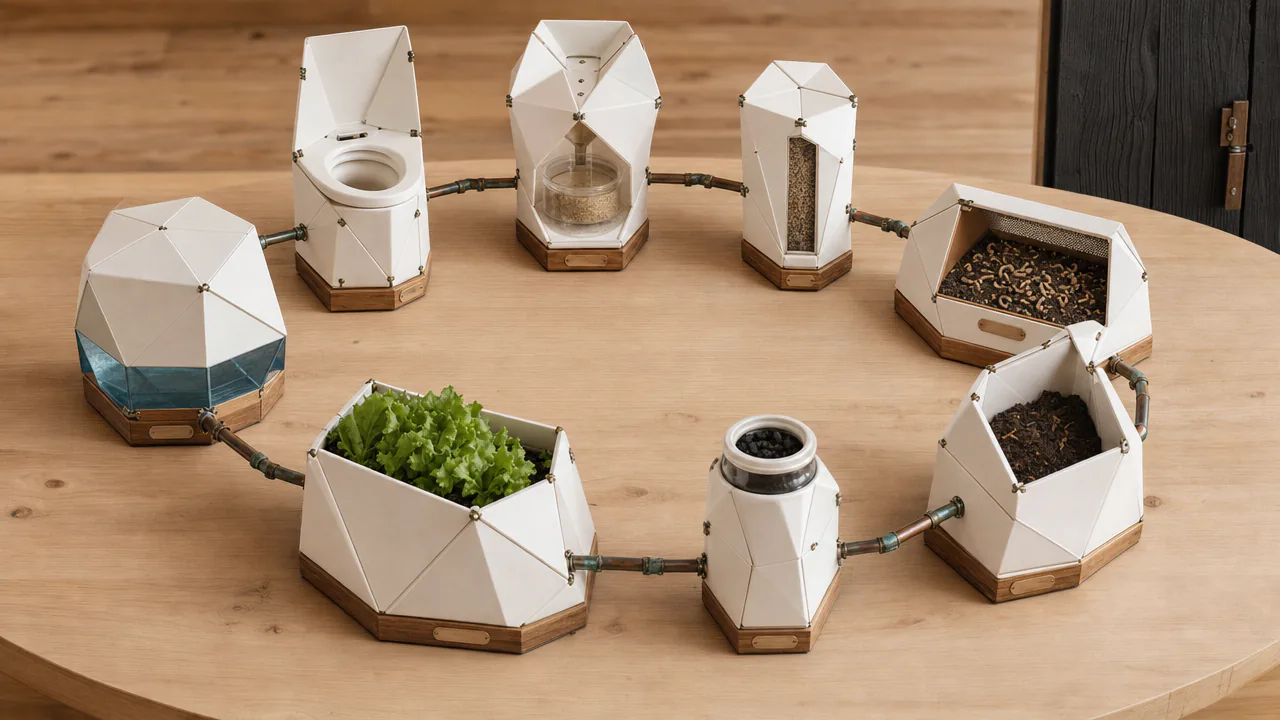
Loop layer concept visual
環Layer 3 The Autonomy Stack · self-closing

Loop. Separate every stream, measure every gram, turn urine, scraps and residue into fertiliser, feed and carbon, export the rest.

7 subsystems23 projects32 papers28 numbers69 sources
L07 · concept visual · AI
環01 Thesis

A fully automated closed-loop site is not a sealed bubble; it is a metered set of separated streams (yellow, brown, green, grey, air) each with one primary product, one fallback route and a daily mass-balance check. The record shows water and O2 close first (Lunar Palace 365 reached 98.2% material closure and 99.7% urine recovery) while solids lag (67%) and food is the most expensive loop (LMLSTP grew <5% of calories while wheat supplied 25% of O2). The non-obvious insight is that on Earth the atmosphere is a free buffer, so ORIJO should not chase gas closure at all: it should close nutrients and water, use plant CO₂ uptake as a crop sensor, and deliberately export carbon as biochar and mycelium infill. Nitrogen is the inverse problem: four people excrete about 12.8 kg N per year, far more than an indoor farm can absorb, so the loop must store N in a solid 'battery' (zeolite, struvite) and ship it out. Automation is mostly chemistry, sensors and logs, not robots; the robot's job is swapping sealed cartridges.

98.2 / 99.7 / 67 %

Lunar Palace 365 material closure / urine recovery / solid-waste recovery

12.8 kg N/yr

Urine nitrogen of 4 people (design value 8.8 g N/person/day)

86 %

Overall urine N recovery on clinoptilolite (97% transfer x 88% elution)

Slab 3 of the stack · see all eight

Maturity of options assessed

  • commercial 6
  • pilot 7
  • experimental 3
  • speculative 0
環02 Subsystem explorer

How the loop layer works, option by option.

Each subsystem lists the technologies the research found, with maturity, an estimated technology readiness level and the numbers that matter. Hover a TRL bar for the reason behind it.

LOOP-S1 · function

Metabolic ledger and mass-balance accounting

Define what has to be closed per person per day and keep a live, sensor-reconciled ledger of water, carbon, O2, N, P, K and Na for every stream on the site.

How it works

The design basis is the NASA BVAD metabolic interface: an 82 kg reference adult consumes 0.895 kg O2, exhales 1.085 kg CO₂ (RQ 0.86), eats 0.80 kg dry food and drinks 3.2 kg water per day, and returns 1.42 kg urine water plus 0.061 kg urine solids, 0.13 kg faeces (wet) and 2.95 kg respiration/perspiration water. Every stream on site is metered (load cells on bins and tanks, flow meters, EC/pH/ORP/NH4/NO2/NO3 probes, CO₂/O2 NDIR and electrochemical cells) and the controller reconciles inflow minus outflow minus storage change for each element daily; the residual is the leak or fault signal. Biosphere 2 showed why this matters: material closure turned a mysterious O2 loss into an accountable carbon sink (concrete carbonation) found by 13C/12C mass balance. Closure is reported as the share of each element's daily throughput supplied from on-site recycling, by element, never as one headline percentage.

PILOTTRL 5

BVAD-anchored digital ledger (per-element closure dashboard)

Stoichiometric mass balance with sensor reconciliation; per-element closure = recycled / required

  • 0.895 kg/person/day reportedO2 consumedbvad-2022
  • 1.085 kg/person/day reportedCO₂ producedbvad-2022
  • 0.8 kg/person/day reportedFood solids consumed (dry)bvad-2022
  • 1.420 + 0.061 kg/person/day reportedUrine water + solidsbvad-2022
  • 8.8 g N/person/day reportedUrine nitrogenfumasoli-2016

Best for All environmentsmandatory for E3 desertE4 polarE8 lunar where imports are expensive

Limits BVAD is an astronaut reference (82 kg, exercise regime); civilian guests vary 20–40%. Pathogen and pharmaceutical status cannot be inferred from mass balance.

Used in every analogue (BIOS-3, Biosphere 2, CEEF, Lunar Palace) as a research instrument; not yet a productised household controller.

史03 Projects · including failures

Who has tried this, and what happened.

23 projects and companies, oldest first. 13 of them closed, failed or went bankrupt; they are kept in, because investors learn more from them than from the successes.

WhenProjectWhatStatusOutcome or lesson
1972–1980sBIOS-3Institute of Biophysics, Krasnoyarsk · USSR / Russia315 m³ sealed steel complex with Chlorella and wheat/vegetable phytotrons; 1–3 crew.closed91% total material closure with 63 m² crops for 2 crew over ~5 months; water and gas fully closed, food partly (meat imported); high lamp power. gitelson-1989salisbury-1997wiki-bios3
1988–1990sNASA Biomass Production ChamberNASA Kennedy Space Center (CELSS) · USA20 m², 113 m³ closed crop chamber for wheat, soybean, lettuce, potato.closed>1200 days near-continuous with no major failures: 196 kg edible biomass, 540 kg O2, 94,700 kg condensate, 739 kg CO₂ fixed. wheeler-1996
1989-present (pilot plant since 2009)MELiSSA Pilot Plant (Claude Chipaux Laboratory)ESA / Universitat Autonoma de Barcelona · Spain / ESAFive-compartment microbial-plant-crew loop; C3 nitrifier, C4a Limnospira PBR and C5 rat isolator connected.research276 days C3-C4a, ~110 days gas-linked to rats with O2 held at 19–21%; nitrite peaks and CO₂ up to 18,000 ppm show biology needs active control. Spun off urine nitrification (Aurin). garcia-gragera-2021esa-melissa-2019arnau-2025yt-melissa
late 1990s — early 2000sBIO-PlexNASA JSC · USAPlanned integrated bioregenerative test complex for long-duration crewed tests.closedProgress reported in 2001; no crewed integrated test found in this sweep; a 2025 review attributes NASA capability gaps to funding cuts and programme discontinuations. Exact cancellation date not confirmed. villarreal-bioplexporterfield-2025
Sep 1991 — Sep 1993Biosphere 2 Mission 1Space Biospheres Ventures (E. Bass) · USA8 people, rainforest/ocean/desert/farm biomes under glass, two 'lung' expansion chambers.failedEngineering success (leak <10%/yr) but ecological failure: O2 fell 21% to 14%, pure O2 injected days 475–494; organic-rich soil respired, concrete absorbed CO₂. Construction cost on the order of $150M (DOE BERAC 2003). dempster-1999severinghaus-1994doe-berac-2003yt-b2
1995–1997Lunar-Mars Life Support Test ProjectNASA Johnson Space Center · USAFour crewed tests (15, 30, 60, 91 days) integrating wheat with physico-chemical air/water systems and an incinerator.closed11.2 m² wheat sustained 1 person's air (15 d); in 91 days wheat gave ~25% of O2 for 4 crew, grown food <5% of calories; water recycled 10 times. barta-lmlstp
2005–2007Closed Ecology Experiment Facilities (CEEF)Institute for Environmental Sciences, Aomori · Japan150 m² plant module + animal/human module; 2 eco-nauts, 2 goats, 23 crops; P/C gas separation between modules.closed82–95% of crew food and 79–100% of goat feed grown inside; O2 and CO₂ were physically separated and transferred between modules, avoiding the Biosphere 2 shared-atmosphere trap. nitta-2010tako-2008
c. 2010–2015 (approximate)VUNA urine treatment in eThekwiniEawag / eThekwini Water and Sanitation · South AfricaCompared struvite, nitrification and other treatments for urine from the large number of urine-diverting dehydration toilets installed in eThekwini.closedContext in which the nitrification/distillation route was scaled; Anyground reading: chemistry worked, collection and transport of urine from dispersed toilets is the hard part. watersa-2015fumasoli-2016udert-2012
2011–2016 (publications)Low-cost struvite production in NepalEawag · NepalVillage struvite reactors on collected urine with bittern/magnesite Mg.closedChemistry is simple; Mg cost and narrow calcination window (700 C, 1 h) decide viability. etter-2011krahenbuhl-2016
2012-presentHomeBiogasHomeBiogas Ltd. · IsraelFlexible-bag household digesters and Bio-Toilet units for food waste and manure/faeces.activeSold in 100+ countries, 20-unit USAF Bio-Toilet contract (2025), 900 El Salvador schools; works best in warm climates with steady feeding. ctech-homebiogas-2025ticker-homebiogas-2025yt-homebiogas
Feb-May 2014Lunar Palace 1 / Yuegong-1 105-day runBeihang University · China3 crew, 21 crop species, mealworms, urine N recycling, solid-waste bioconversion.researchO2 and water recycled, 55% food regenerated, but only 20.5% urine N and 41% solid-waste degradation: solids are the bottleneck. fu-2016-astwiki-yuegong
2017–2018 (370 days)Lunar Palace 365Beihang University · China8 volunteers in two rotating groups living in the closed BLSS for 370 days.research98.2% material closure, 99.7% urine recovery, 67% solid waste recovery; inoculum now studied for lignocellulose degradation. fu-2021-biorxivfu-2025-actaastroliao-2025yt-lp365
c. 2017-presentMadasterMadaster · Netherlands (8 regional sites)Online registry generating material passports from BIM/IFC or Excel.activeWidely cited passport platform (over 16 million m² registered by its own 2022 statement); BIM data quality and manual steps are the bottleneck. madaster-sitemadaster-rollout-2022honic-2024
Dec 2017ArtemISS photobioreactor on ISSESA / MELiSSA · ESALimnospira culture flown to the ISS.researchShowed microalgae produce O2 from CO₂ in orbit; the terrestrial PBR scale-up question (hundreds of litres per person) remains. esa-melissa-2019
2018-presentVunaNexus AurinVunaNexus (Eawag spin-off) · SwitzerlandNitrified, filtered, pasteurised, distilled urine fertiliser from urine-diverting toilets and dry urinals.activeProvisional Swiss authorisation Feb 2016 (ornamentals), extended to edible crops by the Federal Office for Agriculture in 2018; ~70 urine-diverting toilets at ESA HQ Paris (2023); treatment plants in six projects (Dec 2025); about 8,000 L/day claimed (current per 2025 interview, target per TIME 2026); TIME Best Inventions 2026. Proves a regulatory path exists. time-aurin-2026esa-hq-aurinpopsci-aurin-2025krause-2021fumasoli-2016pat-ep4509470pat-ep3548439eawag-aurin
c. 2022-present (launch year not confirmed)Mill Food RecyclerMill Industries · USAKitchen bin that turns scraps into shelf-stable grounds overnight (company claim; mechanism reference: generic under-sink separator-dryer patent US8464970B2, not a Mill patent); grounds marketed for gardens and chicken feed.shippedClaims 80% volume reduction and 26 million lb diverted; $999 device; Whole Foods deployment from 2027. Drying is a stabiliser, not a loop: it buys storage time for BSF/compost. mill-sitetechcrunch-mill-2025pat-us8464970
2023–2024Bozeman household digester case studyMontana State University · USA12 households, commercial vs custom digesters, 12 weeks.researchFinal digestate pH 5.3 (custom prototype) and 6.1 (commercial); C:N 6.6; users found the custom design more user-friendly; cold climate a challenge; 87% would still recommend. ebel-2025
2024–2026Space Analog for the Moon and Mars (SAM) at Biosphere 2University of Arizona · USAOriginal Biosphere 2 Test Module converted to a sealed agricultural analogue; CO₂ uptake measured by injection to hold 800 ppm.researchCO₂ make-up injection doubles as a plant-photosynthesis sensor, a cheap trick for automated crop-health monitoring. sam-b2-2026
to Dec 2025YnsectYnsect · FranceMealworm protein giga-factory (Ynfarm).failedRaised >$600M, judicial liquidation Dec 2025; peak revenue EUR 17.8M (2021), 2023 net loss EUR 79.7M; insect protein costlier than the feed it replaces. techcrunch-ynsectinsectinstitute-777m
to 2025Aspire Food GroupAspire · Canada150,000 sq ft automated cricket plant.failed~$53.2M raised; ran at about half capacity; receivership May 2025. insectinstitute-777m
to 2025Enorm BiofactoryEnorm · DenmarkIndustrial BSF plant.failed~$57M raised; bankrupt Nov 2025, 'sales were not as expected'. insectinstitute-777m
to 2026AgroLoopAgroLoop · HungaryInsect bioconversion plant.failed~$42M raised; bankruptcy Jan 2026; construction consumed funds before commercial production. insectinstitute-777m
to Jul 2026GoterraGoterra · AustraliaDecentralised modular BSF units at customer sites processing food waste.failed~$25.2M raised; voluntary administration June 2026, then creditors voted for liquidation (reported 10 July 2026) after a sale process (22 interested parties) failed. Revenue A$1.43M in the 11 months to 31 May 2026 against an A$8.33M operating loss; A$11.2M creditor claims at appointment. Even on-site, waste-fee-funded BSF did not sustain a business: treat BSF as an internal service, not a revenue line. insectinstitute-777msmartcompany-goterra-…

Failures, read for lessons

  1. Biosphere 2 oxygen crash (1991–93)

    WhyOrganic-rich soils respired far more CO₂ than plants could fix; fresh exposed concrete carbonated ~600 kmol CO₂, hiding the signal; O2 fell to 14% and pure O2 had to be injected; the CaCO3 furnace meant to close the scrubber loop failed.

    Lesson for AnygroundNever share one atmosphere between people and a soil ecosystem; keep the farm air loop separate with a controlled transfer line (CEEF pattern), no exposed fresh cementitious surfaces inside sealed volumes, and an O2 floor alarm with automatic ventilation to outside air on Earth.

  2. Lunar Palace solid-waste bottleneck

    WhyEven at 98.2% material closure, solid waste recovery was 67% (41% in the 105-day run); lignocellulose degrades slowly and microbially fragile.

    Lesson for AnygroundDo not promise solid closure; route inedible biomass to exports that have value (biochar, mycelium infill, compost) and count them as 'regulated exports', not losses.

  3. LMLSTP Phase III food closure

    WhyWheat supplied ~25% of O2 for 4 crew but grown food covered <5% of calories in 91 days.

    Lesson for AnygroundFood is the most area- and energy-hungry loop; ORIJO promises fresh greens, protein trims and nutrient recycling, not caloric autarky.

  4. Ynsect liquidation and the 2025–26 insect-farming collapse

    WhyGiga-factories built before unit economics; insect meal priced above the feed it replaced; energy costs; Goterra's decentralised on-site model also failed.

    Lesson for AnygroundBSF is an internal waste service sized to the household (KAMADO-B); its value is avoided waste haulage and feed for on-site fish or hens, never a product revenue line.

  5. MELiSSA nitrite excursions

    WhyBiomass removal in the packed-bed nitrifier caused nitrite up to 187 mg N/L; nitrite above ~40 mg N/L reached the PBR and inhibited photosynthesis; capacity limit reached at a 1,740 load.

    Lesson for AnygroundAny biological urine loop needs online NO2- sensing, an automatic bypass and load-limiting before downstream crops or algae.

  6. Household anaerobic digesters souring in cold climates

    WhyMontana households saw digestate pH 5.3–6.1; user convenience and cold were the main complaints.

    Lesson for AnygroundUse AD only where it is warm or where IRORI waste heat holds 35 C; default to BSF + in-vessel compost.

  7. BIO-Plex and NASA CELSS discontinuation

    WhyProgramme cuts and discontinuations before integrated crewed testing; capability gap now acknowledged.

    Lesson for AnygroundIntegrated loops die from funding gaps, not physics: ship each loop as a standalone product that pays for itself (water, compost, fertiliser) before integrating.

  8. BIOS-3 partial food closure

    WhyEven at 91% total closure, meat and some foods were imported and Chlorella was not palatable as a staple.

    Lesson for AnygroundClosure targets must be per element and per product; diet acceptance limits closure as much as engineering.

文04 Key papers

The science underneath, 32 papers.

Newest first. Each line states the finding that the dossier relies on.

  1. 2026

    Recycling fertilizers from resource-oriented sanitation systems: product-level characterization and meta-analysis of agronomic performance

    Schroeder C, Haefner F, Krause A et al. · Frontiers in Environmental Science · review

    Across 201 references, excreta-derived fertilisers showed no systematic yield disadvantage versus conventional fertilisers.

  2. 2026

    Plastics and associated chemical contaminants in black soldier fly larvae food waste bioconversion

    Kolobaric A, Hoffman LC, Chapman J · Critical Reviews in Environmental Science and Technology · review

    Many plastic-associated contaminants (phthalates, PFAS, BFRs) partition into frass, a soil re-entry risk (qualitative review).

  3. 2026

    Regrowing mycelium acoustic and insulation panels: the biofabrication, performance, and environmental impact

    Bitting S, Woesten HAB, Hischier R, Block P · Materials & Design · experiment

    First multi-life-cycle evaluation of regrown mycelium insulation panels (numbers not retrieved).

  4. 2025

    Comparative Exposure Assessment of Crops Grown by Urine-Derived Fertilizer and Crops Irrigated with Reclaimed Water

    Rodriguez EE, Dickman RA, Kennedy BC, Aga DS · Environmental Science & Technology · experiment

    Lettuce took up 0.00004–0.0002% of applied pharmaceutical mass; 70-year daily intake is at most 2.5% of a therapeutic dose.

  5. 2025

    Household-scale anaerobic digestion of food waste — a community case study from Bozeman, Montana

    Ebel RH, Eberly JO, Grimberg BI, Seipel TF et al. · Frontiers in Sustainable Food Systems · field-trial

    Over 12 weeks in 12 homes digestate fell to pH 5.3–6.1 with C:N 6.6, signalling acidification in a cold climate.

  6. 2025

    Critical investments in bioregenerative life support systems for bioastronautics and sustainable lunar exploration

    Porterfield DM, Tulodziecki D, Wheeler R · npj Microgravity · review

    NASA funding cuts and programme discontinuations (incl. BIO-Plex era) left capability gaps relative to China's Lunar Palace programme.

  7. 2024

    Recirculating frass from food waste bioconversion using black soldier fly larvae: impacts on process efficiency and product quality

    Lopes IG, Wiklicky V, Vinneras B, Yong JWH et al. · Journal of Environmental Management · experiment

    Recirculating frass raised larval yield per tonne of food waste from 207 to 403 kg (dry) and produced more stable, mature frass.

  8. 2024

    From Data Templates to Material Passports and Digital Product Passports

    (Springer chapter, authors not retrieved) · Springer book chapter · review

    Madaster, Concular and CB'23 produce passports, but lack of standardised templates and data tracing blocks adoption.

  9. 2022

    Life Support Baseline Values and Assumptions Document (Rev2)

    Ewert MK, Chen TT, Powell CD (eds.) · NASA/TP-2015–218570/REV2 · standard

    Reference adult: 0.895 kg O2 in, 1.085 kg CO₂ out, 0.80 kg dry food, 1.42 kg urine water per day; full crop diet needs 65.3 m²/person and 90–100 kg fertiliser salt/person/yr.

  10. 2022

    Dynamics of long-term continuous culture of Limnospira indica in an air-lift photobioreactor

    Garcia-Gragera D, Peiro E, Arnau C, Cornet JF, Dussap CG, Godia F · Microbial Biotechnology 15(3):931–948 · experiment

    Max O2 productivity 1.35 mmol/L/h at D = 0.025 1/h and 930 µmol/m²/s; photoinhibition above 1,700 µmol/m²/s.

  11. 2021

    Establishment of a closed artificial ecosystem to ensure human long-term survival on the moon

    Fu Y-M, Yi Z-H, Du Y et al. · bioRxiv (published Acta Astronautica 2025) · experiment

    370-day Lunar Palace 365: 98.2% material closure, 99.7% urine recovery, 67% solid waste recovery.

  12. 2021

    Integration of Nitrifying, Photosynthetic and Animal Compartments at the MELiSSA Pilot Plant

    Garcia-Gragera D, Arnau C, Peiro E et al. · Frontiers in Astronomy and Space Sciences 8:750616 · experiment

    C3-C4a ran 276 days; the 83 L PBR delivered 1.5–2.1 g O2/h for three rats with 99% ammonium conversion upstream.

  13. 2021

    Review of research into bioregenerative life support system(s) which can support humans living in space

    Liu H, Yao Z, Fu Y, Feng J · Life Sciences in Space Research 31:113–120 · review

    Beihang review of BLSS history and design (82 citations); abstract not retrieved.

  14. 2020

    Production and Optimization of Hermetia illucens (L.) Larvae Reared on Food Waste and Utilized as Feed Ingredient

    Gligorescu A, Fischer CH, Larsen P, Noergaard J et al. · Sustainability 12:9864 · field-trial

    190 kg of food waste produced 79 kg of BSF larvae over 15 pilot batches (FCR 1.7–3.6, dry matter).

  15. 2019

    Mechanical, physical and chemical characterisation of mycelium-based composites with different types of lignocellulosic substrates

    Elsacker E, Vandelook S, Brancart J, Peeters E et al. · PLoS ONE 14:e0213954 · experiment

    Across 5 fibres, mycelium composites met thermal-insulation requirements; mechanics depend more on fibre processing (<5 mm chopped, pre-compressed) than chemistry.

  16. 2018

    Uptake of pharmaceuticals by sorbent-amended struvite fertilisers recovered from human urine and their bioaccumulation in tomato fruit

    de Boer MA, Hammerton M, Slootweg JC · Water Research · experiment

    Adding zeolite/biochar raised struvite N recovery from 5.7% to 9.8%; struvite + zeolite had the highest purity and lowest pharmaceutical uptake.

  17. 2017

    Biochar boosts tropical but not temperate crop yields

    Jeffery S et al. · Environmental Research Letters · review

    Global meta-analysis: +25% average yield in the tropics, no average effect in temperate latitudes.

  18. 2016

    How to Establish a Bioregenerative Life Support System for Long-Term Crewed Missions to the Moon or Mars

    Fu Y et al. · Astrobiology 16:925–936 · experiment

    105-day Lunar Palace 1: 55% of food regenerated, 20.5% urine N recovery, 41% solid-waste degradation.

  19. 2016

    Operating a pilot-scale nitrification/distillation plant for complete nutrient recovery from urine

    Fumasoli A, Etter B, Sterkele B, Morgenroth E, Udert KM · Water Science and Technology 73(1):215–222 · field-trial

    Distillation needs 71 W/cap and nitrification 13 W/cap primary energy at 8.8 g N/cap/day; nitrite accumulation is the main failure mode.

  20. 2012

    Complete nutrient recovery from source-separated urine by nitrification and distillation

    Udert KM, Waechter M · Water Research · experiment

    Founding paper of the nitrification-distillation route (306 citations); numeric abstract not retrieved.

  21. 2012

    Household Biogas Digesters — A Review

    Rajendran K, Aslanzadeh S, Taherzadeh MJ · Energies 5 · review

    Household digesters range 1–150 m³ (fixed dome, floating drum, plug flow); output depends on pH, temperature, loading, HRT and C/N.

  22. 2011

    Low-cost struvite production using source-separated urine in Nepal

    Etter B, Tilley E, Khadka R, Udert KM · Water Research · field-trial

    Village-scale struvite production is feasible; magnesium cost dominates (abstract not retrieved; follow-up 2016 confirms Mg cost is crucial).

  23. 2011

    Nitrogen recovery from source-separated human urine using clinoptilolite and preliminary results of its use as fertilizer

    Beler-Baykal B, Allar AD, Bayram S · Water Science and Technology · experiment

    97% of ammonium transferred to clinoptilolite and 88% recovered, 86% overall, while removing urine salinity.

  24. 2010

    CEEF: Closed Ecology Experiment Facilities

    Tako Y, Arai R, Tsuga S et al. · OpenAlex record (venue not retrieved) · experiment

    With 150 m² of crops, 82–95% of two crew's food and 79–100% of goat feed were produced inside (2005–2007).

  25. 2007

    Phosphate and potassium recovery from source separated urine through struvite precipitation

    Wilsenach JA, Schuurbiers CAH, van Loosdrecht MCM · Water Research 41(2):458–466 · experiment

    An average 95% of influent phosphate removed as ammonium or potassium struvite.

  26. 2006

    Closure of Regenerative Life Support Systems: Results of the Lunar-Mars Life Support Test Project

    Barta D, Henninger D, Edeen M, Lewis J · NASA NTRS 20080026014 / ICES · experiment

    11.2 m² of wheat revitalised one person's air for 15 days; in the 91-day test wheat supplied ~25% of O2 for 4 crew and food <5% of calories.

  27. 2002

    MELISSA: a loop of interconnected bioreactors to develop life support in space

    Godia F, Albiol J, Montesinos JL et al. · Journal of Biotechnology · review

    Landmark description of the five-compartment MELiSSA architecture (173 citations per Elicit); abstract not retrieved.

  28. 1999

    Biosphere 2 engineering design

    Dempster WF · Ecological Engineering 13:31–42 · experiment

    Lungs of 43,000 m³ on 140,000 m³ cut leakage to ~10%/yr; about 600 kmol CO₂ (26 t) carbonated 15,800 m² of concrete; 700 kW average power.

  29. 1997

    Bios-3: Siberian experiments in bioregenerative life support

    Salisbury FB, Gitelson JI, Lisovsky GM · BioScience 47(9):575–585 · review

    Landmark English review of BIOS-3 (1972 onward); full numbers not retrieved (paywall).

  30. 1996

    NASA's Biomass Production Chamber: a testbed for bioregenerative life support studies

    Wheeler RM, Mackowiak CL, Stutte GW, Sager JC et al. · Advances in Space Research 18(4–5):215–224 · experiment

    20 m² over >1200 days produced 196 kg edible biomass, 540 kg O2 and 94,700 kg condensate while fixing 739 kg CO₂.

  31. 1994

    Oxygen loss in Biosphere 2

    Severinghaus JP, Broecker WS, Dempster WF, MacCallum T, Wahlen M · Eos 75 · experiment

    O2 fell from 21% to 14% in 16 months because organic-rich soils respired and the CO₂ reacted with concrete.

  32. 1989

    Long-term experiments on man's stay in biological life-support system

    Gitelson II, Terskov IA, Kovrov BG, Lisovskii GM et al. · Advances in Space Research 9(8):65–71 · experiment

    BIOS-3: 2 crew + 63 m² crops under 130 W/m² PAR achieved 91% total closure of material turnover over 5 months.

数05 Numbers ledger

Every number, with its basis.

Measured, reported, claimed, calculated or target: the basis travels with the value.

QuantityValueUnitBasisSources
O2 consumed per personBVAD Table 3–31 reference 82 kg crew member, RQ 0.86.0.895kg/dayreportedbvad-2022
CO₂ produced per personSame table; 4 people = 4.34 kg/day to fix or vent.1.085kg/dayreportedbvad-2022
Dry food consumed per person12.8 MJ/day energy content.0.8kg/dayreportedbvad-2022
Urine (water + solids) per personFaeces 0.101 kg water + 0.032 kg solids; respiration and perspiration water 2.946 kg.1.42 + 0.061kg/dayreportedbvad-2022
Nitrogen in urineAssumed design value in Fumasoli et al. 2016 ("assuming a nitrogen production of 8.8 g N/cap/d"); 3.2 kg N/person/yr (calculated).8.8g N/person/dayreportedfumasoli-2016
Crop area for a full BVAD dietAll-ELS-crops diet; salad-only diet 1.35 m²/person; salad + carbohydrate diet 19.5 m²/person.65.29m²/personreportedbvad-2022
Inedible biomass from a full crop diet50x the faecal mass: the real solid-waste problem of a food-growing site.6.66kg fresh/person/dayreportedbvad-2022
Fertiliser salts for a full crop dietBVAD citing Lunn 2017; >50% recoverable from inedible biomass.90–100kg/person/yrreportedbvad-2022
Wheat area to supply one person's O2 (nominal rate)895 g / 56 g O2/m²/day; LMLSTP measured 11.2 m² at high light for 15 days; BPC lifetime average (540 kg / 1200 d / 20 m² = 22.5 g/m²/d) implies ~40 m² including turnaround.16m²calculatedbvad-2022barta-lmlstpwheeler-1996
Lettuce area to supply one person's O2895 / 7.78 g O2/m²/day: leafy greens cannot be an air system.115m²calculatedbvad-2022
Limnospira PBR volume per person at max productivity1.35 mmol/L/h x 32 g/mol x 24 h = 1.04 g O2/L/day; 895 / 1.04.860Lcalculatedgarcia-gragera-2022bvad-2022
Lunar Palace 365 material closure370 days, 8 volunteers in 2 groups; urine 99.7%, solid waste 67%.98.2%reportedfu-2021-biorxivfu-2025-actaastro
BIOS-3 total closure2 crew, 63 m² crops, 130 W/m² PAR, ~5 months.91%measuredgitelson-1989
CEEF crew food grown inside150 m² crops for 2 people + 2 goats, 2005–2007 (about 75 m² per person incl. goat feed, calculated).82–95%measurednitta-2010
Lunar Palace 1 urine N recovery / solid waste degradation105-day run, 2014; 55% food regenerated.20.5 / 41%measuredfu-2016-ast
Biosphere 2 O2 declinePure O2 injected days 475–494; ~600 kmol CO₂ to concrete over 15,800 m².21 → 14% O2 over 16 monthsmeasuredseveringhaus-1994dempster-1999
Biosphere 2 lung volume vs air volume~30% expansion capacity at ~150 Pa; enabled ~10%/yr leak.43,000 / 140,000m³reporteddempster-1999
Biosphere 2 electric demandFor 8 people: ~2.1 MWh/person/day (calculated) — closure was bought with energy.700 avg / 1500 peakkWreporteddempster-1999
Urine distillation primary energy (Aurin route)Plus 13 W/cap nitrification; ~2.0 kWh/person/day primary (calculated). Basis: calculated by Fumasoli et al. from pilot operation at 640 mg N/L/d and 1,790 mg NH4-N/L influent, assuming 8.8 g N/cap/day (not a directly metered household value).71W per capitacalculatedfumasoli-2016
Zeolite overall urine N recovery97% transfer x 88% elution; salinity left behind.86%measuredbeler-baykal-2011
Struvite phosphate removal from urineStirred tank with settling compartment.95%measuredwilsenach-2007
Pharmaceutical uptake into lettuce from urine fertiliserWorst-case 70-year intake up to 2.5% of a therapeutic dose.0.00004–0.0002% of appliedmeasuredrodriguez-2025
BSF pilot conversionFCR 1.7–3.6 on dry matter; not a wet-to-wet yield.190 → 79kg food waste → kg larvaemeasuredgligorescu-2020
Capital lost in five insect-farming failures 2025–2026Ynsect >$600M, Enorm ~$57M, Aspire ~$53M, AgroLoop ~$42M, Goterra ~$25M. Goterra moved from administration (Jun 2026) to liquidation (Jul 2026). Ynsect figure is a minimum (>$600M), so the total is a floor.777million USDreportedinsectinstitute-777mtechcrunch-ynsectsmartcompany-goterra-…
Thermophilic hygienisation rule (in-vessel)US 40 CFR 503 PFRP; windrow 15 days with 5 turnings.55 C x 3 daystime-temperaturereportedcfr-503
BPC condensate yield94,700 kg over ~1200 days on 20 m²: transpired water is the cleanest recycled water on site.3.9L/m²/daycalculatedwheeler-1996
Household digestate pH (Montana)Final pH 5.3 in the custom prototype and 6.1 in the commercial unit after 12 weeks (pH rose over the run); acidic digestate in a cold-climate household setting.5.3–6.1pHmeasuredebel-2025
Biochar yield effectMeta-analysis; use biochar as C sink and N-loss cover in temperate sites.+25 tropics / 0 temperate% averagemeasuredjeffery-2017
段06 Autonomy ladder

From manual to Earth-independent, in human minutes.

Human minutes per week for this layer at each level (log bars). The unified site-level scale is on the Autonomy Stack page.

  1. L0

    Flush toilet to sewer or septic, mixed bin to landfill; no measurement.

    Utility connection.

    0 min/wk
  2. L1

    Separated streams (UDD toilet, compost bin, BSF bin) manually emptied, turned and fed; paper log.

    Commercial UDD toilet, BSF kit with ramp, in-vessel composter.

    90 min/wk
  3. L2

    Sensors and load cells on every stream; app alerts for full, odour, temperature, pH; humans move material.

    Load cells, NDIR CO₂, EC/pH probes, LoRa/Wi-Fi telemetry.

    45 min/wk
  4. L3

    Automated dosing and transfer: urine store to struvite/zeolite columns with timed regeneration; compost aeration and temperature log; BSF self-harvest; drier for buffering.

    Peristaltic dosing, solenoid valve manifolds, ion-selective NH4/NO2 sensors, PLC with hygienisation logs.

    20 min/wk
  5. L4

    Daily per-element mass-balance reconciliation; automatic product routing through the safety gate; cartridge swaps by the TSURU robot; remote lab panels quarterly.

    Digital ledger, rules engine, service robot handling sealed cartridges, courier lab sampling.

    10 min/wk
  6. L5

    Self-optimising loop: crop plan, CO₂ transfer, nutrient dosing and exports scheduled against the ledger and PV forecast; humans only for exceptions and the twice-yearly service visit.

    Model-predictive control (MELiSSA-style compartment models), online pathogen proxies, regulatory acceptance of logged processes.

    3 min/wk

ORIJO roadmap for this layer

  • 2027 L1-L2 · v3 Phase 1 Bench
  • 2029 L3 · v3 Phase 3 Catalogue (first IE homes, HATA-MURA farms)
  • 2032 L3-L4 · v3 Phase 4 Extreme (KITA winter-over)
結07 Interfaces

What crosses to the other layers.

Flows into and out of this layer from the synthesis, coloured by currency.

  • Structure →Airtight grow envelope and lung volume for FUIGO; no fresh cement inside sealed volumes5–10 (bellows lung) % of grow-zone volume target
  • Energy →Heat for larvae/compost/AD; power for dosing pumps and blowersabout 1.6 (KAMADO-B 40 W + KAWAYA-U 25 W) kWh/day calculated
  • Water →Separated urine, RO reject and brine, sludgeurine 5.9 (4 people); brine to SHIO-BUKURO L/day calculated
  • → StructureMycelium infill cassettes, biochar, material passportsnot yet quantified kg infill per renewal unknown
  • → EnergyExothermic heat (larvae, compost, digesters) into the hydronic tank20–60 (compost/BSF heating demand, reversible in summer) W reported
  • → WaterPlant condensate and urine-derived distillate back to the grey intake3.9 (NASA BPC transpiration condensate) L/m²/day calculated
  • → GrowNitrate/ammonium liquor, charged zeolite, struvite, frass, biochar; CO₂-rich air35 available (4 people) vs about 0.7–1.4 taken up by one HATA-4 g N/day calculated
  • → BuildEnd-of-life panels, offcuts, refold-return logisticsall modules refoldable - design rule
  • → CareSealed waste cassettes to swap (zeolite, BSF trays, compost bins)12–25 kg zeolite/week calculated
  • → MindMass, pH, EC, NH4, NO2, NO3, Na, CO₂, O2 per stream; ledger residuals± 10% per element per day ledger tolerance target
  • Grow →Crop residue, roots, spent substrateabout 0.1–0.2 (home greens, assumed harvest index); 6.66 kg fresh/person/day if a full diet were grown kg/day calculated
  • Build →Factory offcuts, packaging returnsnot quantified - unknown
  • Care →Zeolite and BSF cassette swaps; odour patrol (NH3/VOC)1 (zeolite cartridge 20–25 kg) swaps/week target
  • Mind →Ledger reconciliation, product routingdaily per element - target
折08 ORIJO design

The recommended stack and what we would build next.

What ORIJO adopts from the state of the art, the new mechanisms this layer adds and the 12-month prototype for each, with its pass and kill criteria.

SubsystemORIJO choiceWhy
LOOP-S1 ledgerBVAD-anchored per-element ledger with load cells and probes on every JO-PORT streamBiosphere 2 showed closure is first an accounting tool; it is also the automation fault detector and the investor KPI.
LOOP-S2 yellowHome: acidified/stored urine → struvite (Mg) → clinoptilolite column; Hotel/station: Aurin-type nitrification + distillation or offtake partnerChemistry route costs watts and survives intermittent occupancy; struvite + zeolite gave the cleanest product in de Boer 2018; biology pays only at steady 10s of people.
LOOP-S3 brown/greenDry-and-hold buffer (Mill-class drier) → BSF bin with ramp; faeces and BSF frass → in-vessel thermophilic composter (55 C x 3 d logged); dry residue → biochar or mycelium infill; AD only in warm sitesDrying decouples waste arrival from larval appetite; compost rule is codified; AD sours in the cold.
LOOP-S4 airDo not seal the house; seal only grow modules and feed them filtered living-room exhaust (CO₂ enrichment) via a bladder lung; algae only as a polar/lunar trimOn Earth the atmosphere is free buffer; full O2 closure needs 16–40 m² wheat or ~860 L PBR per person.
LOOP-S6 gateRules engine: hygienisation log + quarterly panel + Na/NO2 online; default to ornamentalsRegulators approved Aurin for a defined process; logged processes are the path to approval elsewhere.
LOOP-S7 buildPassport (QR + RFID) on every ORIJO panel; mycelium infill cassettes regrown from straw/residue at Shikinen renewalPanels are the reusable asset; infill is the carbon sink that consumes the site's hardest waste stream.

01 New mechanism

TSUBO-Z (zeolite nitrogen battery cartridge)

Sealed 20–25 kg clinoptilolite cartridges in the KAWAYA-U that capture NH4+/K+ from stored urine downstream of a struvite settler; full cartridges are either regenerated in place to liquid feed or swapped by TSURU and shipped/sold as slow-release soil amendment.

How it works

Urine is stored until hydrolysed (alkaline), MgCl2 is dosed in a 20 L settler to precipitate struvite (P ~95% removed), the supernatant passes down-flow through two zeolite cartridges in series; an inline NH4+ ISE after cartridge 1 triggers lead-lag swap at breakthrough; regeneration with KCl yields a clean NH4/K eluate for HATA, salt-free per Beler-Baykal 2011; mass and N are logged into the ledger.

12-month prototype
One UDD toilet, 120 L urine store, 20 L struvite settler with dosing pump, 2 × 25 kg clinoptilolite columns, NH4+ and EC probes, load cells, controller; serve 4 people.
BOM
USD 3,000–6,000 (estimate)
Test
12 months: N and P mass balance, breakthrough curves, eluate vs Hoagland on lettuce (3 cycles), pharmaceutical panel on eluate and lettuce, odour log.
Pass
≥ 75% of urine N and ≥ 85% of urine P captured into products; lettuce yield ≥ 85% of control; no pharmaceutical above Rodriguez 2025 worst-case uptake; ≤ 15 human min/week.
Kill
Overall N capture <50% or cartridge mass >3x calculated; then fall back to struvite-only plus offtake of stored urine to a VUNA/Aurin plant.

02 New mechanism

KAMADO-2 (dry-buffer larvae + hot box)

Two-stage green loop: an overnight drier buffers kitchen scraps, a BSF tray tower with self-harvest ramp converts them, and a 200 L in-vessel composter hygienises frass and faeces with a logged 55 C x 3 day cycle.

How it works

Drier output is rehydrated on demand to keep larval density and feed rate optimal regardless of occupancy (critical for hotels); prepupae climb the ramp into a hopper weighed by a load cell; frass recirculation (up to 40% inclusion) raises larval yield per tonne of food waste in the diet from 207 to 403 kg dry/t, although overall bioconversion efficiency and material reduction fall (Lopes 2024); composter temperature probes write the hygienisation certificate.

12-month prototype
Countertop drier, 3-tray BSF tower with ramp and hopper load cell, 200 L insulated rotating composter with aeration fan and 3 probes.
BOM
USD 2,500–5,000 (estimate)
Test
12 months at a 4-person home and a 6-key hotel pilot; waste in vs larvae, frass, compost out; odour and fly escape; hygienisation logs; E. coli on compost.
Pass
≥ 60% wet mass reduction of food waste; ≥ 95% of compost batches certified 55 C x 3 d; zero escape complaints; ≤ 20 human min/week.
Kill
Colony crashes more than twice per year or fly escape incidents; fall back to drier + composter only.

03 New mechanism

FUIGO lung (bellows CO₂ transfer)

A TPU bellows bladder (5–10% of grow-zone volume) between the living volume and a sealed YOSHI-6G or HATA grow zone, moving CO₂-rich exhaust through HEPA + activated carbon into the crop and returning O2-enriched air, with plant CO₂ drawdown used as a crop-health sensor.

How it works

Like Biosphere 2's lungs but small: the bladder absorbs thermal and pressure swings so the grow zone stays sealed; a fan pulls living-room air at a rate set to hold ~800–1,000 ppm in the grow zone; the controller computes canopy net photosynthesis from CO₂ make-up (as BPC and SAM do) and flags stressed crops; an O2 floor/ceiling interlock vents to outside.

12-month prototype
One sealed grow cassette with bladder, filter line, CO₂/O2/RH sensors, controller; paired with a 2-person living module.
BOM
USD 4,000–8,000 (estimate)
Test
6–12 months: CO₂ uptake vs biomass harvested; VOC/bioaerosol transfer; humidity budget; human-room CO₂.
Pass
Canopy carbon estimate within ± 15% of harvested dry biomass carbon; living-room CO₂ lowered by ≥ 150 ppm at night-to-day transfer; no bioaerosol rise.
Kill
Mould or VOC transfer into the living room, or humidity forcing >200 W extra dehumidification; then use bottled/PV-electrolysis-free CO₂ enrichment only.

04 New mechanism

WARA-ITA (straw-mycelium infill cassette)

Replaceable insulation cassettes for ORIJO panels grown from site straw and crop residue with mycelium, swapped at Shikinen renewal; spent cassettes are composted or charred.

How it works

Chopped (<5 mm) and pre-compressed residue is inoculated with a white-rot fungus in a reusable cassette mould, grown, heat-killed in the drier, and slid into panel bays; each cassette carries a passport with substrate, date and moisture history.

12-month prototype
10 cassettes (one panel bay set), mould, growth tent, drier, moisture sensors in a test panel.
BOM
USD 1,500–3,000 (estimate)
Test
Thermal conductivity (guarded hot plate, external lab), fire reaction (external lab), 12 months in-panel moisture and mould inspection.
Pass
Thermal conductivity within 25% of mineral wool equivalent at installed density; no visible mould growth after 12 months; passes local fire class for concealed infill.
Kill
Fire class or moisture failure; fall back to biochar export for residue.

Sizing reference

home 4p

formula
flow = N_people x BVAD per-person value; N_urine = N x 8.8 g x 365; zeolite_kg_week = N x 8.8 × 7 / q (q = 10–20 mg N/g)

inputs

N
4
q mg N per g
10–20 (v3 assumption)
food waste kg day
1–2 (v3 target)
O2 kg day
3.58
CO2 kg day
4.34
urine L day
5.9
faeces wet kg day
0.53
urine N kg yr
12.8
urine N recoverable by zeolite kg yr
11
zeolite throughput kg week
12–25
fertiliser need full diet kg salt yr
360–400 (if all food grown; not targeted)
wheat area for full O2 m2
64 (nominal) to 160 (BPC average)
basis
calculated

sources

0
src-bvad-2022
1
src-fumasoli-2016
2
src-beler-baykal-2011
3
src-wheeler-1996
4
src-anyground-v3

hotel 6key

formula
person-equivalents P = keys x 2 guests x occupancy; flows = P x BVAD values

inputs

keys
6
guests per key
2
occupancy assumed
0.65
person equivalents
7.8
urine L day
11.6
urine N kg yr
25.1
CO2 kg day
8.5
nitrification distillation primary W
655 (if Aurin route: 7.8 × 84 W)
recommendation
Waterless urinals + UDD WCs; TSUBO-Z for P and N, or monthly offtake of stored urine to a regional Aurin-type plant; KAMADO-2 with drier buffer for occupancy swings.
basis
calculated

sources

0
src-bvad-2022
1
src-fumasoli-2016
2
src-time-aurin-2026

farm module

formula
racks_fed_per_person = 3.2 kg N/yr / rack uptake (0.25–0.5 kg N/yr per HATA-4 rack, v3 calc); residue = edible x (1/HI — 1)

inputs

rack N uptake kg yr
0.25–0.5 (v3 calculated)
BVAD full diet area m2 per person
65.29
racks saturated by one persons urine N
6–13
inedible biomass full diet kg fresh day per person
6.66
condensate L m2 day BPC
3.9
note
One person's urine N can fertilise 6–13 HATA-4 racks; a household therefore exports N unless it has outdoor beds. Residue, not excreta, dominates solids once real crops are grown.
basis
calculated

sources

0
src-anyground-v3
1
src-bvad-2022
2
src-wheeler-1996
3
src-fumasoli-2016
問09 Open problems

What is not solved yet.

  1. No certified, automated household-scale urine-to-fertiliser appliance exists; Aurin is building-scale and zeolite routes lack regulatory approval outside Switzerland's nitrified-urine precedent.
  2. Lignocellulose (inedible biomass) recovery stalls at ~41–67% even in the best analogue; no compact, fast, safe household process closes it.
  3. Online, low-cost pathogen and pharmaceutical sensing does not exist; release decisions rely on time-temperature proxies and quarterly lab panels.
  4. Sodium and boron accumulation in recirculating nutrient loops fed by human-derived products; the bleed stream needs a home.
  5. Energy cost of electric-light crops: closure on Earth competes with simply venting CO₂; a defensible metric is kg imports avoided per kWh, not % closure.
  6. BSF regulation: feed law in the EU and elsewhere restricts substrates for insects destined for food animals; on-site use needs jurisdiction-specific review (not sourced in this sweep).
  7. Mycelium infill: numeric thermal conductivity, fire class and moisture durability at panel scale were not retrieved in this sweep and must be tested.
  8. Material passports depend on BIM data quality; no standard links a passport to a folding hinge's cycle count and wear state.
  9. BIOS-3 and Biosphere 2 food-closure percentages and power figures in this dossier rely partly on secondary sources (Wikipedia, DOE review); the 1997 BioScience review was paywalled.
検10 Verification

Checked adversarially.

Claims re-checked
34
Confirmed
23
Corrected
10
Unverifiable
5

Substantially sound. No fabricated sources or DOIs found; every load-bearing BVAD, Biosphere 2, BIOS-3, CEEF, Lunar Palace, NASA BPC/LMLSTP, MELiSSA and urine-chemistry number matched its primary source with the right unit. Main fixes: Goterra is now in liquidation (Jul 2026), not just administration; Aurin 8,000 L/day is a claim with conflicting tense; urine-struvite downgraded to PILOT/TRL 7; Fumasoli energy figures are calculated, not metered; unsourced 'Lunar Palace opened to public 2025' removed; CEEF authors corrected.

Corrections made (10)
  • N19 urine distillation energy 71 W/capbasis measured → basis calculated (pilot-derived, assumes 8.8 g N/cap/d)
  • N05 urine N 8.8 g/person/day'Design value used by Eawag' → labelled explicitly as an assumption in the paper, not a measurement
  • Aurin 8,000 L/daytarget by mid-2027, CEO statement → company claim with conflicting tense (current per PopSci 2025, target per TIME 2026)
  • P-AURIN authorisation'Authorised in Switzerland 2018' (no source attached for the date) → provisional 2016, edible crops 2018; Eawag source added
  • P-GOTERRA statusvoluntary administration June 2026 → liquidation July 2026 (after administration in June)
  • Struvite precipitation (from urine) maturity/TRLCOMMERCIAL / TRL 8 → PILOT / TRL 7
  • N27 / P-BOZEMAN-AD digestate pH'soured to pH 5.3–6.1' → final pH 5.3 (custom) vs 6.1 (commercial); abstract reports pH increasing over time, so 'souring' framing softened
  • PA-nitta-2010 authors'IES CEEF team (authors not retrieved)'; id implies Nitta → Tako Y, Arai R, Tsuga S et al. (per OpenAlex record); id kept for referential integrity
  • Biosphere 2 concrete CO₂ uptake 600 kmolbasis measured → basis reported (order-of-magnitude estimate)
  • KAMADO-2 frass recirculation claim'20–40% raises yield per tonne' → yield per tonne of food-waste component rises 207→403 kg dry/t at 40% inclusion, but bioconversion efficiency and mass reduction fall
Could not verify (5)
  • item: Madaster 'over 16 million m² registered' (2022) · reason: Google snippet only; primary page not read. Kept as reported/company statement.
  • item: MELiSSA PBR O2 vs 3-rat demand (1.5–2.1 vs 1.44–2.1 g O2/h) · reason: Not located in the portion of Garcia-Gragera 2021 read in this pass (first 100k characters). Kept, not re-verified.
  • item: BIOS-3 'meat imported', '1972–1984' dates · reason: Primary (Salisbury 1997) paywalled; Gitelson 1989 abstract confirms only 315 m³, 63 m², 130 W/m² PAR, 91% closure, 5 months.
  • item: HomeBiogas '30,000 homes' · reason: Headline-only source (Ticker News); not read.
  • item: BIO-Plex cancellation date · reason: Already labelled unconfirmed in file; no primary found.

Certification route

  • C-L1Switzerland · provisional 2016; edible crops 2018

    Swiss fertiliser authorisation of Aurin (urine-derived)

    Product authorisation for a defined process

    For ORIJO: Only known regulatory precedent; ORIJO exports N as a product only where such approval exists, otherwise to ornamentals/biomass.

典11 Sources

69 sources, linked.

Raw data: /d/layers/loop.json. Search log and method: Evidence.

  1. src-bvad-2022Ewert, Chen, Powell (eds.) — Life Support Baseline Values and Assumptions Document, NASA/TP-2015–218570/REV2 (Feb 2022), Tables 3–31, 4–91, 4–92 and section 4.14 · agency · read
  2. src-fu-2021-biorxivFu Y-M et al. — Establishment of a closed artificial ecosystem to ensure human long-term survival on the moon (Lunar Palace 365), bioRxiv 2021 · paper · read
  3. src-fu-2025-actaastroFu Y, Liu H et al. — A case for supporting human long-term survival on the Moon: 'Lunar Palace 365' mission, Acta Astronautica 2025 (abstract via Google Scholar snippet; full text 403) · paper
  4. src-fu-2016-astFu Y et al. — How to Establish a Bioregenerative Life Support System for Long-Term Crewed Missions to the Moon or Mars, Astrobiology 16:925–936 (2016), abstract via OpenAlex · paper · read
  5. src-wiki-yuegongWikipedia — Yuegong-1 (secondary; facility area, crop list, mission dates) · news
  6. src-gitelson-1989Gitelson II, Terskov IA, Kovrov BG, Lisovskii GM et al. — Long-term experiments on man's stay in biological life-support system, Adv. Space Res. 9(8):65–71 (1989), PubMed abstract · paper · read
  7. src-salisbury-1997Salisbury FB, Gitelson JI, Lisovsky GM — Bios-3: Siberian experiments in bioregenerative life support, BioScience 47(9):575–585 (1997) (paywalled; metadata only) · paper
  8. src-wiki-bios3Wikipedia — BIOS-3 (secondary; several figures tagged citation needed) · news
  9. src-dempster-1999Dempster WF — Biosphere 2 engineering design, Ecological Engineering 13:31–42 (1999) · paper · read
  10. src-severinghaus-1994Severinghaus JP, Broecker WS, Dempster WF, MacCallum T et al. — Oxygen loss in Biosphere 2, Eos 75 (1994), abstract via OpenAlex · paper · read
  11. src-doe-berac-2003US DOE BERAC — An evaluation of the Biosphere 2 Center as a national scientific user facility (March 2003) · agency · read
  12. src-nitta-2010CEEF: Closed Ecology Experiment Facilities (Institute for Environmental Sciences, Aomori), 2010 overview (Tako Y, Arai R, Tsuga S et al.), abstract via OpenAlex · paper · read
  13. src-tako-2008Tako Y et al. — One-week habitation of two humans in an airtight facility with two goats and 23 crops, Adv. Space Res. (2008) (metadata only) · paper
  14. src-wheeler-1996Wheeler RM, Mackowiak CL, Stutte GW, Sager JC et al. — NASA's Biomass Production Chamber: a testbed for bioregenerative life support studies, Adv. Space Res. 18(4–5):215–224 (1996), PubMed abstract · paper · read
  15. src-barta-lmlstpBarta D, Henninger D, Edeen M, Lewis J — Closure of Regenerative Life Support Systems: Results of the Lunar-Mars Life Support Test Project (NTRS 20080026014) · agency · read
  16. src-villarreal-bioplexVillarreal JD, Tri TO — Bioregenerative Planetary Life Support Systems Test Complex (BIO-Plex): Progress to Date, SAE ICES 2001 (snippet only) · paper
  17. src-porterfield-2025Porterfield DM, Tulodziecki D, Wheeler R — Critical investments in bioregenerative life support systems for bioastronautics and sustainable lunar exploration, npj Microgravity (2025), abstract via OpenAlex · paper · read
  18. src-garcia-gragera-2021Garcia-Gragera D, Arnau C, Peiro E et al. — Integration of Nitrifying, Photosynthetic and Animal Compartments at the MELiSSA Pilot Plant, Front. Astron. Space Sci. 8:750616 (2021) · paper · read
  19. src-garcia-gragera-2022Garcia-Gragera D, Peiro E, Arnau C, Cornet JF, Dussap CG, Godia F — Dynamics of long-term continuous culture of Limnospira indica in an air-lift photobioreactor, Microb. Biotechnol. 15(3):931–948 (2022), PubMed abstract · paper · read
  20. src-esa-melissa-2019ESA — A decade-long quest to build an ecosystem in a room (MELiSSA Pilot Plant, 5 April 2019) · agency · read
  21. src-arnau-2025Arnau C, Peiro E, Godia F — MELiSSA Pilot Plant: Progressing in the MELiSSA Loop Closure, ICES-2025 (Elicit abstract) · paper
  22. src-fumasoli-2016Fumasoli A, Etter B, Sterkele B, Morgenroth E, Udert KM — Operating a pilot-scale nitrification/distillation plant for complete nutrient recovery from urine, Water Sci. Technol. 73(1):215–222 (2016), PubMed abstract · paper · read
  23. src-udert-2012Udert KM, Waechter M — Complete nutrient recovery from source-separated urine by nitrification and distillation, Water Research (2012) (metadata only) · paper
  24. src-time-aurin-2026TIME Best Inventions 2026 — VunaNexus Aurin · news · read
  25. src-popsci-aurin-2025Popular Science — Swiss startup turns urine into plant fertilizer (8 Dec 2025) · news · read
  26. src-krause-2021Krause A, Haefner F, Augustin F, Udert KM — Qualitative risk analysis for contents of dry toilets used to produce novel recycling fertilizers, Circular Economy and Sustainability (2021) (Scholar snippet: nitrified urine fertiliser approved in Switzerland in 2018) · paper
  27. src-schroeder-2026Schroeder C, Haefner F, Krause A et al. — Recycling fertilizers from resource-oriented sanitation systems: product-level characterization and meta-analysis of agronomic performance, Front. Environ. Sci. (2026), abstract via OpenAlex · paper · read
  28. src-wilsenach-2007Wilsenach JA, Schuurbiers CAH, van Loosdrecht MCM — Phosphate and potassium recovery from source separated urine through struvite precipitation, Water Research 41(2):458–466 (2007), PubMed abstract · paper · read
  29. src-etter-2011Etter B, Tilley E, Khadka R, Udert KM — Low-cost struvite production using source-separated urine in Nepal, Water Research (2011) (metadata only) · paper
  30. src-krahenbuhl-2016Kraehenbuehl M, Etter B, Udert KM — Pretreated magnesite as a source of low-cost magnesium for producing struvite from urine in Nepal, Sci. Total Environ. 542:1155–1161 (2016), PubMed abstract · paper · read
  31. src-deboer-2018de Boer MA, Hammerton M, Slootweg JC — Uptake of pharmaceuticals by sorbent-amended struvite fertilisers recovered from human urine and their bioaccumulation in tomato fruit, Water Research (2018), abstract via OpenAlex · paper · read
  32. src-beler-baykal-2011Beler-Baykal B, Allar AD, Bayram S — Nitrogen recovery from source-separated human urine using clinoptilolite and preliminary results of its use as fertilizer, Water Sci. Technol. (2011), abstract via OpenAlex · paper · read
  33. src-rodriguez-2025Rodriguez EE, Dickman RA, Kennedy BC, Aga DS — Comparative Exposure Assessment of Crops Grown by Urine-Derived Fertilizer and Crops Irrigated with Reclaimed Water, Environ. Sci. Technol. (2025), abstract via OpenAlex · paper · read
  34. src-gligorescu-2020Gligorescu A, Fischer CH, Larsen P, Noergaard J et al. — Production and Optimization of Hermetia illucens Larvae Reared on Food Waste and Utilized as Feed Ingredient, Sustainability 12:9864 (2020), abstract via Semantic Scholar · paper · read
  35. src-lopes-2024Lopes IG, Wiklicky V, Vinneras B, Yong JWH et al. — Recirculating frass from food waste bioconversion using black soldier fly larvae, J. Environ. Manage. (2024), abstract via OpenAlex · paper · read
  36. src-kolobaric-2026Kolobaric A, Hoffman LC, Chapman J — Plastics and associated chemical contaminants in black soldier fly larvae food waste bioconversion, Crit. Rev. Environ. Sci. Technol. (2026), abstract via OpenAlex · paper · read
  37. src-insectinstitute-777mInsect Institute — $777 million invested in five failed insect farming companies: what happened · news · read
  38. src-techcrunch-ynsectTechCrunch — How reality crushed Ynsect, the French startup that had raised over $600M for insect farming (26 Dec 2025) · news · read
  39. src-rajendran-2012Rajendran K, Aslanzadeh S, Taherzadeh MJ — Household Biogas Digesters — A Review, Energies 5 (2012), abstract via OpenAlex · paper · read
  40. src-ebel-2025Ebel RH, Eberly JO, Grimberg BI, Seipel TF et al. — Household-scale anaerobic digestion of food waste — a community case study from Bozeman, Montana, Front. Sustain. Food Syst. (2025), abstract via OpenAlex · paper · read
  41. src-ctech-homebiogas-2025CTech (Calcalist) — Israel's HomeBiogas steps into the defense sector via new contract with U.S. Air Force (27 May 2025) · news · read
  42. src-ticker-homebiogas-2025Ticker News — HomeBiogas transforms waste into clean energy in 30,000 homes (10 Dec 2025) (headline only) · news
  43. src-yt-homebiogasYouTube — A Quick Lesson: How HomeBiogas Works (HomeBiogas channel) · video
  44. src-mill-siteMill Industries — Mill Food Recycler product page · company · read
  45. src-techcrunch-mill-2025TechCrunch — Whole Foods to install smart food waste bins from Mill starting in 2027 (16 Dec 2025) (headline only) · news
  46. src-cfr-50340 CFR Part 503 Appendix B — Pathogen treatment processes (PFRP composting time-temperature) · standard · read
  47. src-jeffery-2017Jeffery S et al. — Biochar boosts tropical but not temperate crop yields, Environ. Res. Lett. (2017), abstract via OpenAlex · paper · read
  48. src-elsacker-2019Elsacker E, Vandelook S, Brancart J, Peeters E et al. — Mechanical, physical and chemical characterisation of mycelium-based composites with different types of lignocellulosic substrates, PLoS ONE 14:e0213954 (2019), abstract via OpenAlex · paper · read
  49. src-bitting-2026Bitting S, Woesten HAB, Hischier R, Block P — Regrowing mycelium acoustic and insulation panels: biofabrication, performance and environmental impact, Materials & Design (2026) (Scholar snippet) · paper
  50. src-madaster-siteMadaster — platform home page (regional sites, passports, circularity KPIs) · company · read
  51. src-madaster-rollout-2022Madaster — The international roll-out of Madaster (29 Sep 2022) (Google snippet: over 16 million m² registered) · company
  52. src-honic-2024From Data Templates to Material Passports and Digital Product Passports (Springer, 2024), abstract via OpenAlex · paper · read
  53. src-qr-passport-2022Using engraved QR codes to connect building components to materials passports for circular construction, EC3 2022 (Elicit abstract) · paper
  54. src-watersa-2015Technologies for the treatment of source-separated urine in the eThekwini Municipality, Water SA 41(2) (2015) (Elicit metadata/abstract) · paper
  55. src-anyground-v3Anyground v3 concept.json (mechanism M06 MOTTAINAI loop; modules KAWAYA-U, KAMADO-B, HATA-4, UKI-P) · company · read
  56. src-yt-melissaYouTube — MELiSSA Pilot Plant (UAB) videos incl. 'Interview with Francesc Godia, director of the MELiSSA pilot plant' · video
  57. src-yt-lp365YouTube — China's 'Lunar Palace' breaks record after 365+5 days (CGTN/New China TV, 2018) · video
  58. src-yt-bsfYouTube — BSF pupae self-harvesting into a bucket (ramp self-harvest demo) · video
  59. src-yt-b2YouTube — Biosphere 2 oxygen explainers (2025–2026 cluster, e.g. 'Why Biosphere 2's Oxygen Fell From 21% to 14%') · video
  60. src-pat-ep4509470EP4509470A1 — Method and system for wastewater treatment and nutrient recovery (2025; biofilm nitrification container + optional urine store and distiller) · patent
  61. src-pat-ep3548439EP3548439A1 — Method and apparatus for the nitrification of high-strength aqueous ammonia solutions (2019; two-step AOB/NOB oxidation) · patent
  62. src-pat-es3034813ES3034813T3 — Intelligent device for composting organic waste by using larvae of saprophagous insects (2025) · patent
  63. src-pat-us8464970US8464970B2 — Under-sink waste processing appliance (separator + dryer for organic pulp, 2013) · patent
  64. src-pat-us20180360008US20180360008A1 — System and method for propagating dipteran larvae (2018) · patent
  65. src-sam-b2-2026A Study of Super-Dwarf Pea for Bioregenerative Life Support at the Space Analog for the Moon and Mars (Biosphere 2 Test Module, 2026), abstract via OpenAlex · paper · read
  66. src-liao-2025Liao B, Feng T et al. — Simulated microgravity confines and fragments the straw-based lignocellulose degrading microbial community (inoculum from Lunar Palace 365), Microbiol. Spectr. (2025), PubMed abstract · paper · read
  67. src-esa-hq-aurinTIME 2026 report on ~70 urine-diverting toilets at ESA Paris HQ (2023) feeding a basement Aurin plant · news · read
  68. src-eawag-aurinEawag — Aurin — Duenger aus Urin (project page; Google snippet: provisional approval since Feb 2016, approved by the Swiss Federal Office for Agriculture for edible plants since 2018) · agency
  69. src-smartcompany-goterra-2026SmartCompany — Goterra enters liquidation after hopes of sale fall through (10 Jul 2026) · news · read