Reserve a pilot slot

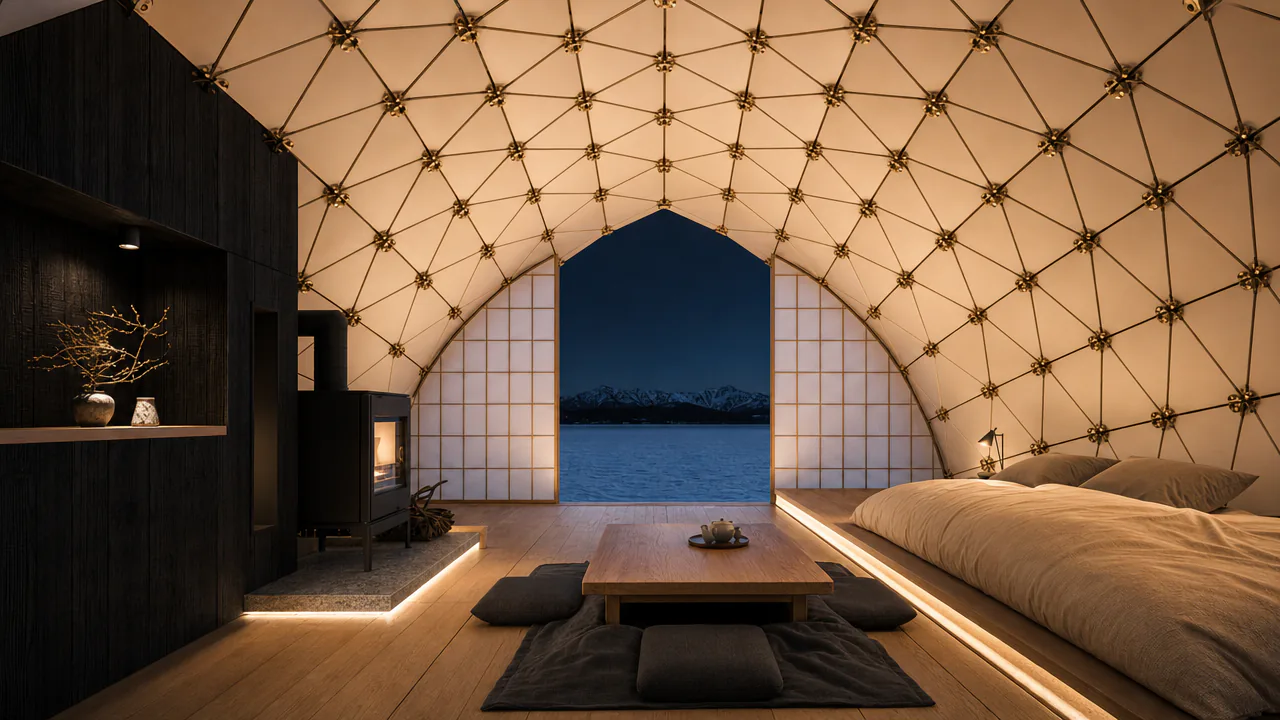
Fold flat. Land anywhere. Live, farm or host guests by the next sunrise.

環M01–M13 Systems · a system of systems

Thirteen mechanisms.
One grid, one port.

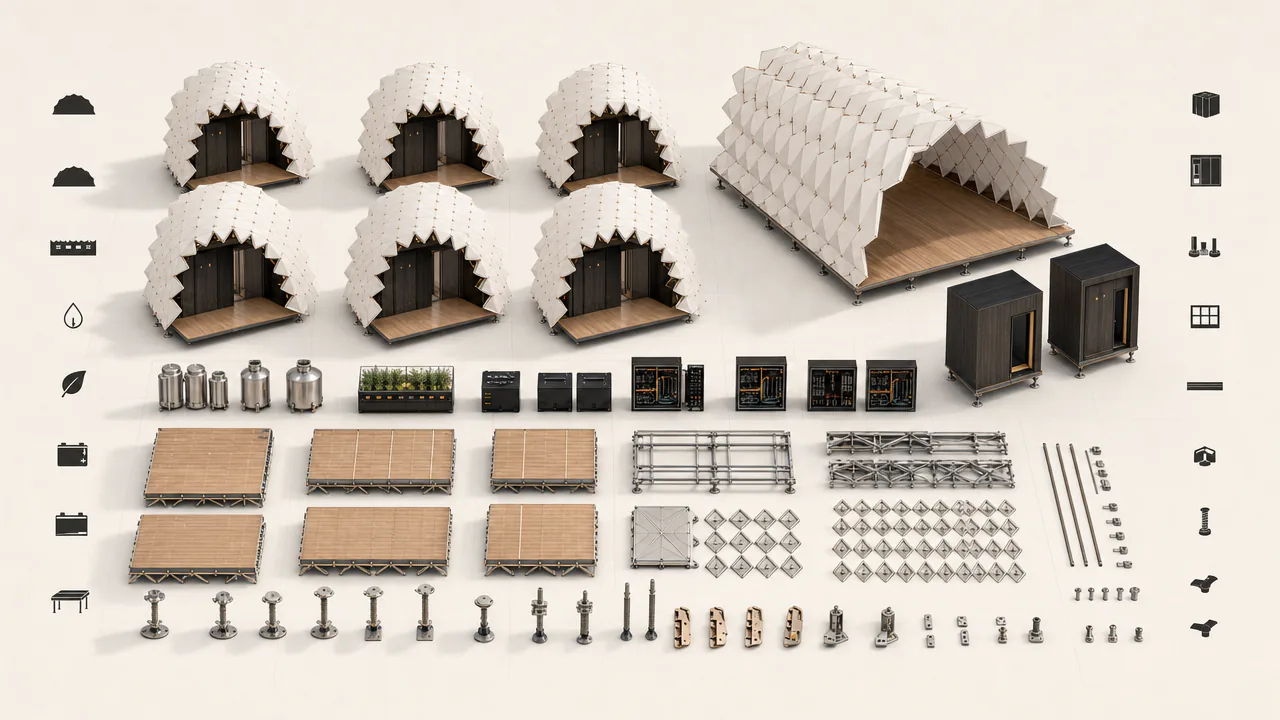
Every organ — water, battery, farm, toilet, larvae bin — sits on a 910 × 1820 mm jo tile and plugs into the same socket. The streams between them are the building’s nervous system.

One ORIJO site on the 910 mm JO-PORT gridIsometric drawing: a YOSHI-4 vault on ASHI legs docked to a KURA-3 service core; a column of organs (farm cassette, water harvester, battery, water organ, twin pad, urine-diverting WC, larvae digester) plugged into jo tiles; a Miura PV wing, a bifacial PV fence and a Kresling water mast. Coloured lines on the ground carry electricity, water, vapour, heat, nutrients, waste and data between them.PV wing to DC spineBifacial fence to DC spineDC spine 48–60 V to organsDC spineDC spineDC spineDC hub in KURAMast to KURA (potable)KUMO harvest to mastGrey water to MIZUPotable back from MIZUTwin-pad manifold (bypass)Heat-pump tank to radiant floorPV-T heat to sorbent (morning release)Urine N on zeolite to HATALarvae frass to bedsKitchen waste to larvaeUrine and faeces to KAWAYAPassports and telemetry to KURA hubNight air into sorbentNight air into sorbentLatch states from TSURU

Streams toggle

13 mechanisms21 modules1 socket · JO-PORT 910 × 1820 mm7 resource streamsDrawn to scale · 1 grid square = 910 mm
索01 The index

Each mechanism is a recipe: proven ingredients, one new combination.

Thirteen mechanisms turn a flat pack into a habitat that feeds, waters and powers itself. Each card lists what it is made of, the numbers it must hit and how mature its parts are today.

Filter

Maturity of parts, by mechanism

01020304050607080910111213
commercial
pilot
experimental
speculative
M01EXPERIMENTAL

KASANE hinge

the fold that seals, stops and locks itself

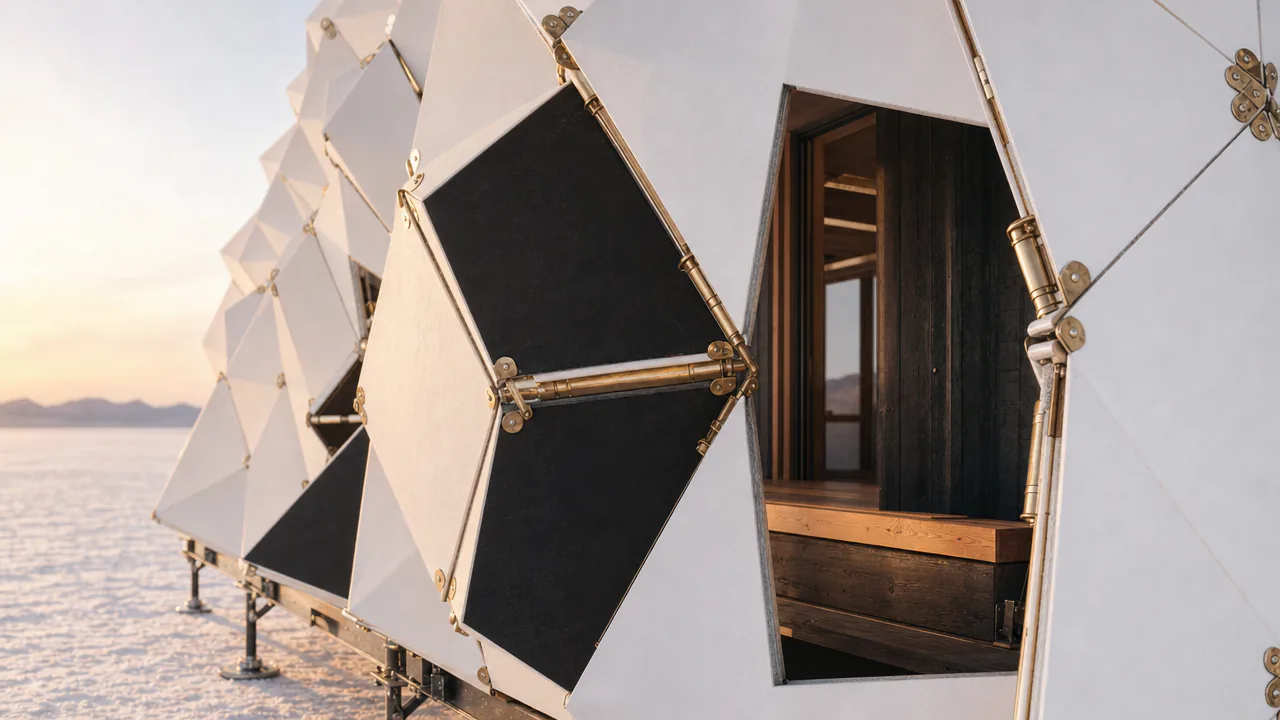
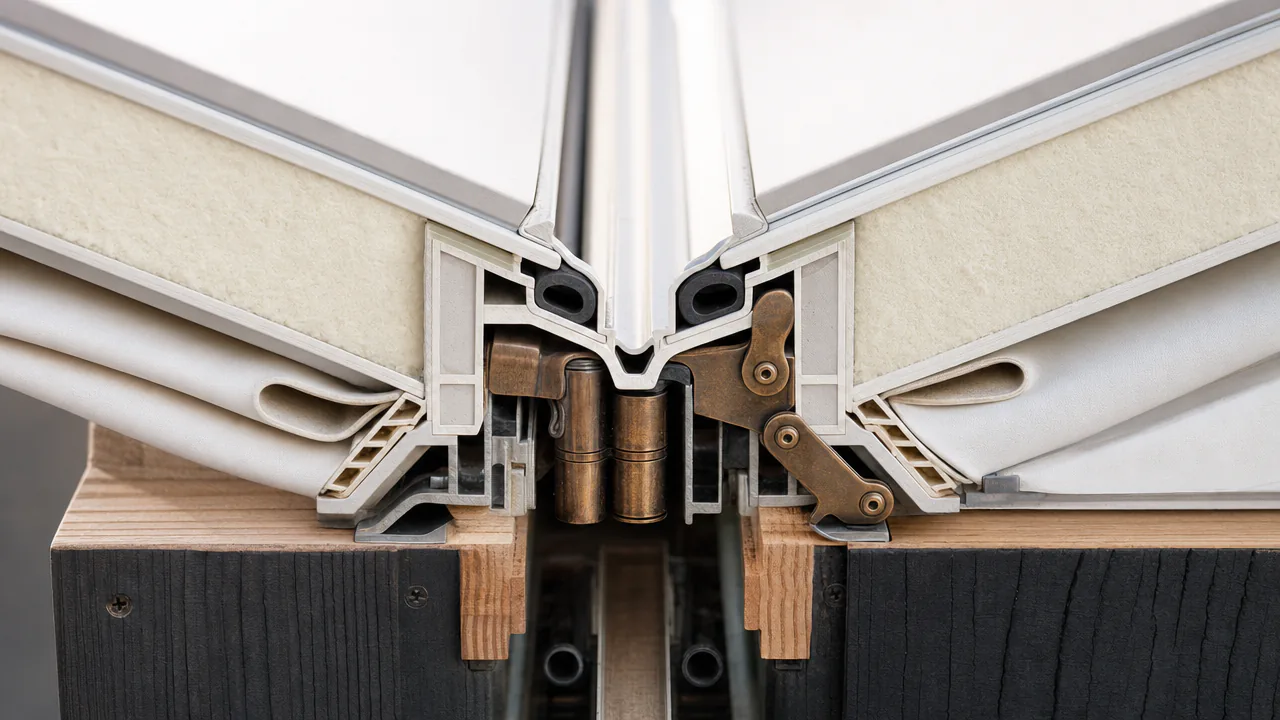
Two membranes and a gasket replace taped seams: a tight membrane on the axis face of each crease and a slack bellows on the face that opens carry air, rain and vapour across the fold, a structural edge closeout takes bearing, and a thermally broken latch carries the tension side of the crease moment.

230mm
opening-face bellows at t = 120 mm, 90° fold calculated
5.7kN
latch tension per 910 mm (0.5 kN·m/m) calculated
2,000cycles
membrane hinge life target
  • BYU membrane-fold surrogate hinge
  • One thickness method per article: Tachi tapered…
  • Tight axis-face membrane plus slack bellows or…
  • Pultruded GFRP or hardwood edge closeouts as the…
  • +5
How it works · 12 steps · 7 parts
  1. Facet panels are glass-FRP sandwiches with a PIR core: 80-120 mm for temperate sites; polar sites need 200-250 mm PIR-equivalent (U about 0.09-0.11 W/m2K at panel centre). A mycelium core is an option only where mass and U targets allow (it adds 7-24 kg/m2 at 120 mm).
  2. Every panel edge carries a structural closeout of pultruded GFRP or hardwood, 15-25 mm deep. This closeout, not the core, is the bearing surface; a 10-20 mm aerogel strip sits behind it to keep the thermal line continuous.
  3. Each test article uses one thickness method. The Miura wall uses Tachi tapered panels, which have a limited fold range, so its folded thickness is taken from the fold geometry. The vault uses Chen/You offset panels, which fold flat but need stack depth for the offset hinge lines. No packing figure assumes both at once.
  4. Rigid-foldability is checked before tooling: the crease pattern is run in a kinematic simulator (MERLIN or Origami Simulator) and must show zero facet strain through the whole fold. Patterns that need facet bending or snap-through (for example the classic Yoshimura) are not used for rigid thick panels.
  5. At each crease the rotation axis sits on one face, and that face alternates between mountain and valley creases. A tight vacuum-laminated PVDF-coated polyester membrane spans the crease on the axis face. On the opposite face the edge gap changes by about t x dTheta, so the membrane there is a slack loop or bellows of at least 1.2 x t x dTheta (about 230 mm for t = 120 mm and a 90 degree fold change; about 150 mm for t = 80 mm), or a bonded EPDM or silicone strip with at least 300% elongation.
  6. The inner layer is the vapour control layer and the outer layer the rain screen; at each valley the space between them drains to the sill gutter, with a heat-traced or self-draining outlet at cold sites.
  7. The offset or taper geometry lets each crease close only to its design dihedral; faces meet and stop it, so a wall cannot over-rotate even if a winch is mis-operated.
  8. At the design dihedral the edge closeouts bear on each other in compression. Under wind reversal the tension side of each crease moment passes through the latch, so the latch is a primary structural member: latch tension T is about M_crease / (0.8 t), and it is sized for fatigue as well as preload.
  9. The latch is thermally broken: a GFRP or polyamide body with a bronze cam only at the bearing point, mounted on the inside face behind the vapour layer so it does not pierce the membrane.
  10. An EPDM bulb gasket inside the membrane is compressed by the same latch preload as a second air barrier.
  11. Each latch carries a Hall-effect position sensor and a strain gauge; the module passport records engaged or not, and TSURU verifies every latch after deployment.
  12. A failed membrane or bellows strip is cut out over 300 mm and re-laminated with a field vacuum kit as an obi patch (target 30 minutes).
PartMaterialSpec
Facet panelGlass-FRP faces, PIR core (mycelium optional), aerogel strip behind edge closeout80-120 mm temperate, 200-250 mm PIR-equivalent polar; 10-12 kg/m2 at 120 mm PIR (calculated)
Edge closeoutPultruded GFRP channel or hardwood15-25 mm deep bearing surface; allowable bearing stress from closeout datasheet, not from the core (PIR about 0.15-0.3 MPa)
Axis-face membranePVDF-coated polyester, vacuum laminatedtight across crease; target 2,000 fold cycles
Opening-face bellowsSlack PVDF-polyester loop, or EPDM/silicone sheet (>= 300% elongation) bonded to membranelength >= 1.2 x t x dTheta (150 mm at 80 mm, 230 mm at 120 mm, 90 degree fold)
Over-centre latchGFRP or polyamide body, bronze cam at bearing point only, stainless pinprimary tension member; T = M_crease / (0.8 t); 910 mm pitch; inside face behind vapour layer; Hall sensor
Backup gasketEPDM bulbcompressed 30-40% at preload (target)
Obi repair kitMembrane roll, adhesive, portable vacuum pump300 mm patch, 30 min (target)

12-month prototype 2.4 m thick-panel Miura wall section (Tachi tapered panels) and a 3.64 m span x 1.82 m long rigid-foldable quadrilateral-panel vault strip (Chen/You offset panels; pattern verified at zero facet strain), both with axis-face membranes, opening-face bellows, edge closeouts, thermally broken latches and gaskets; a 2 x 2 x 2 m sealed test box built from the same facets; hinge coupons for ageing.

Pass No water penetration in the spray sequence; box q50 <= 1.5 m3/(h.m2); membrane and bellows intact and leakage rise < 25% after 2,000 cycles; latch preload retained within 10%; coupons pass ageing blocks; cone-calorimeter results consistent with a target of Euroclass B-s2,d0 (EN 13501-1), with NFPA 285 as the US route.

Kill Membrane delamination before 500 cycles, box q50 > 3.0 m3/(h.m2) with gasket, or water penetration at any opening-side crease (bellows): occupied enclosures revert to the v2 rule (fixed insulated rooms, origami only on unoccupied canopies and wings).

BOM USD 70,000-150,000 including rigs, chamber rental and lab fees (materials only about 18,000-35,000)

Risks UV and abrasion ageing of the coated fabric and bellows at outside creases · Ice formation in valley drainage channels and condensation at crease lines in cold climates · Fire performance of FRP and foam cores (no code route proven yet) · Thermal bridging at latches and edge closeouts · Latch fatigue under wind reversal · PFAS regulation of fluoropolymer coatings

EXPERIMENTAL: each ingredient is a prototype or lab result; the weathertight, insulated building hinge with an opening-face bellows is unbuilt and is the single most important risk in ORIJO.
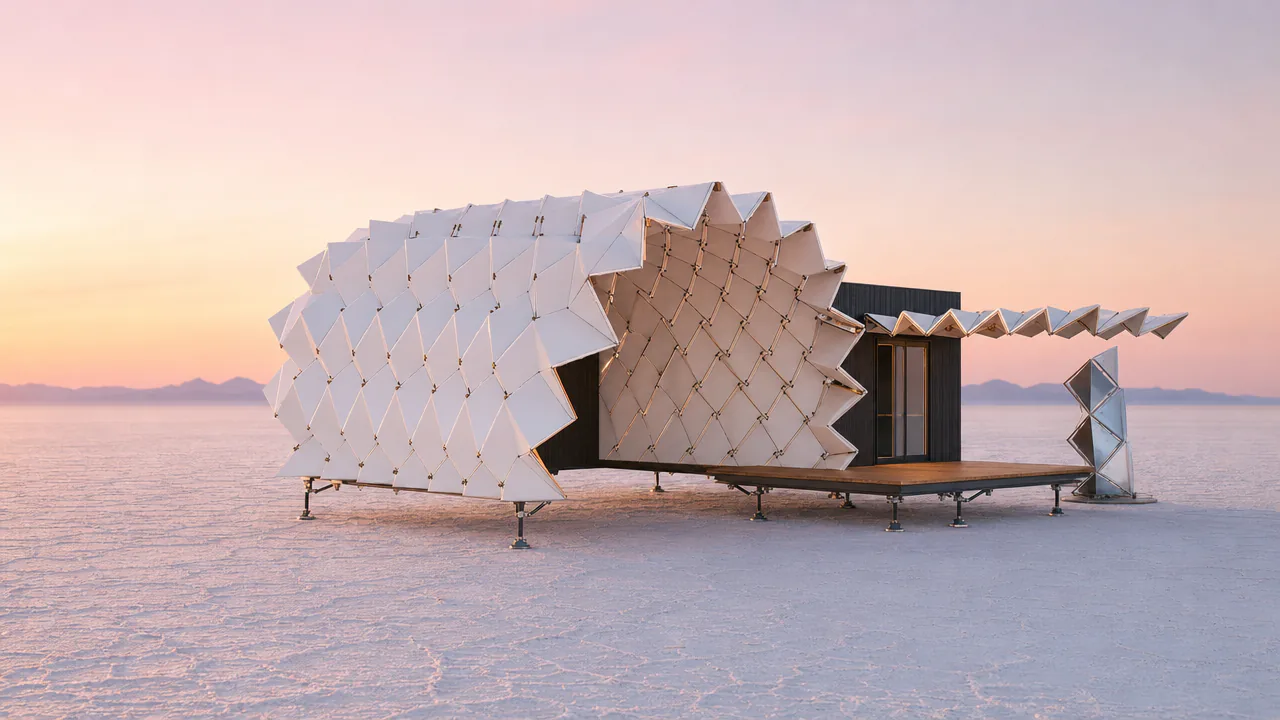
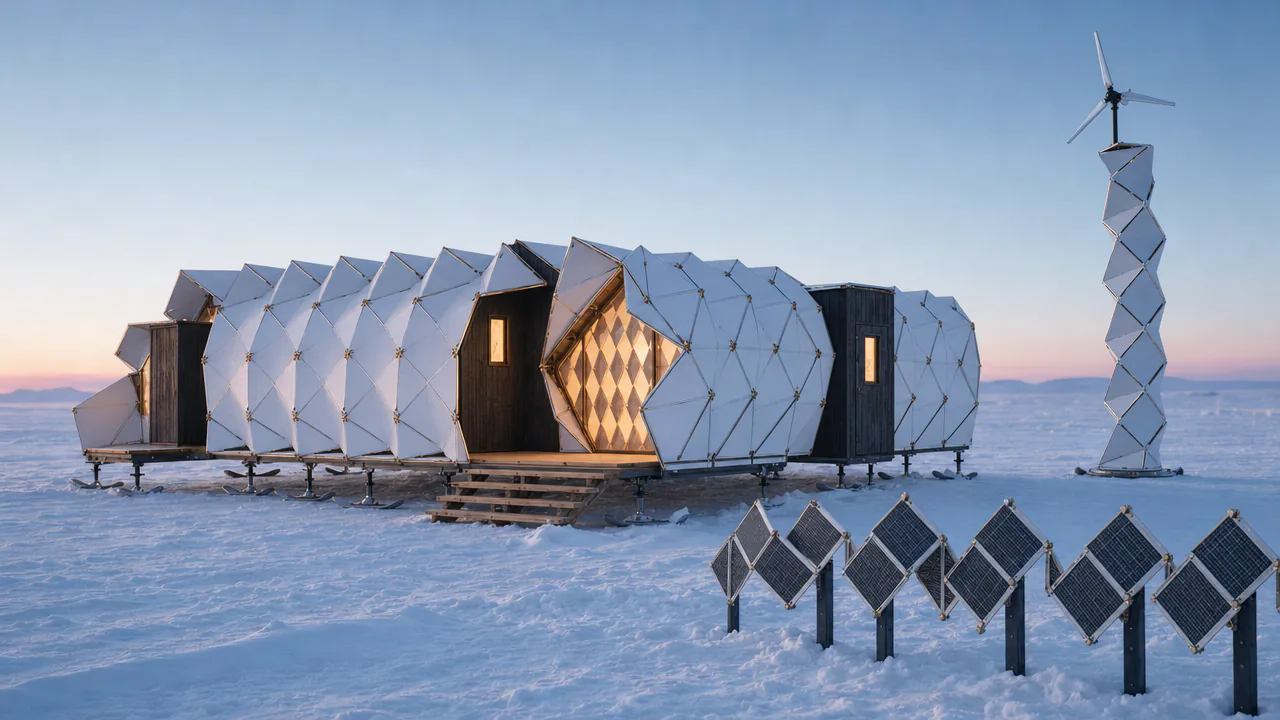
Deep dive · Structure →
M02EXPERIMENTAL

YOSHI vault

the one-day thick-panel barrel room

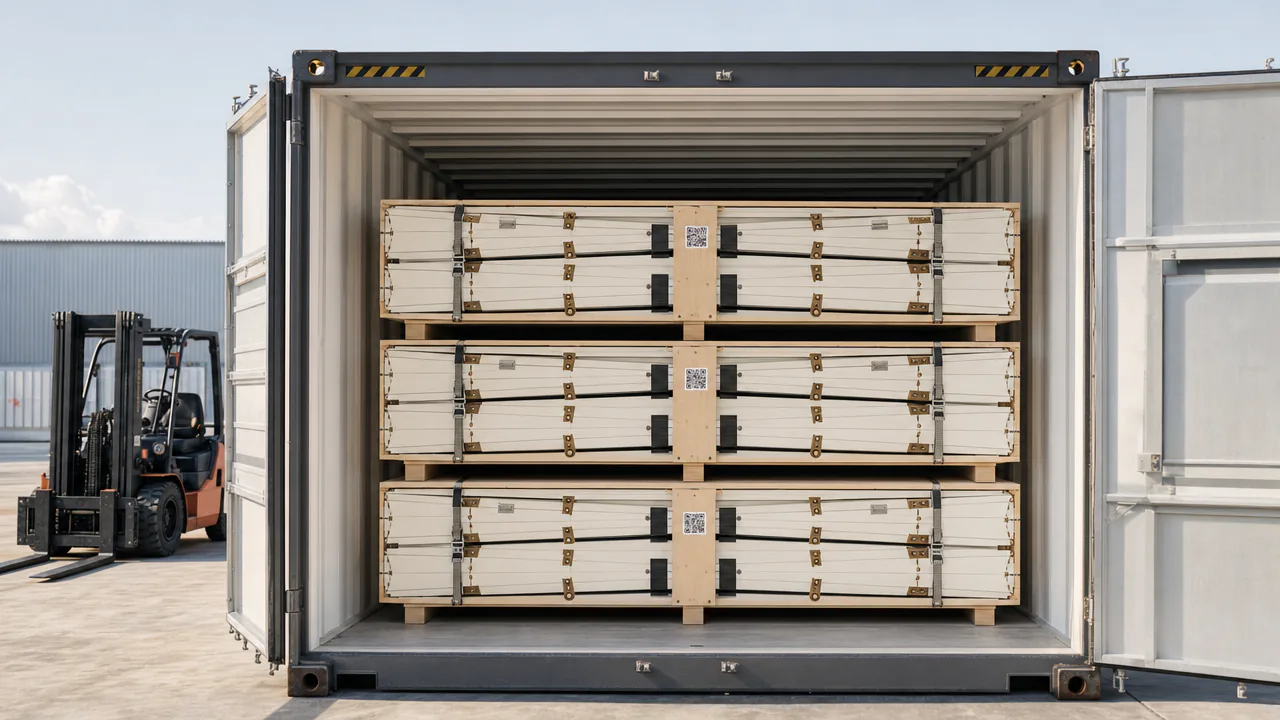
Two road-legal half-shell packs, each 3.70 x 2.30 x 1.10 m, unfold on one degree of freedom into a 26.5 m2 insulated barrel vault of about 48 m3 whose creases are its ribs, its gutters and its robot rails.

26.5m²
floor from two road-legal packs calculated
2.6×
expansion, shell only calculated
≤ 4h
packs on pad to sealed shell target
  • Rigid-foldable one-DOF quadrilateral-panel cylinder
  • Chen/You offset thick panels
  • Kinematic simulation with zero facet strain before…
  • Karakuri counterweights or a geared 12 V winch
  • +4
How it works · 10 steps · 7 parts
  1. ASHI legs are set and levelled; MUTOIS floor cassettes unfold onto them to form a 3.64 x 7.28 m floor diaphragm with a sill beam on each long side.
  2. The shell ships as two half-length (3.64 m, 2-bay) packs. Each is lowered onto two kinematic datum pins, at the fixed gable for the first half and at the splice frame for the second; transit straps are released by app command after a pre-check.
  3. The crease pattern is a rigid-foldable quadrilateral-panel (Miura-derived) cylinder with degree-4 vertices, built with Chen/You offset panels and checked in a kinematic simulator at zero facet strain. It has one degree of freedom, so the whole half-shell moves together; there is no crown-first transition front.
  4. The moving gable portal is winched along floor rails. Because span and rise change as the cylinder extends, the haunch shoes run in PTFE-lined slides along the sill rails; the slide travel is designed, not left to friction. Near the folded state the pull force rises steeply, so the first part of the stroke uses a geared winch or a jack start, and counterweights (optional) balance the rising facets.
  5. If a staged opening is needed, it comes from staged latches or control cables, not from the pattern.
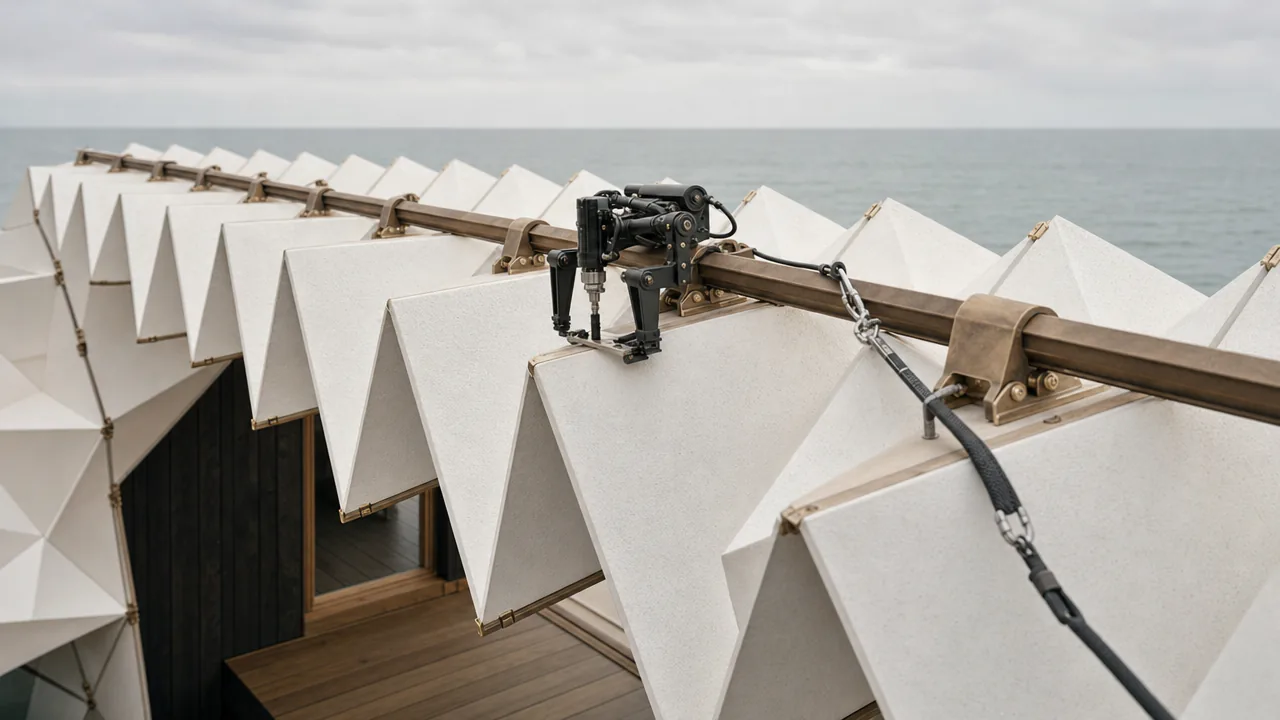
  6. At full extension the one-way offset stops engage; the two halves are joined at a latched splice ring frame; TSURU walks the ridge rail and closes each latch at 910 mm pitch, logging sensor state.
  7. Haunch facets lock into the sill shoe; tension ties across the span resist spreading thrust.
  8. Kirigami shoji gables (F6) unfold by one string; the door cassette and the KURA core dock by JO-PORT.
  9. A blower-door fan in the KURA core pressurises the shell; leaks are localised by TSURU thermal camera and fixed before handover.
  10. Load path: snow and self-weight travel as folded-plate shell action along ridges and valleys to haunch shoes, sill beams, ASHI legs and anchors; wind uplift returns through edge-closeout bearing, latches in tension and base ties. Retraction is the reverse.
PartMaterialSpec
Facet setKASANE panels (M01), Chen/You offsetabout 87 m2 developed area for YOSHI-4 (calculated: arc about 8.5 m x 1.2 corrugation x 7.28 m x 1.2); panel solid volume 6.96 m3 at 80 mm, 10.4 m3 at 120 mm
Gable portals and splice frameAluminium frame, hinoki infillabout 300 kg in total (estimate); winch mount
Haunch shoe slideStainless shoe on PTFE-lined sill railtravel from fold simulation; friction coefficient <= 0.1 (target)
Winch and optional counterweightsGeared 12 V winch; steel counterweight cassetteabout 300 kg if counterweights travel with the unit
Floor cassettesMUTOIS aluminium-honeycomb modules2 x 4 ken, 2.5 kPa live load target
Ridge railSegmented aluminium T-slot, socket bolted through to ridge beamdatum socket every 910 mm, broken at every transverse crease
Base tiesDyneema or stainless rod with turnbuckleone per 1.82 m bay

12-month prototype Precondition: M01 hinge built and through at least 500 test cycles by month 4. Then one half-length (3.64 m, 2-bay) full-section YOSHI shell on a test pad with ASHI legs, gable portal, haunch slides and geared winch; temperate 80 mm panels; pattern verified at zero facet strain before tooling.

Pass Measured pack within the 3.70 x 2.30 x 1.10 m envelope; half-shell deploys <= 4 h with no crane; deflection within FE prediction +/- 20%; q50 <= 1.5 m3/(h.m2) at month 12 (fallback <= 2.5).

Kill Facets need > 25% extra mass for stiffness, deployment needs a crane, or leakage cannot be brought below q50 3.0 m3/(h.m2): freeze occupied YOSHI and sell F2/F3 wings and masts on fixed rooms.

BOM USD 60,000-120,000

Risks Snow drift on crease valleys creating unbalanced loads · Tolerance stack-up across about 300 m of crease and dozens of vertices · Haunch slide friction and peak winch force near the folded state · Pack envelope not yet confirmed by fold simulation · Code approval of a novel folded shell · Hinge wear during repeated relocations

EXPERIMENTAL: rigid-foldable thick-panel cylinders exist as models and small prototypes; an insulated, airtight, snow-loaded occupied vault is unbuilt.

Deep dive · Structure →
M03COMMERCIALEXPERIMENTALSPECULATIVE

ASHI legs

anchoring that turns land into a lease

Four to eight self-levelling legs on screw piles put a habitat on soil without a foundation pour or a trench, with a braced lateral load path; roof, snow, rock, water and regolith feet are concept-level options that each need their own structural case.

5.4kN
static load per leg, YOSHI-4 on 4 legs calculated
15min
per screw pile target
23km
Halley VI moved on legs and skis measured
  • Halley VI jackable legs and skis
  • TenFold self-levelling hydraulic legs
  • Shigeru Ban beer-crate ballast foundations
  • Helical screw piles
  • +4
How it works · 9 steps · 6 parts
  1. Site scan by drone photogrammetry and a probe rod gives slope, soil class and obstacles; the configurator selects leg count, pile length and cut-off heights.
  2. Coarse slope is taken up by pile cut-off height or a stepped sill. Each telescoping leg then carries a jack for fine trim only: +/-115 to +/-230 mm (TenFold spec: 9 in total surface variability, hydraulic), which is about 3% (1.8 deg) over 7.28 m.
  3. Screw piles are driven by a compact excavator auger head (target 15 min per pile). No trench is dug.
  4. Lateral load goes through X-bracing between legs or a moment-rigid sill-to-leg connection. Each leg and pile head is rated for at least 1.5 x 1/n of the wind shear (about 5-10 kN per leg for 4-8 legs).
  5. Height is held by a mechanical pin or threaded lock nut with a published load rating. A separate replaceable impact absorber is fitted only where an impact case exists. Snow build-up and settlement are handled by re-jacking, as at Halley.
  6. Leg capacity comes from commercial jacks, e.g. 2-5 t rated per leg against about 5.4 kN static per leg for YOSHI-4 on 4 legs, plus wind and snow combinations.
  7. HRV intake air is protected from frost without a trench: a glycol loop in thermal helical piles feeds a pre-heat coil, or an electric frost pre-heater (about 0.3-1 kW) sits on the HRV. A separate earth-tube trench is an option only for multi-year sites.
  8. Rooftops: zero penetrations only for HOSHI-class pods, subject to a structural check (even HOSHI-2 needs about 1-2 t of ballast). YOSHI-4 on an existing roof needs a spreader steel frame bearing on columns or beams, or mechanical tie-downs.
  9. To leave, legs retract, piles unscrew and the site is restored.
PartMaterialSpec
Telescoping legAluminium/steel tube with commercial jack (2-5 t rated)trim +/-115 to +/-230 mm; pin or lock-nut height lock
Screw pileGalvanised helical pilepull-out and lateral capacity from site tests
BracingSteel X-bracing or moment sill connection>= 5-10 kN lateral per leg (target)
Impact absorber (optional)Replaceable crush cartridgeonly where an impact case exists
Frost pre-heatThermal-pile glycol loop + coil, or electric HRV pre-heaterabout 100 W per 60 m3/h per 5 K; 0.3-1 kW
Concept feet (not in prototype)Ballast pallet box with bagged sand / UHMW ski / stainless rock plate / HDPE pontoon / regolith bageach needs its own structural, buoyancy or mooring case

12-month prototype Leg set with screw piles, jacks, pin locks and bracing for the M02 half-length test shell; electric HRV frost pre-heater; one rooftop-ballast feasibility calculation with a structural engineer, using commercial pallet boxes or bagged sand (no custom crate mould).

Pass Level within +/- 5 mm after trim; pull-out >= 2x design uplift; lateral capacity per leg >= 1.5 x 1/n of design wind shear; HRV intake above -5 C (target) in local winter.

Kill Screw piles cannot meet uplift plus lateral load at typical soils without concrete: switch to precast pad footings and keep the leg and jack system.

BOM USD 25,000-60,000

Risks Frost heave on piles · Low lateral capacity of helical piles in soft soil · Wind sliding on roofs and roof structural capacity under ballast · Trench safety and excavation cost where an earth tube is chosen · Biofouling, fitting corrosion, permitting of open-water heat exchange, mooring and stability for the pontoon foot · Custom crate tooling (about USD 50-150k mould) if a jo crate is ever made

COMMERCIAL components (screw piles, jacks, bracing); EXPERIMENTAL as a levelled, braced leg system; SPECULATIVE for ski, pontoon, rock-plate, rooftop-ballast and regolith feet

Deep dive · Structure →
M04COMMERCIALPILOTEXPERIMENTAL

JO-PORT

the tatami socket for life support

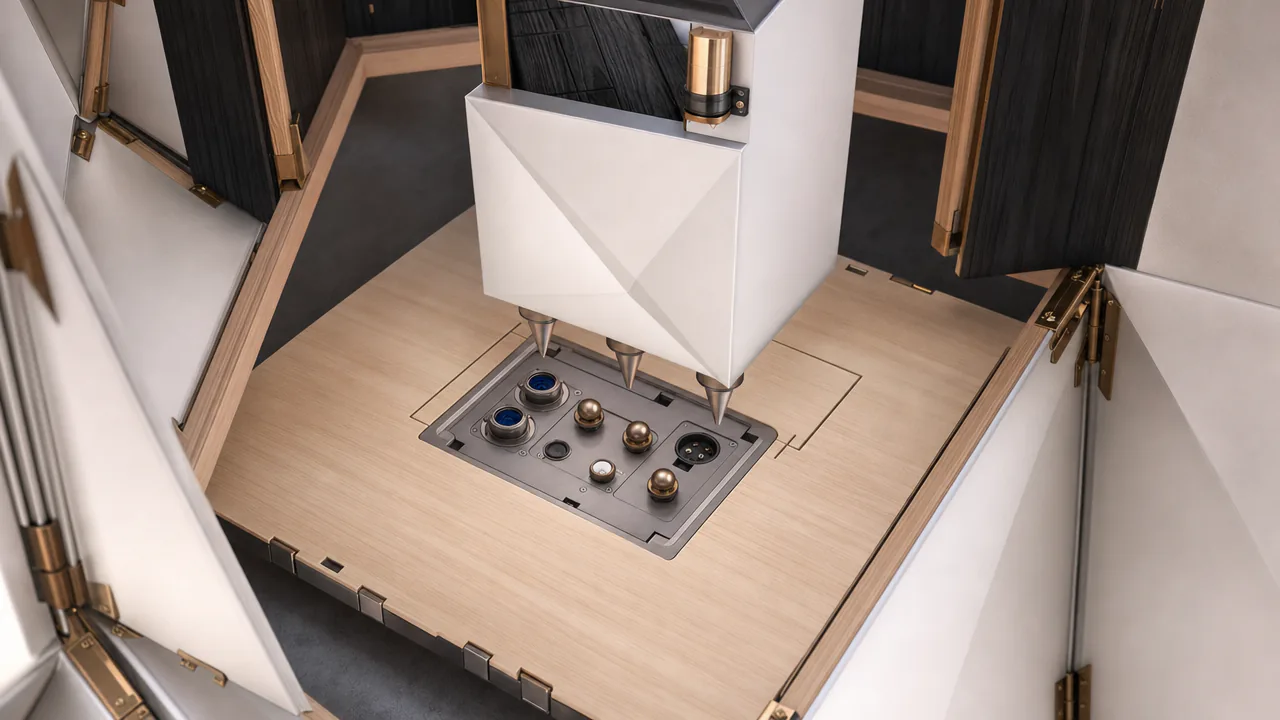
A 910 x 1820 mm floor tile with a three-point datum spread over the module footprint and separate utility islands that every organ - water, battery, farm cassette, bath, bed - plugs into like a tatami mat, after a passport handshake and a leak test.

910 × 1820mm
one jo tile, one socket target
≤ 0.5mm
datum repeatability after 500 dusty cycles target
< 60min
two-person swap of a 1-jo organ target
  • Tatami/ken grid
  • WOTA Unit footprint
  • Quasi-kinematic datum: hardened steel balls on…
  • Flat-face dry-break couplers
  • +3
How it works · 9 steps · 6 parts
  1. The datum is spread over the whole module: two hardened steel balls (>= 58 HRC) at the port end and one at the far end, running in hardened steel V-block inserts pressed into the tile. The balls carry lateral location under light preload; the module's weight goes to flat bearing pads, so contact stress stays within the insert's capacity (quasi-kinematic).
  2. The port box at one short end floats about +/-3 mm on a compliant mount, so the ports mate relative to the module, not the tile. It holds separate islands for DC 48-60 V, potable in, grey out, optional air duct and data (CAN/Ethernet + NFC).
  3. The organ is lowered by TSURU (when available) or rolled by two people; lead-in cones guide the V-grooves onto the balls and a spring clamp preloads the seat.
  4. NFC reads the module passport (ID, revision, mass, ratings, ports, firmware); the controller compares it with the site configuration.
  5. Enable sequence for each fluid island: mate flat-face dry-break couplers, pressurise the closed interstitial volume, run a pressure-decay test on the transducer, then open the downstream solenoid isolation valve. Then DC precharge, then power. Any failure leaves that island isolated.
  6. Urine never passes a dry-break coupler: it leaves by a gravity drain with an air gap, or by a flushable quick-disconnect with an acid-flush cycle against struvite.
  7. Neighbouring tiles lock edge-to-edge with LVL or steel keys at 1-2 mm clearance and a wedge or cam take-up; the 0.5 mm datum is local to each tile, so tolerances do not stack across tiles.
  8. Removal reverses the sequence; residual fluid falls into the tile drip tray; the passport logs the event.
  9. Critical organs (water, battery) get a twin port on the adjacent tile, which costs one free 1.66 m2 jo per critical organ, so a replacement is live before the old one is pulled (shikinen).
PartMaterialSpec
Datum setHardened 52100 steel balls (>= 58 HRC), hardened steel V-block inserts, flat bearing padstwo balls at port end, one at far end; at 1.3 kN a 25 mm ball on hardened steel gives p0 about 2.5-3 GPa (calculated)
Port boxCast aluminium on compliant float+/-3 mm float
Water islandsStainless flat-face dry-break couplers (ISO 16028 class), solenoid isolation valve, test port, pressure transducerpotable and grey separated; urine by gravity drain
DC islandBlind-mate connector (Anderson-class)2 kW per port; house DC total <= 2 kW at 48 V, or a 60 V bus; heavy loads (bath, heat pump) on 380 V DC or AC
Edge keysLVL or steel1-2 mm clearance, wedge or cam take-up
Passport tagNFC + QRlinks to fleet record

12-month prototype Six floor tiles with spread datums, floating port boxes and isolated fluid islands, plus three organs: a buildable DC greywater test organ (pump, filter, UV, tanks, 50-150 kg), a 10-15 kWh LiFePO4 rack and an NFT farm rack; DC precharge and protection electronics; test rig.

Pass Zero leaks and zero unsafe enables in 500 cycles; datum repeatability <= 0.5 mm at the far end after 500 dusty cycles; swap < 60 min by two people; robot swap timing only if TSURU is available.

Kill > 1% false mates or seal damage from dirt: split the port into a datum tile plus a separate hand-connected utility panel.

BOM USD 35,000-60,000

Risks Dirt and ice in couplers · Struvite and calcium scale fouling in urine lines · House DC load above about 2 kW erasing the 48 V DC advantage · Standardising before the catalogue is stable · DC arc-fault protection maturity · WOTA Unit availability outside Japan and pilot regions

EXPERIMENTAL integration of COMMERCIAL parts (connectors, DC hardware); the water organ is a stand-in, because the WOTA Unit is PILOT (pre-mass-production, AC only, no port interface)

Deep dive · Structure →
M05COMMERCIALPILOTEXPERIMENTAL

KUMO loom

desert water from night air, sized for the residual

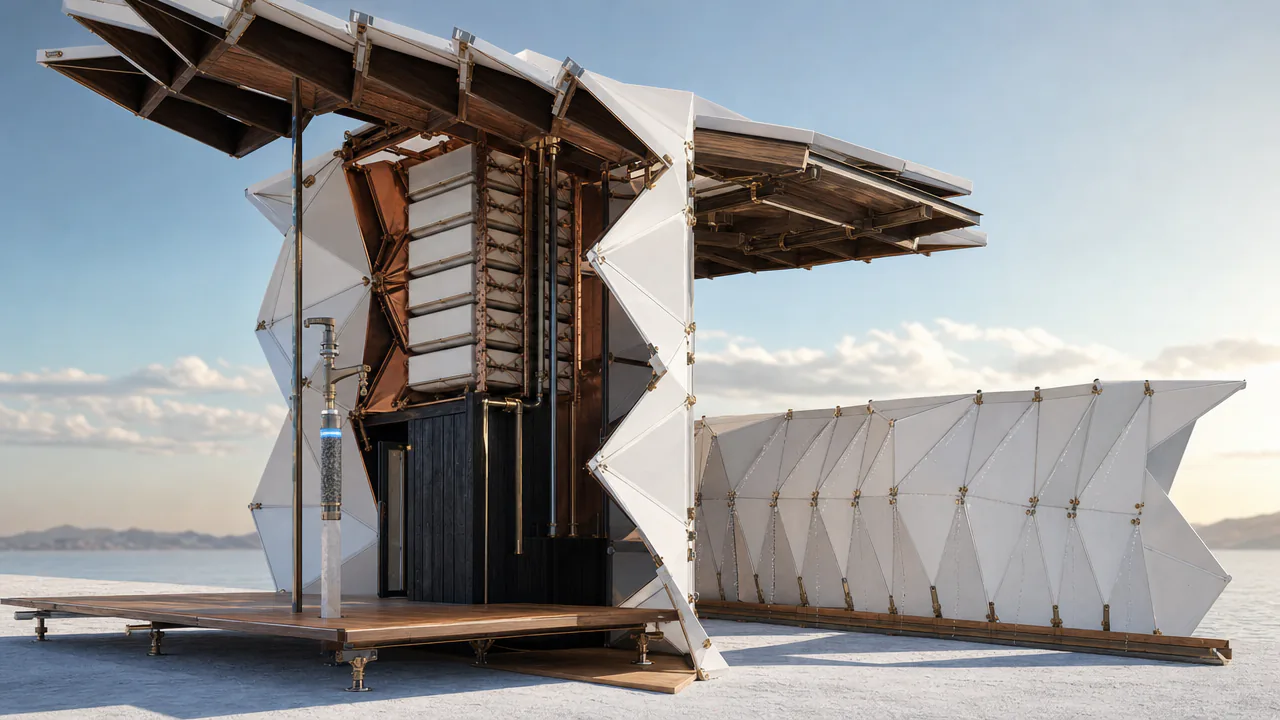
Recycle first, then harvest only drinking, cooking and make-up water from night air: sorbent cassettes load at night and release in the cool morning to a night-chilled condenser, driven by glazed solar heat - a harvester about 5-15x smaller than one that makes all water from air.

5–15×
smaller harvester when recycling comes first calculated
0.285L/kg·day
MOF-303, fully passive, real desert measured
2.4–12L/day
per KUMO-12 rack calculated
  • Recycle first
  • MOF-303 / MOF-801 and CaCl2-hydrogel sorbents,…
  • v2 Duplex Vapor Loom thermal swing on folded copper…
  • Morning desorption window against a night-cooled…
  • +4
How it works · 9 steps · 5 parts
  1. SIZE: the configurator computes harvest = people x (demand x (1 - net recovery) + 2-3 L drinking and cooking), with demand 60-100 L/person/day (water-conserving) and 90-95% net recovery in desert conditions, giving about 5-13 L/person/day. Yield per kg is taken from single-cycle passive data, not lab multi-cycle data.
  2. CAPTURE (night): rack louvres open and low-power DC fans pull air through the sorbent beds - CaCl2-hydrogel composite or MOF-303 bonded to folded copper lamellae (v2 cassette). The rack runs one cycle per day; shaded daytime desert air (5-15% RH) is below the MOF-303 uptake step, so there is no daytime capture.
  3. RELEASE (morning, about 07:00-11:00): the beds are shuttered into a sealed chamber and heated by a glazed solar-thermal collector loop; PV-T backsheet heat is used only as preheat or for CaCl2 composites. The governing check is p_sat(T_cond) / p_sat(T_bed) <= 0.1 for MOF-303 (e.g. condenser 25 C and bed about 70 C) or <= 0.2-0.25 for CaCl2 (bed about 55-60 C at a 25 C condenser). A DC trim heater fills cloudy-morning gaps.
  4. CONDENSE: vapour goes to a condenser backed by night-cooled thermal mass or ground-coupled water that is separate from the potable tank, with a radiative-cooling coating on its shaded face; condensate drips into a weighed sump. Condenser temperature and the residual sorbent loading at the end of each release are logged.
  5. VERIFY: conductivity, turbidity and temperature are logged; water defaults to the grey loop until in specification.
  6. PURIFY: activated-carbon polish, then a calcite/dolomite mineral cartridge with CO2 dosing from a food-grade cylinder, then UV-C LED at 265-280 nm, then a chlorine residual for storage. Lithium checks apply only if a LiCl sorbent is used.
  7. STORE: food-grade bladder in the base cells of the KRES mast (3-6 m gravity head) with a radiative-cooled top.
  8. DISTRIBUTE: gravity to JO-PORT potable islands; DC booster pump; UV ring at each tap as the final barrier.
  9. FALLBACK: fog-mesh skin on coastal deserts and ridges, a commercial hydropanel or AWG, or a truck fill port; the harvester never carries life safety alone.
PartMaterialSpec
Sorbent cassetteCaCl2-hydrogel composite or MOF-303 on folded copper lamellae2 kg active sorbent each; 12 per rack (24 kg)
Solar-thermal collectorGlazed flat-plate or evacuated-tube collector; PV-T backsheet plate as preheat70-100 C delivery to bed loop
Condenser and cold massAluminium panel, radiative coating, night-cooled water or ground-coupled loopseparate from potable storage
Mineral cartridge + CO2Food-grade calcite + dolomite; food-grade CO2 cylinderrefill every 6-12 months (target)
UV-C module265-280 nm LED flow reactorDC, few watts

12-month prototype KUMO-2 bench: two beds, 2 x 2 kg sorbent (CaCl2-hydrogel first, MOF-303 if purchasable), glazed solar-thermal collector with a PV-T preheat panel, night-cooled condenser mass separate from storage, treatment train with CO2 dosing; at an arid field site plus a climate chamber.

Pass >= 0.3 L/kg/day field mean at 20-40% night RH for CaCl2 composites, or >= 0.2 L/kg/day for MOF-303, on one cycle per day; measured heat <= 4 kWh_th/L; <= 3% annual PV yield loss vs a ventilated reference panel; potable lab pass.

Kill < 0.15 L/kg/day or unsolved salt carry-over: buy commercial hydropanels or AWG/MOF units (SOURCE, AirJoule, Ahbstra class) for make-up and keep the recycle-first architecture.

BOM USD 15,000-35,000

Risks MOF availability and price unknown · Collector area per person larger than the roof allows at low-yield sites · Dust fouling of sorbent beds · Salt leaching from composites · Condenser mass too warm after hot nights

EXPERIMENTAL (passive sorbents at pilot scale; WOTA Unit pre-mass-production; integration unbuilt). The recycle-first architecture with commercial make-up is the investable core.

Deep dive · Water →
M06COMMERCIALPILOTEXPERIMENTAL

MOTTAINAI loop

five streams, near-zero sewer

Separate grey, yellow, brown, green and air-moisture streams at the source, and each becomes an input or a regulated export: showers come back as showers, urine nitrogen is captured on a regenerated zeolite bed as fertiliser, kitchen waste feeds larvae, and a sanitary holding tank stays as the legal fallback.

98%
ISS water recovery with brine processor measured
8.8g N
in urine per person per day measured
±10%
nitrogen mass-balance closure target
  • WOTA greywater biology + membrane + RO + UV/Cl
  • Urine-diverting dry toilet
  • Urine stabilisation by storage or acidification,…
  • Aurin/VUNA full-nitrification route as the alternative
  • +4
How it works · 10 steps · 6 parts
  1. SEPARATE at the source: urine-diverting dry toilet (no blackwater), grey drains (kitchen sink via a grease interceptor), kitchen organics bin, crop residue chute, HRV/dehumidifier condensate line.
  2. GREY: the MIZU organ runs biology, membrane, RO, UV and chlorine; up to 97% is reused with rainwater make-up (vendor spec); make-up water is logged separately; RO reject goes to solar membrane distillation, ornamental irrigation or the holding tank.
  3. YELLOW: urine is stabilised by storage or acidification so ammonium (NH4+) stays the dominant species, then passes a clinoptilolite exchange bed that captures NH4+ and K+ at 10-20 mg N/g. The bed is regenerated in place with a KCl or NaCl rinse, which produces a liquid NH4/K fertiliser; it is not a disposable pod. (Alternative: full nitrification to nitrate liquor used directly as hydroponic feed, the Aurin/VUNA route.)
  4. Charged zeolite also feeds zeoponic seedling trays and substrate beds in HATA; surplus nitrogen goes to outdoor beds or to a fertiliser offtake, because one NFT rack uses only a few percent of household urine N.
  5. BROWN: dried faeces from the ventilated chamber are composted thermophilically for non-food landscape, or incinerated or collected where regulation requires.
  6. GREEN: kitchen and crop residue (about 1-2 kg/day for 4 people) feed a BSF larvae bin on a 10-14 day cycle; larvae feed fish or poultry, frass goes to outdoor beds.
  7. AIR-MOISTURE: plant transpiration and breath are condensed by the dehumidifier and HRV and returned to the grey intake.
  8. LUNG: sealed farm modules carry a bladder that absorbs pressure swings and receive the living unit's CO2-rich exhaust through a HEPA and activated-carbon stage, within a stated humidity budget (target about 1,000 ppm CO2 in the grow zone).
  9. SODIUM: recirculating nutrient is bled off on a sodium set point to the holding tank (urine carries about 2-4 g Na per person per day).
  10. MONITOR: EC, pH, ORP, turbidity and Na online; quarterly lab panels for pathogens and pharmaceuticals; anything out of spec goes to the sanitary holding tank or septic connection.
PartMaterialSpec
MIZU organWOTA-Unit-class partner appliance (pre-mass-production)1680 x 780 x 1400 mm, 170 kg, 400 W rated (more with heater)
Urine store / acidification tankHDPE120 L per 4-8 people (target)
Zeolite exchange bedNatural clinoptilolite 0.9-2.5 mm25-50 kg for 4 people, regenerated weekly with KCl/NaCl rinse (calculated)
BSF binHDPE trays, self-harvest ramp1-2 kg waste/day for 4 people
Lung bladder + transfer lineTPU bladder; HEPA + activated-carbon filter5-10% of grow-zone air volume (target)
Sanitary holding tankHDPE or septic connectionregulated fallback; sodium bleed and out-of-spec streams

12-month prototype Household-scale loop: commercial urine-diverting toilet, urine storage/acidification tank, regenerated zeolite exchange columns, NFT lettuce rack plus zeoponic seedling trays and a substrate bed, BSF bin, greywater recycler (WOTA BOX rental where available), filtered CO2 transfer line, sanitary holding tank.

Pass No pathogen exceedance in edible tissue; grey reuse >= 90% measured with make-up water logged separately; 20-50% of excreted urine N recovered into crops or exports with N balance closed within +/-10%; yield >= 85% of control.

Kill Urine-derived fertiliser fails food-safety tests: route it to ornamentals, landscape and fertiliser offtake, keep the grey loop and BSF. Regulator refusal is a jurisdictional risk (Aurin is approved for edible crops in Switzerland), not a global kill.

BOM USD 15,000-40,000

Risks Regulatory acceptance of urine-derived fertiliser varies by jurisdiction · Pharmaceutical residues · Sodium and salt build-up in recirculating nutrient · Nitrogen surplus with no local outlet · Humidity, VOC and bioaerosol transfer from living unit to farm · BSF economics failed industry-wide (internal service only)

PILOT grey loop (WOTA Unit pre-mass-production; WOTA BOX commercial for showers); EXPERIMENTAL urine-to-zeolite and closed nitrogen loop

Deep dive · Loop →
M07COMMERCIALEXPERIMENTAL

HATA loom

the fully autonomous farm on a jo pitch

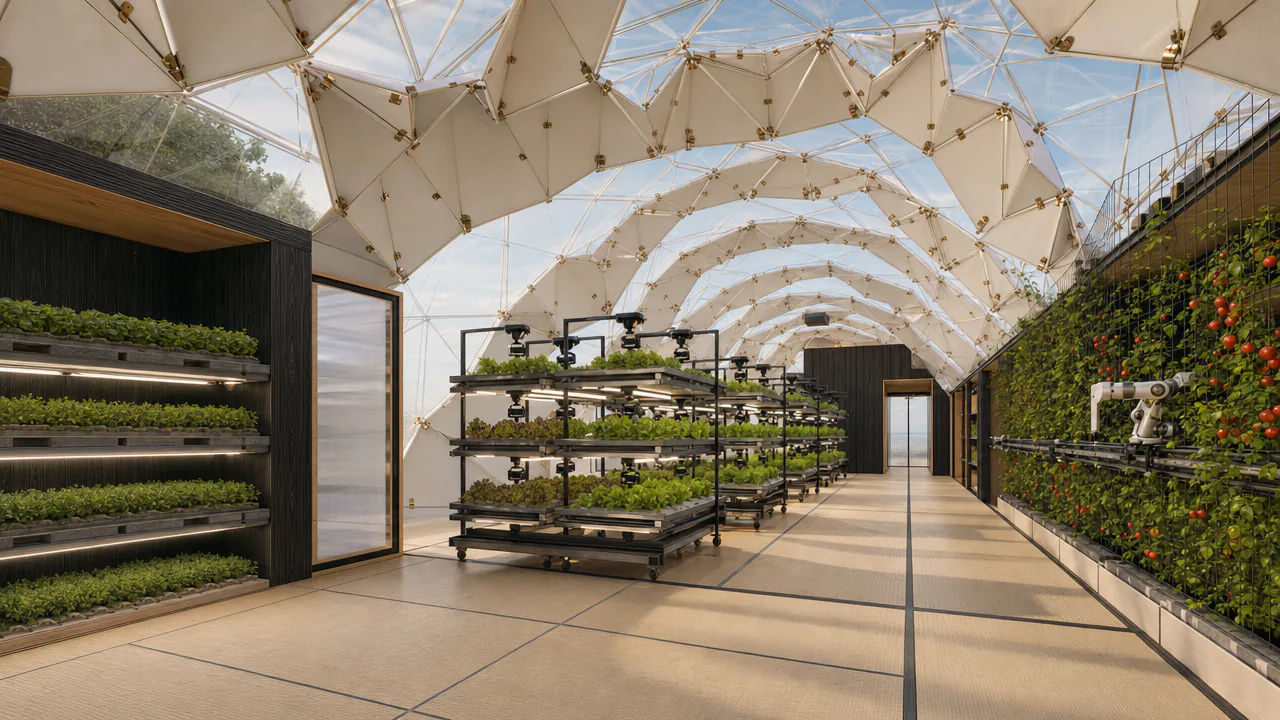
Make every plant legible to cheap machines: trays on a 910 mm pitch move on rollers, fixed cameras and a rail arm find each plant at a known coordinate, and the farm keeps running if Anyground disappears.

6.1–8.9kg/wk
greens per HATA-4 cassette calculated
~15kWh/kg
central energy intensity calculated
≤ 30min/wk
crew time per cassette target
  • v2 Cultivation Loom fixture-first design
  • Spread Techno Farm tray standardisation
  • Rail arm on a fixed-position fruit wall
  • FarmBot gantry and cable robot for a later outdoor…
  • +4
How it works · 10 steps · 5 parts
  1. PLAN: the twin takes site climate, solar resource, people and diet, then returns crop mix (greens, herbs, cherry tomatoes or strawberries, duckweed protein), cassette count, kWh/day and kg/week.
  2. SOW: a seed-metering cartridge drops pelleted seed into plugs in half-jo trays (910 x 455 mm) on mineral substrate at the nursery tier. Zeoponic (urine-charged zeolite) substrate is used for edible crops only after its separate bench trial passes pathogen and pharmaceutical assays.
  3. MOVE: trays ride roller lanes; one linear shuttle per HATA cassette indexes trays between four tiers and re-spaces them onto wider-pitch trays at about day 10 and day 20 (Spread logic).
  4. MONITOR: fixed cameras per tier measure canopy area, colour and tipburn; the twin updates a probabilistic harvest date per tray.
  5. IRRIGATE AND FEED: NFT with mineral nutrient solution and automatic EC/pH dosing; transpiration recaptured.
  6. LIGHT AND AIR: indoor tiers run DLI recipes at 14-17 mol/m2/day with fixtures of at least 2.7-3.0 umol/J; glazed YOSHI-6G vaults use daylight with LED top-up; occupant CO2 is ducted in through a filtered lung line.
  7. POLLINATE AND HARVEST: cherry tomatoes sit in a rigid gutter grid; a rail arm pollinates by vibration or air pulse (shown for buzz-pollinated tomatoes) and picks by camera at known coordinates. Strawberries need even pollen spread, so a strawberry wall uses bumblebees or a brush fallback. Greens are harvested by whole tray at a cutting station.
  8. CLEAN AND RECYCLE: trays pass a clean-in-place station; residues go to BSF.
  9. MAINTAIN AND QUARANTINE: pump, LED and seeder cartridges are swapped through JO-PORTs; any cassette can be sealed and sanitised alone (Bowery pathogen lesson).
  10. ADAPT: desert adds HIMURO cold store and shading; arctic runs fully sealed with LED heat recovered; a later outdoor phase adds FarmBot beds and a cable robot under BYOBU-PV fences.
PartMaterialSpec
HATA-4 cassetteAluminium frame, food-grade PP trays1 jo footprint, 4 tiers, 6.6 m2 canopy (part used as nursery and re-spacing)
Fruit wall armLow-cost 6-axis cobot on V-slot railcamera + vibration/air nozzle + cutter
LED fixturesHorticultural LED>= 2.7 umol/J (>= 3.0 to hold 12.5 kWh/kg)
Twin + firmwareHome Assistant/ESPHome, open recipeslocal-first, cloud optional
Later outdoor phase (not in 12-month build)4-cable robot kit, FarmBot, byobu aeroponic screensafter indoor gate

12-month prototype In a reefer container, independent of YOSHI, TSURU, JO-PORT and MOTTAINAI: two HATA-4 cassettes, one cherry-tomato (or strawberry with bumblebee fallback) fruit wall with rail arm, one duckweed shelf, local-first firmware. Commissioned by month 4, then 6 months of logged production on mineral nutrient. Urine-charged zeolite runs as a separate bench trial with pathogen and pharmaceutical assays before any edible harvest.

Pass >= 6.5 kg greens/week/cassette (or the equivalent per m2 of finishing-tier area) at <= 15 kWh/kg; <= 30 crew min/week/cassette; pick success >= 65% with <= 5% fruit damage at fixed coordinates (80% stretch).

Kill > 60 crew min/week/cassette, > 20 kWh/kg, or < 5 kg/week/cassette after two cycles: sell the farm as a staffed workcell (v2 position), not as autonomous.

BOM USD 50,000-100,000

Risks Energy cost of indoor greens (only high-value or remote-premium crops pay) · Crop pathogens in closed systems · Pick success below human level in cluttered canopies · Food-safety and GAP certification of urine-derived substrate · Vertical-farm sector failures colour investor perception

COMMERCIAL components; EXPERIMENTAL integration and autonomy level

Deep dive · Farm →
M08COMMERCIALEXPERIMENTAL

IRORI spine

heat the human, bank PV as heat-pump hot water, run on DC

Size heat for people, not air; bank surplus PV as heat-pump hot water at 2.5-3 kWh of heat per PV kWh; keep a small radiant hearth only as a comfort option; and run every organ on a 48-60 V DC spine with a published priority ladder - autonomy becomes a software product.

2.5–3×
heat per PV kWh via CO₂ heat pump vs resistive calculated
70USD/kWh
stationary pack price (BNEF 2025) measured
2.3kWh
72-hour keep-alive energy calculated
  • 48-60 V DC spine
  • LFP stationary packs inside / sodium-ion outside…
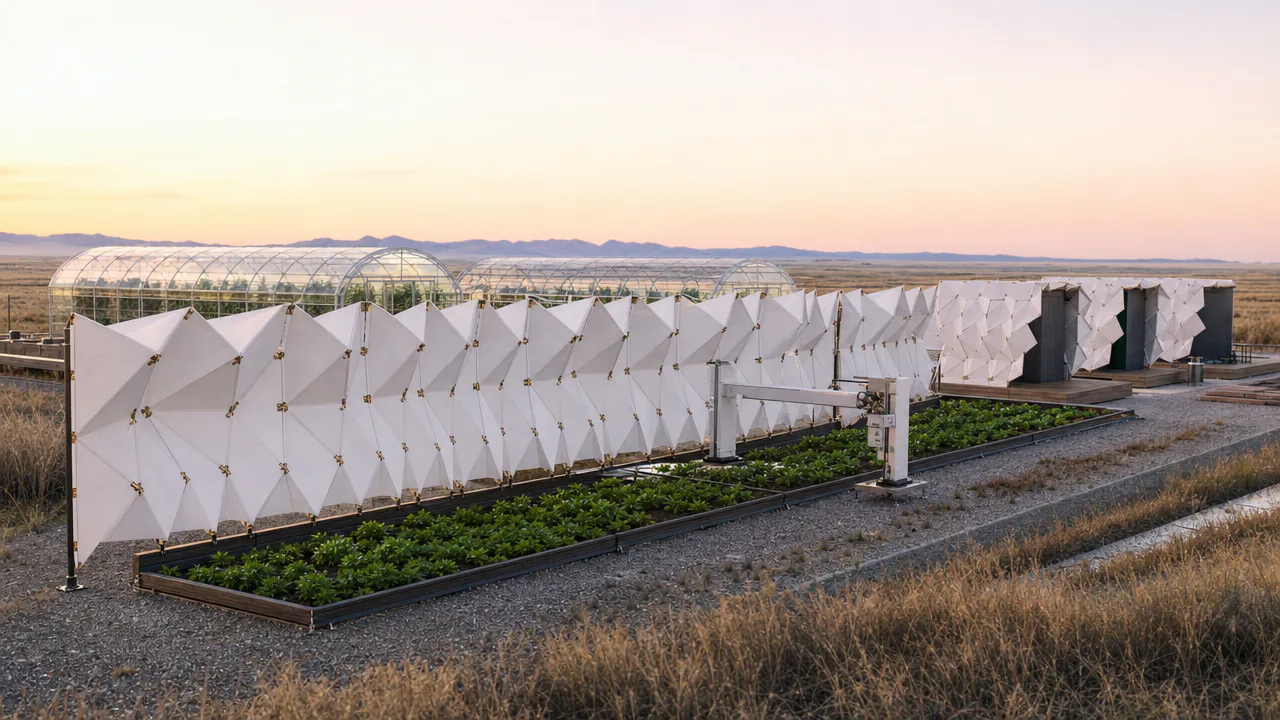
  • MIURA PV wings + BYOBU vertical bifacial fences
  • CO2 heat pump charging a 300-500 L insulated water…
  • +5
How it works · 9 steps · 5 parts
  1. ENVELOPE FIRST: the configurator picks panel class, kotatsu table, heated sleeping platform and HRV before any PV is sized, and plans a winter deficit at high latitude rather than a surplus.
  2. GENERATE: MIURA wings over the engawa (about 4.5 kWp after facet, hinge and frame packing losses) and BYOBU vertical bifacial fences (snow-shedding, albedo gain); micro-hydro or small HAWT only as measured-site bonuses.
  3. DISTRIBUTE: MPPTs feed a 48-60 V bus running in the floor cassettes to JO-PORT DC islands; point-of-load converters replace inverter stages; heavy loads stay within the house DC budget or move to 380 V DC or AC.
  4. STORE ELECTRICITY: LFP inside the heated envelope for daily cycling; a 2-5 kWh sodium-ion bank in the unheated vestibule carries keep-alive loads (comms, sensors) down to its rated discharge floor so a heat-loss event never bricks the system.
  5. STORE HEAT (default): surplus PV runs a CO2 heat pump into a 300-500 L insulated water tank, about 23 kWh thermal from about 8 kWh of PV at COP about 3.
  6. STORE HEAT (optional hearth): a 0.4-0.6 t sand or soapstone radiant hearth, core at or below 250 C, with 150 mm microporous insulation and a rockwool jacket, about 25 kWh thermal, a 12-24 h buffer. It stands on a dedicated pier or slab pad rated at least 10 kPa, off the floor cassettes; touchable faces stay at or below 45 C (ISO 13732-1); a summer vent or bypass dumps heat outside; fire separation as for a stove.
  7. HEAT AND COOL: CO2 heat pump makes 70 C water; HRV with frost pre-heat; radiative-cooled roofs, windcatcher and night-sky radiator cool hot sites.
  8. PRIORITISE: firmware ladder - life safety (CO/CO2, smoke, comms) > water treatment > food (cold store, farm) > heat to people > comfort > guest extras - with forecast-driven load shifting.
  9. OPERATE: Venus OS + Home Assistant run locally; MQTT telemetry over Starlink feeds the fleet dashboard; the site runs without the cloud.
PartMaterialSpec
DENCHI cabinetLFP 20-40 kWh + Na-ion 2-5 kWh1/2 jo, Victron-class inverter/charger; installed cost about USD 4-16k at 200-400/kWh
Heat-pump tankCO2 heat pump + 300-500 L insulated tankabout 23 kWh thermal at 40 K swing
IRORI hearth (optional)Steel plinth, 150 mm microporous + rockwool jacket, 0.4-0.6 t sand or soapstonecore <= 250 C; on pier >= 10 kPa; touch faces <= 45 C
MIURA-W wingRigid PV facets26.5 m2, about 4.5 kWp
ControllerCerbo GX or Raspberry Pi + Home Assistantlocal-first, MQTT

12-month prototype Test hut in a cold climate with DC spine, LFP + Na-ion zoning, kotatsu table and heated platform, and an A/B of a 0.5 t radiant hearth against a heat-pump water tank.

Pass Hearth uncontrolled release within 20% of the calculated value (about 14%/day) and touch faces <= 45 C; >= 15% heating energy reduction at equal comfort votes; comms and sensors alive 72 h at -20 C on a 2-5 kWh Na-ion bank alone, and the bank reaches >= 80% charge after warming to -15 C.

Kill Hearth loss > 20%/day or useful heat per PV kWh below the tank's: drop the hearth as an energy store and sell it only as a comfort option; the heat-pump tank stays the default.

BOM USD 20,000-45,000

Risks Surface temperature and fire safety of a hot hearth indoors · Floor loading of any thermal mass · Na-ion stationary ecosystem maturity and supply concentration · Winter PV deficit at high latitude

COMMERCIAL components (LFP, Victron, CO2 heat pumps, tanks); EXPERIMENTAL Na-ion stationary integration and the small radiant hearth

Deep dive · Loop →
M09EXPERIMENTAL

TSURU

the service robot that walks on the creases

A 25-35 kg inchworm robot navigates by the building itself - it locks its feet into datum sockets bolted to the ridge beams every 910 mm - so the structure is its map and its fixture for ridge-adjacent tasks such as closing and verifying latches and swapping cartridges.

910mm
datum-socket pitch on the ridge target
3.0cm
ARMADAS foot capture of misalignment measured
≥ 95%
autonomous completion of contracted tasks target
  • NASA ARMADAS lattice-relative inchworm robots
  • Ridge-beam datum sockets at 910 mm pitch with petal…
  • Continuous fall-arrest trolley
  • v2 versioned task contracts and module passports
  • +3
How it works · 10 steps · 6 parts
  1. Every YOSHI ridge, the KURA spine and each farm bay carry a segmented T-slot rail. The rail sits on one panel and is broken at every transverse crease; datum sockets at 910 mm pitch are bolted through to the ridge beam, not to the skin, and have drained, self-cleaning cups.
  2. TSURU is a 5-DoF bipedal inchworm: it locks one foot, swings the other to the next socket and locks again. Each foot is a 2-3 point tapered cone or petal lock with 20-30 mm passive lead-in (after the ARMADAS 3.0 cm petal capture), rated for at least 0.6 kN.m moment and 3 kN fall-arrest load, with lock-confirmation sensing.
  3. Accuracy is local: socket-to-socket error is set by the socket and its lead-in, while hinge play and erection tolerance (several mm per joint) mean building coordinates come from a post-erection survey, not from the robot.
  4. Load case: at full 910 mm swing the robot carries 5-8 kg; the 15 kg payload is handled only in double-stance mode with both feet locked. Joint actuators are sized for at least 400 N.m peak at ankle and hip (M = g x (m_body x L/2 + m_payload x L) x 1.7). Step time is 15-30 s, about 0.03-0.06 m/s.
  5. A continuous fall-arrest trolley runs along every rail TSURU uses outdoors.
  6. Tasks arrive as versioned contracts and are limited to ridge-adjacent work: latch close and verify, hinge thermal scan, filter/UV/sorbent swaps at JO-PORTs, seed-cartridge reload. PV and slope washing go to a separate brush crawler or to people.
  7. TSURU is ferried by a person between modules; one robot serves one contiguous rail network.
  8. Ground and cluster tasks use a rented legged inspector or a farm utility rover on scheduled service visits; cartridges of up to 65 kg can arrive routinely by drone at roadless sites.
  9. Exceptions escalate to a remote operator over Starlink; anything outside the contract goes to a local human runner.
  10. Renewal: sensor triggers or the shikinen schedule create a swap job; the new organ installs on the twin pad, commissions, and the old one leaves for the micro-factory.
PartMaterialSpec
TSURU bodyCarbon/aluminium links, BLDC joints25-35 kg; 5-8 kg payload at full swing, 15 kg in double stance; 5 DoF; >= 400 N.m peak joints (target)
Foot lock2-3 point tapered cone or petal lock>= 0.6 kN.m moment, >= 3 kN fall-arrest, 20-30 mm lead-in, lock-confirm sensor
SocketStainless cup bolted through to ridge beamdrained, self-cleaning; 910 mm pitch
Tool headsLatch driver, thermal camera, cartridge grippertool changer on foot
Fall-arrest trolleyStainless trolley on railcontinuous along exterior rails
Cable kit (month 12-24)4 winches, Dyneemaindoor bays only; anchors on fixed frames, not folding panels

12-month prototype TSURU v0 on a 7.28 m bench rail and the 3.64 m rail of the M02 half-length test shell, with petal-lock feet, bolted sockets and a continuous fall-arrest trolley. Cable kit moves to month 12-24.

Pass >= 95% autonomous completion; zero dropped payloads; zero failed locks under load; mean task time within 2x the measured human baseline.

Kill < 80% completion after redesign: TSURU becomes a human-carried tool and rails stay as datums; service by local runners.

BOM USD 40,000-80,000 BOM plus about 300,000-500,000 labour (2-3 FTE)

Risks Ice, grit and water in sockets preventing lock · Liability for falls and for people below · Rail continuity across transverse creases · Scope creep toward general-purpose robots

EXPERIMENTAL (TRL 3: lattice-walking robots are indoor prototypes; crease-rail service robot unbuilt)

Deep dive · Robot →
M10EXPERIMENTAL

FLIP-FOLD skin

a louvre facet that switches solar gain by season

A secondary louvre facet that turns white side out in hot weather and black side out in cold, tripped by a wax piston that senses interior air with a wide hysteresis band; a seasonal manual flip is the baseline product and the self-flip is an option.

97.1%
BaSO₄-side solar reflectance (lab, cm scale) measured
≥ 8°C
hysteresis band: white > 26, black < 18 target
≥ 5,000cycles
bench flips before maintenance target
  • Janus BaSO4/carbon facet faces
  • Central-axis louvre pivot with over-centre toggle…
  • Wax-motor or NiTi actuator sensing interior or…
  • Thin EPS/XPS core on heating facets; winter dampers…
  • +3
How it works · 7 steps · 5 parts
  1. Each facet is a louvre on a central-axis pivot, with parallel pivot axes in each row so neighbours do not collide, mounted over the KASANE membrane with a ventilated gap. One face is BaSO4 white (solar absorptance about 0.03), the other carbon black (about 0.94); both faces are high-emissivity in the infrared, so the flip changes only daytime solar gain.
  2. Heating facets have a thin 3-5 mm EPS/XPS stiffening core instead of aerogel, and winter dampers close the gap so it works as a solar air collector feeding the interior. Aerogel is used only on white-only cooling facets.
  3. A commodity wax-cylinder opener or NiTi spring senses interior or gap air through a shaded sensing bulb, never the facet itself. A hysteresis band of at least 8 C (white above 26 C interior, black below 18 C) stops the facet's own state from driving it into a limit cycle.
  4. The actuator does not lift the facet: about 70 N of wax force trips a pre-tensioned over-centre cam and toggle spring that rotate it 180 degrees. A detent or latch rated at least 500 N at the facet edge holds it against wind.
  5. Baseline SKU: a seasonal manual flip twice a year (by hand, or by TSURU where a facet is ridge-adjacent). The self-flipping version is an option.
  6. Farm vaults are ventilated by a wax-motor ridge vent sized at about 15-20% of floor area, with a cold lockout that keeps it shut below 5 C outside. Hygromorph flaps are only a secondary trickle vent.
  7. In summer, the farm-vault glazing (not the opaque facets) gets a chalk-wash coat; at dry sites such as the Atacama a dry brush or minimal-water wash replaces rain washing.
PartMaterialSpec
Janus louvre facetBaSO4 paint / 3-5 mm EPS-XPS core (heating) or aerogel (cooling-only) / carbon-black0.91 x 0.91 m; central pivot
Toggle and wind lockOver-centre cam, toggle spring, detent>= 500 N at facet edge
ActuatorCommodity wax-cylinder opener or NiTi spring with shaded remote bulbabout 70 N; trips cam; >= 8 C hysteresis
Ridge ventWax-motor vent with cold lockoutabout 15-20% of floor area
Hygromorph flap (secondary)Wood-PLA + TPU print, or ASA-based / wood-veneer bilayer10 x 15 cm trickle vent

12-month prototype Twenty 0.83 m2 louvre facets with pivots, toggles and wind locks on two instrumented rooftop rigs (hot-dry and cold sites), plus a bench cycler in a climate chamber.

Pass >= 5,000 bench flips without failure; no wind-driven flips in field; solar reflectance >= 0.90 after 12 months with a monthly dry brush; no limit cycling in field logs.

Kill Mechanism fails < 1,000 bench cycles: ship the seasonal manual-flip SKU only.

BOM USD 15,000-35,000 (facets about USD 150-400 each, 2 rigs about USD 3-6k each with pyranometer and loggers, bench cycler, site logistics)

Risks Soiling and reflectance loss in desert dust · Pivot and toggle fatigue · Wind flutter and back-driving · UV and creep of hygromorph flaps

TRL 2-3 integrated (lab cm-scale Janus membrane, hand-flipped; wax actuators TRL 9; self-flipping 1 m facet unbuilt)

Read the section ↓
M11COMMERCIALPILOTSPECULATIVE

FOLD-TO-ORDER

configurator to micro-factory in 15 working days

Drop a pin and pick farm, hotel or home: the configurator returns a binding kit-and-shipping price plus a capped site-works estimate, a physics-checked litre/kWh/kg balance, a revenue or savings forecast and the cut files that the nearest licensed micro-factory starts after the site survey is approved.

≤ 15days
working days, deposit + survey to shipped kit target
±15%
cap on the site-works estimate target
≤ 20h
engineering per order target
  • Sekisui Heim HAPPS mass-customisation kitting
  • IRC Appendix BB 400 sq ft
  • State modular / factory-built housing certification…
  • Physics coefficients from the sweeps
  • +6
How it works · 9 steps · 3 parts
  1. Site pin: climate record, solar resource, humidity, snow and wind classes, and the local regulatory path (state modular or factory-built program, local appendices, RV/ANSI A119.5 for units on wheels) are looked up.
  2. Typology and size: the customer chooses farm, hotel, home, research station or (for partners) lunar analog. US home SKUs are kept at or below 37.2 m2 by choice, to use the Appendix BB relaxations where a jurisdiction has adopted them; larger homes go through the standard IRC.
  3. A rules engine resolves the order into jo tiles and organs from the fixed catalogue, as HAPPS does for Sekisui Heim.
  4. Balance sheet: water (recycle first), energy (envelope first), food (DLI and m2), nights (ADR and occupancy) shown live.
  5. Structural check: pre-validated FE templates per fold family and load class; occupied units are signed off by a partner engineering firm under an SLA (target 48 h), not a promise to the customer.
  6. A binding kit and shipping price is issued with a capped site-works estimate (+/-15%) for foundation, utilities, access and permit fees; the customer pays a deposit, and the site price is finalised after a site survey.
  7. The 15-working-day clock runs from deposit plus approved site survey to shipped kit; permit approval time is shown separately per jurisdiction.
  8. Cut files, BOM and robot task contracts go to the nearest licensed micro-factory: a containerised kit (1-2 x 40 ft) deployed into a leased shed or tent of about 300-500 m2, certified under the state modular or factory-built program with third-party in-plant inspection; module passports are created.
  9. At commissioning the site twin goes live on the fleet dashboard.
PartMaterialSpec
ConfiguratorWeb app + parametric CAD + rules enginebinding kit price, capped site estimate, forecast
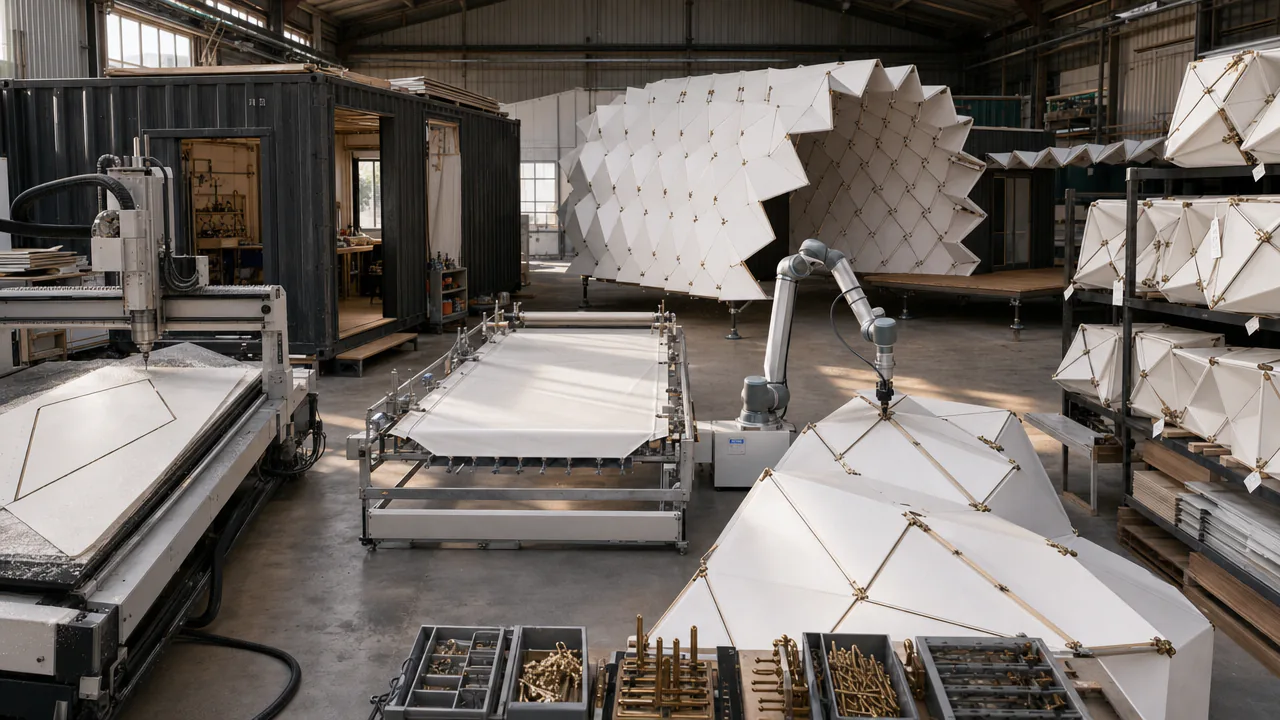
Micro-factory1-2 x 40 ft containerised kit (CNC router, vacuum laminator, cobot) in a leased 300-500 m2 shedlicensed, regional, state-certified
Catalogue21 SKUsone grid, one port

12-month prototype Configurator v0 for three SKUs plus one containerised micro-factory (CNC router, vacuum laminator, one cobot) in a leased shed; pilot on non-occupied SKUs (farm or greenhouse, often exempt as agricultural buildings) or in one pre-approved state.

Pass Each order shipped in <= 15 working days from deposit plus approved survey, BOM error <= 5%, engineering <= 20 h per order, final site works within the +/-15% cap.

Kill > 20 engineering hours per order after the third order, or catalogue SKUs fail a state modular plan review: narrow the catalogue to fixed configurations sold like MUJI Hut.

BOM USD Hardware 150,000-350,000; software and engineering staff about 600,000-1,200,000 (3-5 FTE for 12 months); certification and permits 50,000-150,000

Risks Permit variance across jurisdictions · State modular certification per plant delaying occupied units · Partner micro-factory quality · Configurator promises exceeding physics or site reality

COMMERCIAL: kitting (HAPPS) and CNC kit libraries (WikiHouse); PILOT: licensed robotic micro-factories (AUAR); SPECULATIVE: origami SKUs and the physics-checked configurator

Read the section ↓
M12COMMERCIALEXPERIMENTAL

SHIKINEN twin-pad lease

renewal as recurring revenue

Anyground keeps owning the organs and finances their renewal inside a lease priced by a published capital-recovery formula: a new module is commissioned on the twin pad and cut over in minutes, and every returned part has a measured refurbishment value.

2,310USD/yr
example lease, USD 10k module, 10 %, 5 yr, 20 % residual calculated
≥ 99.9%
water organ availability target
≤ 15min
interruption per planned swap target
  • Ise Jingu 20-year rebuild on an adjacent plot
  • Nakagin Capsule Tower
  • Drake Landing
  • Freight Farms
  • +3
How it works · 8 steps · 6 parts
  1. Each SKU has a published swap cycle (example targets: UV and filters 1 yr, sorbent cassettes 2-3 yr, farm cassettes 5 yr, membranes 10 yr, shell 20 yr).
  2. Telemetry (water quality, energy, strain, latch state, crop health) feeds condition-based triggers.
  3. Water organ swap: the new module is placed on the twin pad, connected to a twin-pad manifold with isolation and bypass valves and dry-break quick connects, flushed and disinfected through a dedicated port, and cut over only when an inline turbidity and chlorine sensor passes.
  4. Battery organ swap: break-before-make through an automatic transfer switch; aged and new packs are never paralleled.
  5. Returned modules go back by reverse logistics, are refurbished at the micro-factory, and are re-leased or resold; refurbishment yield is measured against the residual value assumed in the lease.
  6. Lease price L = C x CRF(r,n) - R x SFF(r,n) + M + Lg, with CRF = r/(1-(1+r)^-n) and SFF = r/((1+r)^n - 1); C is module capex, R residual value, M maintenance, Lg logistics.
  7. In emergencies, modules come from a dedicated surge pool, not from active leases unless the lessee opts in, under agreements set up with the municipality in advance.
  8. Lease contracts include an open-firmware escrow so customer sites run if Anyground fails.
PartMaterialSpec
Twin padSpare JO-PORT tileper critical organ
Twin-pad water manifoldIsolation and bypass valves, dry-break quick connects, flush/disinfect port, inline turbidity/chlorine sensorabout USD 1-3k per pad (estimate)
Battery transfer switchAutomatic transfer switch, break-before-makeno paralleling of aged and new packs
Spare-module pool2 water + 2 battery modules for a 10-unit pilotcosted from M04, M06 and M08
Fleet dashboardHome Assistant/MQTT aggregationcondition-based maintenance
Firmware escrowOpen-source release triggercontractual

12-month prototype Lease about 10 pilot units with telemetry and twin pads for water and battery organs, plus a spare pool of 2 water and 2 battery modules; run at least 2 deliberate full-organ swaps per unit (one water, one battery), swapping early on purpose.

Pass (M + Lg) <= 15% of L; actual refurbishment yield >= the assumed residual R; water availability >= 99.9% and battery >= 99.5%; planned swaps within the interruption target.

Kill (M + Lg) > 25% of L, or refurbishment yield < 50% of R: sell hardware outright with an optional service plan.

BOM USD 40,000-90,000 for telemetry, contracts and firmware escrow; spare-module pool and logistics listed separately and costed from M04, M06 and M08

Risks Balance-sheet intensity of owning hardware (cost of capital dominates) · Reverse-logistics cost per swap at distributed sites · Too few failure events in a small pilot to estimate availability · Customer preference to own

COMMERCIAL model elements (product-as-a-service, maintenance-inclusive leasing, OpCo/PropCo); EXPERIMENTAL as a lease for small distributed habitat organs

Read the section ↓
M13SPECULATIVE

TSUKI outpost

the same grammar with the pressure boundary moved inside

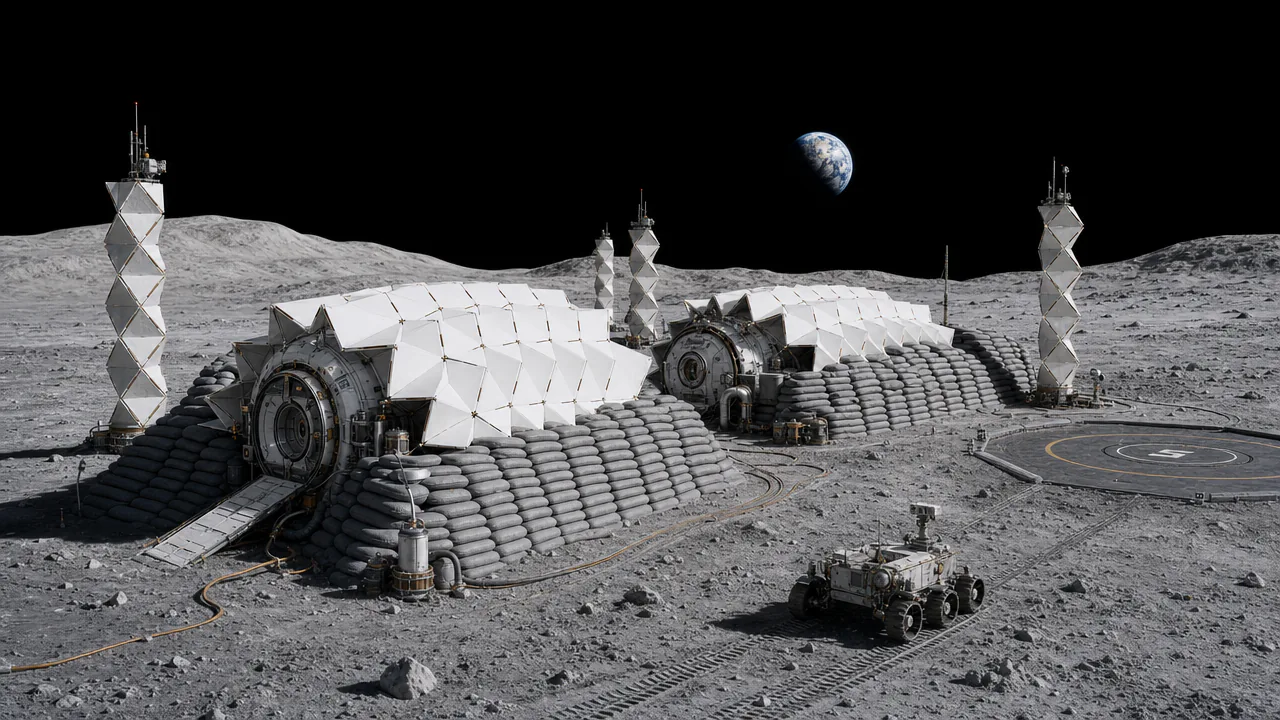
On the Moon a new domed pressure head carries the KURA systems layout, a softgoods bladder with a woven restraint carries pressure, and a YOSHI rigid-panel shell outside carries regolith bags; Earth analogs de-risk layout, human factors, operations and power/water integration, not flight hardware.

714kN
axial end-cap load, 3 m at 101 kPa calculated
3.9kPa
regolith load on the Moon (23.5 on Earth) calculated
30days
crewed Earth analog target
  • ILC Dover hybrid rigid end-cap + softgoods mid-section
  • Max Space / Sierra Space restraint-layer habitats
  • SAGA LUNARK origami habitat
  • Inflatable bistable Kresling lunar towers
  • +5
How it works · 8 steps · 4 parts
  1. A rigid domed (torispherical) pressure head with a hatch cut-out carries the KURA systems layout - ECLSS, water, power and the stowed softgoods bladder (X-Hab architecture). It is a new pressure vessel, not KURA box geometry.
  2. The bladder is deployed and pressurised between two end-caps; a Vectran-class woven restraint layer carries hoop load, and longitudinal straps carry the axial end-cap load F = p x pi x r^2 into a ring frame at each head (about 714 kN at 101 kPa or 400-500 kN at 56-70 kPa for a 3 m diameter).
  3. Softgoods are certified to NASA practice: burst at least 4x the maximum design pressure (e.g. 4 x 15.2 = 60.8 psi).
  4. A YOSHI rigid-panel shell with lockable hinges deploys over it as a regolith-bag carrier and micrometeoroid/thermal layer, not as a pressure vessel; it is sized for about 3.9 kPa of lunar shielding load.
  5. Robotic pads and berms are laser-sintered from regolith (ICON LVMT) before crew arrival.
  6. A source-agnostic power brick (DC bus + hydronic loop) accepts a 10 kWe fission unit; on Earth the same brick is tested with PV and a basalt-gravel thermal store.
  7. Sealed HATA cassettes and algae/duckweed shelves close part of the food and gas loop; ISS/Lunar Palace-class water closure needs urine processing (vapour-compression distillation plus brine processing).
  8. Circadian lighting and fractal-patterned kumiko interiors address the 14-day night and isolation.
PartMaterialSpec
Pressure headAluminium-lithium or composite, domedKURA systems layout, new pressure head; ring frame for axial straps
Bladder + restraintVectran or UHMWPE webbing, multilayer softgoodspartner-supplied; burst >= 4x MDP
Outer shellYOSHI facets with lockable hinges, regolith bagsnon-pressure; about 3.9 kPa lunar shielding load
Power brickDC bus + hydronic loop1-10 kWe class

12-month prototype Two separate partner-funded test articles. (A) Uncrewed pressure article: a sub-scale bladder with Vectran or UHMWPE webbing restraint (not drop-stitch) between two domed end-caps. (B) Crewed 30-day unpressurised analog: KURA core, YOSHI shell with lockable hinges and about 0.25 m of sandbags (lunar-equivalent load), testing water loop, power brick and wellbeing.

Pass (A) leak rate <= 0.1-0.2% of volume per day and burst >= 4x MDP. (B) total water recovery = recovered potable mass / total wastewater mass incl. urine, greywater and condensate >= 85% without urine processing (>= 93% if a urine distiller is included); no crew-safety incidents.

Kill Not a company-funded line: continues only with partner or grant funding.

BOM USD 250,000-600,000 for (B) with COTS ECLSS; plus about 100,000-250,000 for (A) test-facility time and webbing fabrication (partner/grant funded)

Risks No flight heritage; Earth analogs reach TRL 3-4 for layout and operations only · Pressure-vessel redesign and softgoods certification · Regulatory and launch dependence · Distraction from Earth revenue

SPECULATIVE

Read the section ↓
陽M10 FLIP-FOLD skin

A facet that turns white in summer, black in winter — by itself.

A secondary louvre facet that turns white side out in hot weather and black side out in cold, tripped by a wax piston that senses interior air with a wide hysteresis band; a seasonal manual flip is the baseline product and the self-flip is an option.

EXPERIMENTAL
Janus louvre facets on a vault: some turned white, some black, bronze pivots and togglesI18 · Janus flip facets
I18Seasonal louvre facets over the KASANE membrane, bronze pivots on a central axis.Concept visual · AI

Why it works

Both faces are high-emissivity in the infrared, so at night they radiate the same. Only daytime solar gain changes: BaSO4 white absorbs about 3 %, carbon black about 94 %. The facet never lifts itself — 70 N of wax force trips a pre-tensioned over-centre spring that does the 180°.

BaSO₄-side solar reflectance (lab, cm scale) measured
97.1%
hysteresis band: white > 26, black < 18 target
≥ 8°C
bench flips before maintenance target
≥ 5,000cycles
Fig. M10 · FLIP-FOLDJanus louvre facet, 0.91 × 0.91 m
Interior22.0 °C
Face outBlack
Solar gain752 W/m²
SunlightAbsorbed → gap airReflected sunlightSensing bulb line

Drag to orbit · click a part · click the canvas, then scroll to zoom

Absorbed by facet calculated
624W

α × G × 0.83 m² facet; white α ≈ 0.03, black α ≈ 0.94.

Wax piston target
0N of 70

Trips the cam; the toggle spring does the work.

Flips this session
0

Field estimate 300–700 a year calculated

8 °C36 °Cinterior air at the sensing bulb whiteblack ≥ 8 °C hysteresis band flips white at 26 °Cflips black at 18 °C
The sensing bulb reads interior or gap air in shade — never the facet — and the 8 °C band means the facet’s own state cannot chatter it back and forth. The seasonal hand flip is the baseline product; the self-flip is the option.

How it works

  1. 01

    Each facet is a louvre on a central-axis pivot, with parallel pivot axes in each row so neighbours do not collide, mounted over the KASANE membrane with a ventilated gap. One face is BaSO4 white (solar absorptance about 0.03), the other carbon black (about 0.94); both faces are high-emissivity in the infrared, so the flip changes only daytime solar gain.

  2. 02

    Heating facets have a thin 3-5 mm EPS/XPS stiffening core instead of aerogel, and winter dampers close the gap so it works as a solar air collector feeding the interior. Aerogel is used only on white-only cooling facets.

  3. 03

    A commodity wax-cylinder opener or NiTi spring senses interior or gap air through a shaded sensing bulb, never the facet itself. A hysteresis band of at least 8 C (white above 26 C interior, black below 18 C) stops the facet's own state from driving it into a limit cycle.

  4. 04

    The actuator does not lift the facet: about 70 N of wax force trips a pre-tensioned over-centre cam and toggle spring that rotate it 180 degrees. A detent or latch rated at least 500 N at the facet edge holds it against wind.

  5. 05

    Baseline SKU: a seasonal manual flip twice a year (by hand, or by TSURU where a facet is ridge-adjacent). The self-flipping version is an option.

  6. 06

    Farm vaults are ventilated by a wax-motor ridge vent sized at about 15-20% of floor area, with a cold lockout that keeps it shut below 5 C outside. Hygromorph flaps are only a secondary trickle vent.

  7. 07

    In summer, the farm-vault glazing (not the opaque facets) gets a chalk-wash coat; at dry sites such as the Atacama a dry brush or minimal-water wash replaces rain washing.

Parts · also the non-WebGL fallback

PartMaterialSpec
Janus louvre facetBaSO4 paint / 3-5 mm EPS-XPS core (heating) or aerogel (cooling-only) / carbon-black0.91 x 0.91 m; central pivot
Toggle and wind lockOver-centre cam, toggle spring, detent>= 500 N at facet edge
ActuatorCommodity wax-cylinder opener or NiTi spring with shaded remote bulbabout 70 N; trips cam; >= 8 C hysteresis
Ridge ventWax-motor vent with cold lockoutabout 15-20% of floor area
Hygromorph flap (secondary)Wood-PLA + TPU print, or ASA-based / wood-veneer bilayer10 x 15 cm trickle vent

12-month prototype

Build
Twenty 0.83 m2 louvre facets with pivots, toggles and wind locks on two instrumented rooftop rigs (hot-dry and cold sites), plus a bench cycler in a climate chamber.
Test
Bench: heat-lamp cycling every 20 min at -30 C and +60 C for 5,000 cycles. Field: 12 months of state, delta-T, interior heat gain, soiling and reflectance logging.
Pass
>= 5,000 bench flips without failure; no wind-driven flips in field; solar reflectance >= 0.90 after 12 months with a monthly dry brush; no limit cycling in field logs.
Kill
Mechanism fails < 1,000 bench cycles: ship the seasonal manual-flip SKU only.
BOM
USD 15,000-35,000 (facets about USD 150-400 each, 2 rigs about USD 3-6k each with pyranometer and loggers, bench cycler, site logistics)
選M11 FOLD-TO-ORDER

From a pin on a map to cut files in fifteen working days.

Drop a pin and pick farm, hotel or home: the configurator returns a binding kit-and-shipping price plus a capped site-works estimate, a physics-checked litre/kWh/kg balance, a revenue or savings forecast and the cut files that the nearest licensed micro-factory starts after the site survey is approved.

COMMERCIALPILOTSPECULATIVE
  1. 1Drop a pin

    Site pin: climate record, solar resource, humidity, snow and wind classes, and the local regulatory path (state modular or factory-built program, local appendices, RV/ANSI A119.5 for units on wheels) are looked up.

  2. 2Pick typology and size

    Typology and size: the customer chooses farm, hotel, home, research station or (for partners) lunar analog. US home SKUs are kept at or below 37.2 m2 by choice, to use the Appendix BB relaxations where a jurisdiction has adopted them; larger homes go through the standard IRC.

  3. 3Rules engine resolves jo tiles

    A rules engine resolves the order into jo tiles and organs from the fixed catalogue, as HAPPS does for Sekisui Heim.

  4. 4Live balance sheet

    Balance sheet: water (recycle first), energy (envelope first), food (DLI and m2), nights (ADR and occupancy) shown live.

  5. 5Structural check

    Structural check: pre-validated FE templates per fold family and load class; occupied units are signed off by a partner engineering firm under an SLA (target 48 h), not a promise to the customer.

  6. 6Binding kit price

    A binding kit and shipping price is issued with a capped site-works estimate (+/-15%) for foundation, utilities, access and permit fees; the customer pays a deposit, and the site price is finalised after a site survey.

  7. 7The 15-day clock

    The 15-working-day clock runs from deposit plus approved site survey to shipped kit; permit approval time is shown separately per jurisdiction.

  8. 8Nearest micro-factory

    Cut files, BOM and robot task contracts go to the nearest licensed micro-factory: a containerised kit (1-2 x 40 ft) deployed into a leased shed or tent of about 300-500 m2, certified under the state modular or factory-built program with third-party in-plant inspection; module passports are created.

  9. 9Commissioning

    At commissioning the site twin goes live on the fleet dashboard.

Step 3, live · the rules engine resolves a typology into organs

Default modules per typology from the catalogue; quantities and capex are illustrative. Build your own in the configurator.

Open the configurator →
A containerised micro-factory in a leased shed: CNC router, vacuum laminator and a cobot folding white facetsI16 · Micro-factory
I161–2 × 40 ft containerised kit in a 300–500 m² leased shed: CNC router, vacuum laminator, cobot.Concept visual · AI
working days, deposit + survey to shipped kit target
≤ 15days
cap on the site-works estimate target
±15%
engineering per order target
≤ 20h
Ingredients, prototype and risks
  • Sekisui Heim HAPPS mass-customisation kitting
  • IRC Appendix BB 400 sq ft (37.2 m2) relaxation threshold (optional, locally adopted) as a product choice
  • State modular / factory-built housing certification per plant
  • Physics coefficients from the sweeps (water, energy, food, nights)
  • Parametric origami shelter to CNC drawings research
  • WikiHouse open CNC file library
  • AUAR-style containerised micro-factory kits deployed into a leased shed
  • Dvele anti-pattern (opaque price)
  • Glamping ADR benchmarks
  • Japanese catalogue + IKEA flat-pack

Risks Permit variance across jurisdictions · State modular certification per plant delaying occupied units · Partner micro-factory quality · Configurator promises exceeding physics or site reality

Build
Configurator v0 for three SKUs plus one containerised micro-factory (CNC router, vacuum laminator, one cobot) in a leased shed; pilot on non-occupied SKUs (farm or greenhouse, often exempt as agricultural buildings) or in one pre-approved state.
Test
Three paying pilot orders end-to-end; BOM error, lead time, engineering hours per order, site-estimate error after survey; one state modular plan review of a catalogue SKU.
Pass
Each order shipped in <= 15 working days from deposit plus approved survey, BOM error <= 5%, engineering <= 20 h per order, final site works within the +/-15% cap.
Kill
> 20 engineering hours per order after the third order, or catalogue SKUs fail a state modular plan review: narrow the catalogue to fixed configurations sold like MUJI Hut.
BOM
USD Hardware 150,000-350,000; software and engineering staff about 600,000-1,200,000 (3-5 FTE for 12 months); certification and permits 50,000-150,000
新M12 SHIKINEN twin-pad lease

Ise rebuilds its shrine every twenty years. We lease the renewal.

Anyground keeps owning the organs and finances their renewal inside a lease priced by a published capital-recovery formula: a new module is commissioned on the twin pad and cut over in minutes, and every returned part has a measured refurbishment value.

COMMERCIALEXPERIMENTAL

Twenty years of one site · example swap cycles target

Year 05101520UV lamp + filtersswap every 1 yr20×Sorbent cassettesswap every 2–3 yr8×Farm cassettesswap every 5 yr4×Membranesswap every 10 yr2×Shellswap every 20 yr1×Ise Jingu precedent: the shrine is rebuilt on the adjacent plot every 20 years (reported)

Scrub the year: swaps so far 0.

The twin-pad swap · water organ

PAD A · in service PAD B · twin pad MIZU-1MIZU-1 flush port NTU·Cl to KURAbypass reverse logistics → refurbish → re-lease
  1. 1

    Place

    The new module lands on the twin pad, a spare JO-PORT tile beside the one in service.

  2. 2

    Connect

    Dry-break quick connects; isolation valve B stays shut.

  3. 3

    Flush and disinfect

    Through a dedicated port, never through the house line.

  4. 4

    Verify

    Inline turbidity and chlorine must pass before anything opens.

  5. 5

    Cut over

    Bypass held open: B opens, A closes. Interruption target zero for water.

  6. 6

    Return

    The old module goes back by reverse logistics, is refurbished and re-leased — its yield is measured against the residual R.

The lease, priced in the open

L = C·CRF(r,n) − R·SFF(r,n) + M + Lg

Lease L calculated
2,310USD / yr

Matches the worked example: USD 10k, 10 %, 5 yr, 20 % residual → about 2,310 a year before maintenance and logistics.

pass 15 %kill 25 %

(M + Lg) / L = 0 % · the pilot passes at ≤ 15 % and is killed above 25 %.

CRF
0.2638
SFF
0.1638

How it works

  1. 01

    Each SKU has a published swap cycle (example targets: UV and filters 1 yr, sorbent cassettes 2-3 yr, farm cassettes 5 yr, membranes 10 yr, shell 20 yr).

  2. 02

    Telemetry (water quality, energy, strain, latch state, crop health) feeds condition-based triggers.

  3. 03

    Water organ swap: the new module is placed on the twin pad, connected to a twin-pad manifold with isolation and bypass valves and dry-break quick connects, flushed and disinfected through a dedicated port, and cut over only when an inline turbidity and chlorine sensor passes.

  4. 04

    Battery organ swap: break-before-make through an automatic transfer switch; aged and new packs are never paralleled.

  5. 05

    Returned modules go back by reverse logistics, are refurbished at the micro-factory, and are re-leased or resold; refurbishment yield is measured against the residual value assumed in the lease.

  6. 06

    Lease price L = C x CRF(r,n) - R x SFF(r,n) + M + Lg, with CRF = r/(1-(1+r)^-n) and SFF = r/((1+r)^n - 1); C is module capex, R residual value, M maintenance, Lg logistics.

  7. 07

    In emergencies, modules come from a dedicated surge pool, not from active leases unless the lessee opts in, under agreements set up with the municipality in advance.

  8. 08

    Lease contracts include an open-firmware escrow so customer sites run if Anyground fails.

Precedents and parts

  • Ise Jingu 20-year rebuild on an adjacent plot (shikinen sengu)
  • Nakagin Capsule Tower (designed for replacement, never financed)
  • Drake Landing (C$1-2M repair, no renewal financing, original collector maker no longer making the panels)
  • Freight Farms (vendor-cloud failure)
  • WOTA disaster deployments from a dedicated fleet
  • Twin-pad water manifold and battery automatic transfer switch
  • AutoCamp OpCo/PropCo
example lease, USD 10k module, 10 %, 5 yr, 20 % residual calculated
2,310USD/yr
water organ availability target
≥ 99.9%
interruption per planned swap target
≤ 15min

12-month prototype

Build
Lease about 10 pilot units with telemetry and twin pads for water and battery organs, plus a spare pool of 2 water and 2 battery modules; run at least 2 deliberate full-organ swaps per unit (one water, one battery), swapping early on purpose.
Test
12 months of scheduled, condition-based and deliberate swaps; measure cut-over time, crew-hours, truck-km and refurbishment cost per returned module.
Pass
(M + Lg) <= 15% of L; actual refurbishment yield >= the assumed residual R; water availability >= 99.9% and battery >= 99.5%; planned swaps within the interruption target.
Kill
(M + Lg) > 25% of L, or refurbishment yield < 50% of R: sell hardware outright with an optional service plan.
BOM
USD 40,000-90,000 for telemetry, contracts and firmware escrow; spare-module pool and logistics listed separately and costed from M04, M06 and M08
月M13 TSUKI outpost

Same grammar on the Moon — with the pressure boundary moved inside.

On the Moon a new domed pressure head carries the KURA systems layout, a softgoods bladder with a woven restraint carries pressure, and a YOSHI rigid-panel shell outside carries regolith bags; Earth analogs de-risk layout, human factors, operations and power/water integration, not flight hardware.

SPECULATIVE
Lunar outpost: two folded vaults under regolith sandbags with domed pressure heads, Kresling masts and a sintered landing pad, Earth in the black skyI15 · Lunar outpost
I15Concept only. Earth analogs de-risk layout, operations, power and water — not flight hardware.Concept visual · AI
F = 714 kNN = 152 kN/m10 kWe fission PV + basalt store1234567891011 Ø 3.0 m
Axial end-cap load F = p·π·r² calculated
714kN

Carried by longitudinal straps into a ring frame at each head (r = 1.5 m).

Hoop load N = p·r calculated
152kN/m

Taken by the woven restraint, not the bladder.

Burst ≥ 4 × MDP target calculated
58.6psi

Here MDP is taken as the selected cabin pressure. NASA practice; the concept example is 4 × 15.2 psi MDP = 60.8 psi.

Regolith load on the shell calculated
3.9kPa

1.5 m of bags at 1,600 kg/m³ under lunar gravity.

  1. Pressure head — new domed vessel carrying the KURA systems layout and the hatch.
  2. Ring frame — collects the axial strap load at each head.
  3. Softgoods bladder — the pressure boundary, now inside.
  4. Woven restraint — Vectran-class webbing carries hoop load.
  5. Longitudinal straps — carry F = p·π·r² head to head.
  6. YOSHI rigid shell — lockable hinges; a regolith-bag carrier and micrometeoroid / thermal layer, never a pressure vessel.
  7. Regolith bags — 1.5 m on the Moon; 0.25 m of sand gives the same load on Earth.
  8. Sintered pad — laser-sintered from regolith before crew arrive.
  9. Power brick — DC bus + hydronic loop; fission on the Moon, PV + basalt store on Earth.
  10. Sealed HATA cassettes and algae / duckweed shelves close part of the food and gas loop.
  11. Circadian light, kumiko interiors — for the 14-day night and isolation.

How it works

  1. 01

    A rigid domed (torispherical) pressure head with a hatch cut-out carries the KURA systems layout - ECLSS, water, power and the stowed softgoods bladder (X-Hab architecture). It is a new pressure vessel, not KURA box geometry.

  2. 02

    The bladder is deployed and pressurised between two end-caps; a Vectran-class woven restraint layer carries hoop load, and longitudinal straps carry the axial end-cap load F = p x pi x r^2 into a ring frame at each head (about 714 kN at 101 kPa or 400-500 kN at 56-70 kPa for a 3 m diameter).

  3. 03

    Softgoods are certified to NASA practice: burst at least 4x the maximum design pressure (e.g. 4 x 15.2 = 60.8 psi).

  4. 04

    A YOSHI rigid-panel shell with lockable hinges deploys over it as a regolith-bag carrier and micrometeoroid/thermal layer, not as a pressure vessel; it is sized for about 3.9 kPa of lunar shielding load.

  5. 05

    Robotic pads and berms are laser-sintered from regolith (ICON LVMT) before crew arrival.

  6. 06

    A source-agnostic power brick (DC bus + hydronic loop) accepts a 10 kWe fission unit; on Earth the same brick is tested with PV and a basalt-gravel thermal store.

  7. 07

    Sealed HATA cassettes and algae/duckweed shelves close part of the food and gas loop; ISS/Lunar Palace-class water closure needs urine processing (vapour-compression distillation plus brine processing).

  8. 08

    Circadian lighting and fractal-patterned kumiko interiors address the 14-day night and isolation.

Ingredients

  • ILC Dover hybrid rigid end-cap + softgoods mid-section
  • Max Space / Sierra Space restraint-layer habitats
  • SAGA LUNARK origami habitat (unpressurised analog)
  • Inflatable bistable Kresling lunar towers
  • ICON Olympus LVMT laser regolith pads
  • Kilopower 1-10 kWe fission
  • Lunar Palace 1 bioregenerative loop
  • LUNARK circadian light + fractal interiors
  • Source-agnostic power brick (basalt thermal store on Earth)
axial end-cap load, 3 m at 101 kPa calculated
714kN
regolith load on the Moon (23.5 on Earth) calculated
3.9kPa
crewed Earth analog target
30days

Partner-funded prototype

Build
Two separate partner-funded test articles. (A) Uncrewed pressure article: a sub-scale bladder with Vectran or UHMWPE webbing restraint (not drop-stitch) between two domed end-caps. (B) Crewed 30-day unpressurised analog: KURA core, YOSHI shell with lockable hinges and about 0.25 m of sandbags (lunar-equivalent load), testing water loop, power brick and wellbeing.
Test
(A) hydrostatic or pneumatic burst targeting 4x MDP; 24-72 h leak-decay at MDP. (B) 30-day crewed stay with daily weighed water mass balance and crew wellbeing logs.
Pass
(A) leak rate <= 0.1-0.2% of volume per day and burst >= 4x MDP. (B) total water recovery = recovered potable mass / total wastewater mass incl. urine, greywater and condensate >= 85% without urine processing (>= 93% if a urine distiller is included); no crew-safety incidents.
Kill
Not a company-funded line: continues only with partner or grant funding.
BOM
USD 250,000-600,000 for (B) with COTS ECLSS; plus about 100,000-250,000 for (A) test-facility time and webbing fabrication (partner/grant funded)