Water from night air.
Sized for the residual.
Recycle every litre you can. Then pull only what is lost — and what you drink — out of the desert night: sorbent beds load in the dark, a sealed morning chamber gives the water back to a night-cooled condenser, and four barriers make it safe.
Most of the water is never made. It comes back.
A desert harvester that makes all of a household’s water from air would be enormous. KUMO is sized only for the residual: the few per cent the MIZU water organ cannot return, plus what people drink and cook with.
Water-conserving household.
In desert conditions; vendor states up to 97 % with rain make-up.
What the night air has to supply.
One rack, one day, nine moves.
A KUMO-12 rack on one jo tile, its glazed collector, the Miura condenser wing, the sump, the treatment train and a KRES-7 mast — every pipe drawn where it runs. Play the day, or pull it apart: explode the rack, cut it in half, click any part.
Drag to orbit · right-drag to pan · click a part · click, then scroll to zoom
- 01Size for the residual 24 hThe configurator computes harvest = people x (demand x (1 - net recovery) + 2-3 L drinking and cooking), with demand 60-100 L/person/day (water-conserving) and 90-95% net recovery in desert conditions, giving about 5-13 L/person/day. Yield per kg is taken from single-cycle passive data, not lab multi-cycle data.
- 02Night capture 22:00–06:00Rack louvres open and low-power DC fans pull air through the sorbent beds - CaCl2-hydrogel composite or MOF-303 bonded to folded copper lamellae (v2 cassette). The rack runs one cycle per day; shaded daytime desert air (5-15% RH) is below the MOF-303 uptake step, so there is no daytime capture.
- 03Morning release 07:00–11:00The beds are shuttered into a sealed chamber and heated by a glazed solar-thermal collector loop; PV-T backsheet heat is used only as preheat or for CaCl2 composites. The governing check is p_sat(T_cond) / p_sat(T_bed) <= 0.1 for MOF-303 (e.g. condenser 25 C and bed about 70 C) or <= 0.2-0.25 for CaCl2 (bed about 55-60 C at a 25 C condenser). A DC trim heater fills cloudy-morning gaps.
- 04Condense 07:30–11:00Vapour goes to a condenser backed by night-cooled thermal mass or ground-coupled water that is separate from the potable tank, with a radiative-cooling coating on its shaded face; condensate drips into a weighed sump. Condenser temperature and the residual sorbent loading at the end of each release are logged.
- 05Verify 11:00Conductivity, turbidity and temperature are logged; water defaults to the grey loop until in specification.
- 06Purify 11:10Activated-carbon polish, then a calcite/dolomite mineral cartridge with CO2 dosing from a food-grade cylinder, then UV-C LED at 265-280 nm, then a chlorine residual for storage. Lithium checks apply only if a LiCl sorbent is used.
- 07Store 11:20Food-grade bladder in the base cells of the KRES mast (3-6 m gravity head) with a radiative-cooled top.
- 08Distribute any hourGravity to JO-PORT potable islands; DC booster pump; UV ring at each tap as the final barrier.
- 09Fallback alwaysFog-mesh skin on coastal deserts and ridges, a commercial hydropanel or AWG, or a truck fill port; the harvester never carries life safety alone.
Part index · 86 parts in ten subsystems
Click a name to find it in the model. Specs marked target are Anyground design targets; output numbers are calculated from single-cycle passive yields.
Rack & air path14
Sorbent cassettes12
Release chamber9
Solar-thermal loop11
Condenser & cold mass10
Sump & verification8
Purification train8
KRES mast storage6
Distribution5
Site & fallback3
A drawer of folded copper that breathes once a day.
Each of the twelve cassettes holds 2 kg of sorbent bonded to a folded copper lamella. The folds make long open channels for night air and put a heated tube under every fold for the morning.
Drag to orbit · click a layer
2 kg × yield per kg per cycle, at the loading shown.
Set by the condenser and bed temperatures in section 04.
- Night. Louvres open, fans pull air along every channel; the coat loads and darkens. Shaded daytime air at 5–15 % RH sits below the MOF-303 uptake step, so there is no daytime capture.
- Morning. The rack is shuttered into a sealed chamber. Hot fluid from the glazed collector runs the tubes; vapour leaves for the condenser and the coat dries back.
Water leaves the bed only if the condenser is cold enough relative to it.
During release the bed “sees” the vapour pressure of the condenser. If psat(Tcond) / psat(Tbed) sits below the sorbent’s uptake step, the bed gives its water up. That is why release happens in the cool morning against a night-chilled mass — not at noon.
psat(Tcond) / psat(Tbed) — e.g. 3.17 kPa / 31.2 kPa = 0.10 at 25 °C / 70 °C.
≤ 0.1 MOF-303 · ≤ 0.2–0.25 CaCl₂ composite.
A 35–42 °C midday condenser would need an 85–95 °C bed.
Loaded at night minus left after release, as a share of the step.
Chart B is a shape, not a measured isotherm: MOF-303 is drawn with its sharp uptake step just above the 0.1 release ratio and above shaded daytime desert air; the CaCl₂ composite takes water up gradually. The 0.1 and 0.2–0.25 limits, the 2–4 kWhth/L and every yield come from the concept’s verified numbers.
How many racks, how much sun.
The configurator’s formula, live. Yields are single-cycle passive figures, not lab multi-cycle data — the same model drives the readouts in the 3D figure above.
L per kg sorbent per day. MOF-801 Arizona and MOF-303 real-desert figures are measured; the CaCl₂-hydrogel range must be measured on the KUMO-2 bench.
Harvest needed
34L/day
8.5 L per person · 9.7× smaller than making all 330 L/day from air calculated
7.2 L/day per rack = 24 kg × yield · each rack 0.91 × 1.82 m, one jo tile
2.7 kWhth/L = 0.8 kWh/L ÷ efficiency
13 m² per person · 31 jo tiles
Fans 7.2 + MIZU ≤ 9.6 (1 unit at rated 400 W)
2,000 L ÷ daily harvest
Refrigeration AWG for comparison: about 0.3 kWh/L at 26.7 °C / 60 % RH — 10 kWh/day here — but it stops below 30–35 % RH, which is most desert nights. Collector yield uses the PV-T backsheet figure (7 kWh/m²/day × 0.2–0.3) as the concept does; the glazed collector’s real yield is a KUMO-2 measurement.
Condensate is nearly pure. That is the problem — and the start.
Water from air carries no minerals and can carry dust or salt from the bed. It is weighed and logged, kept on the grey loop until in specification, then polished, remineralised, disinfected and stored with a residual. The tap adds a last UV barrier.
- 01Weighed sumpL per cycle → L/kg/day
- 02Sensor gateconductivity · turbidity · temperature; grey until in spec
- 03Activated carbonpolish
- 04Calcite / dolomite + CO₂food-grade; refill 6–12 months target
- 05UV-C LED265–280 nm · DC, a few watts
- 06Chlorine residualfor storage
- 07KRES-7 bladder~2,000 L · radiative-cooled top calculated
- 08JO-PORT → tap UV ringgravity + DC booster · final barrier
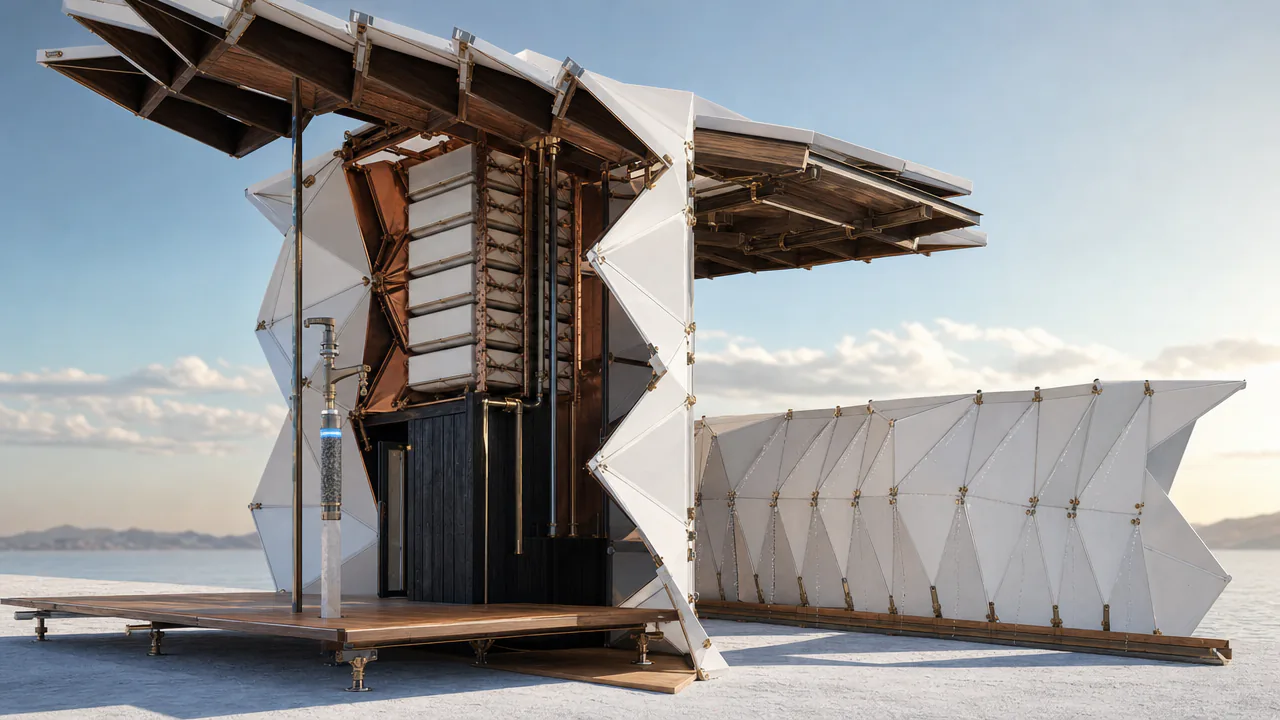 I08 · Desert water rack
Fallback, always
The harvester never carries life safety alone.
- Fog-mesh skin on coastal deserts and ridges
- A commercial hydropanel or AWG for make-up
- A truck fill port straight into the mast bladder
- Lithium checks apply only if a LiCl sorbent is used
- KUMO-12 folded
- 0.91 x 1.82 x 2.00 (1 jo) m
- Deployed
- 1 jo + Miura condenser wing 3.64 x 1.82
- Mass
- 280 kg target
- Price band
- $14,000-28,000 illustrative
- KRES-7 mast
- diameter 1.20 x 6.30 · stores about 2,000 L
Single-cycle, passive, in real deserts.
KUMO is sized on field yields from one cycle per day. The famous 1.3 L/kg/day figure needs rapid active cycling indoors — it is listed, and it is not used.
| Quantity | Value | Unit | Basis | Source |
|---|---|---|---|---|
| MOF-801 passive single-cycle desert yield, Arizona | about 0.1 | L/kg/day | measured | doi.org · 10.1126/sciadv.aat3198 |
| MOF-303 fully passive harvester, real desert climate | about 0.285 | L/kg/day | measured | doi.org · 10.1016/j.device.2023.100054 |
| CaCl2-hydrogel composite, single cycle per day | 0.3-0.8 | L/kg/day | target | must be measured on the KUMO-2 bench |
| MOF-303 1.3 L/kg/day (indoor, 32% RH, 20-minute rapid cycling with active heating) | active multi-cycle, not applicable to KUMO | L/kg/day | measured | doi.org · 10.1021/acscentsci.9b00745 |
| Vapour-pressure check for desorption into a condenser | <= 0.1 (MOF-303); <= 0.2-0.25 (CaCl2) | p_sat(T_cond)/p_sat(T_bed) | calculated | e.g. p_sat(25 C) 3.17 kPa / p_sat(70 C) 31.2 kPa = 0.10; a 35-42 C midday condenser would need an 85-95 C bed |
| Heat needed per litre harvested | 2-4 | kWh_th/L | calculated | 0.8 kWh/L desorption enthalpy / 20-40% system thermal efficiency |
| PV-T backsheet thermal yield at a 60 C outlet | about 1.4-2.1 | kWh_th/m2/day | calculated | 7 kWh/m2/day x 0.2-0.3 |
| Collector area per person for drinking and cooking water only (2-3 L) | about 2-9 | m2 | calculated | 2-3 L x 2-4 kWh/L / 1.4-2.1 kWh/m2/day |
| WOTA Unit treatment capacity (not demand) | 438-720 | L/day | claimed | wota.co.jp |
| WOTA Unit recovery, with rainwater replenishment | up to 97 | % | claimed | wota.co.jp |
| Harvest need per person | about 5-13 | L/day | calculated | 60-100 L demand x 5-10% loss (3-10 L) + 2-3 L drinking and cooking |
| Harvester size reduction from recycle-first | about 5-15 | x | calculated | 60-100 L/person/day / 5-13 L/person/day, central range |
| KUMO-12 rack output (24 kg sorbent, one cycle per day) | 2.4-12 | L/day | calculated | 24 kg x 0.1-0.5 L/kg/day; about 0.3-1.5 persons' residual per rack |
| Refrigeration AWG energy at 26.7 C / 60% RH; stops below 30-35% RH | about 0.3 | kWh/L | measured | doi.org · 10.1088/2634-4505/accec9 |
| Annual PV yield loss of a PV-T panel vs a ventilated reference panel | <= 3 | % | target | Anyground gate |
KUMO-2: two beds, ninety logged nights.
EXPERIMENTAL (passive sorbents at pilot scale; WOTA Unit pre-mass-production; integration unbuilt). The recycle-first architecture with commercial make-up is the investable core.
Build
KUMO-2 bench: two beds, 2 x 2 kg sorbent (CaCl2-hydrogel first, MOF-303 if purchasable), glazed solar-thermal collector with a PV-T preheat panel, night-cooled condenser mass separate from storage, treatment train with CO2 dosing; at an arid field site plus a climate chamber.
BOM$15,000-35,000target
Test · 90 days
90 days of logged L/kg/day against night RH and temperature on one cycle per day; condenser temperature log; residual loading at end of each release; collector heat delivered per litre; PV yield vs a ventilated reference panel; full potable lab panel after treatment; salt carry-over checks.
Pass
>= 0.3 L/kg/day field mean at 20-40% night RH for CaCl2 composites, or >= 0.2 L/kg/day for MOF-303, on one cycle per day; measured heat <= 4 kWh_th/L; <= 3% annual PV yield loss vs a ventilated reference panel; potable lab pass.
Kill → fallback
< 0.15 L/kg/day or unsolved salt carry-over: buy commercial hydropanels or AWG/MOF units (SOURCE, AirJoule, Ahbstra class) for make-up and keep the recycle-first architecture.
Named risks
- MOF availability and price unknown
- Collector area per person larger than the roof allows at low-yield sites
- Dust fouling of sorbent beds
- Salt leaching from composites
- Condenser mass too warm after hot nights
Sources