A farm that
runs itself on a
910 mm pitch.
Every plant gets an address. Trays roll on rollers, a lift shuttle moves them between four tiers, fixed cameras watch each one and a rail arm picks fruit at known coordinates. Cheap machines can do the work because the crop is laid out for them.
Make the crop legible to cheap machines before making the machines smarter.
Vertical farms failed on energy, pathogens and vendor clouds. HATA keeps the parts that work and changes what the robot has to know. Every tray is half a tatami mat. Every tray slot has a fixed coordinate, and so does every plant on it.
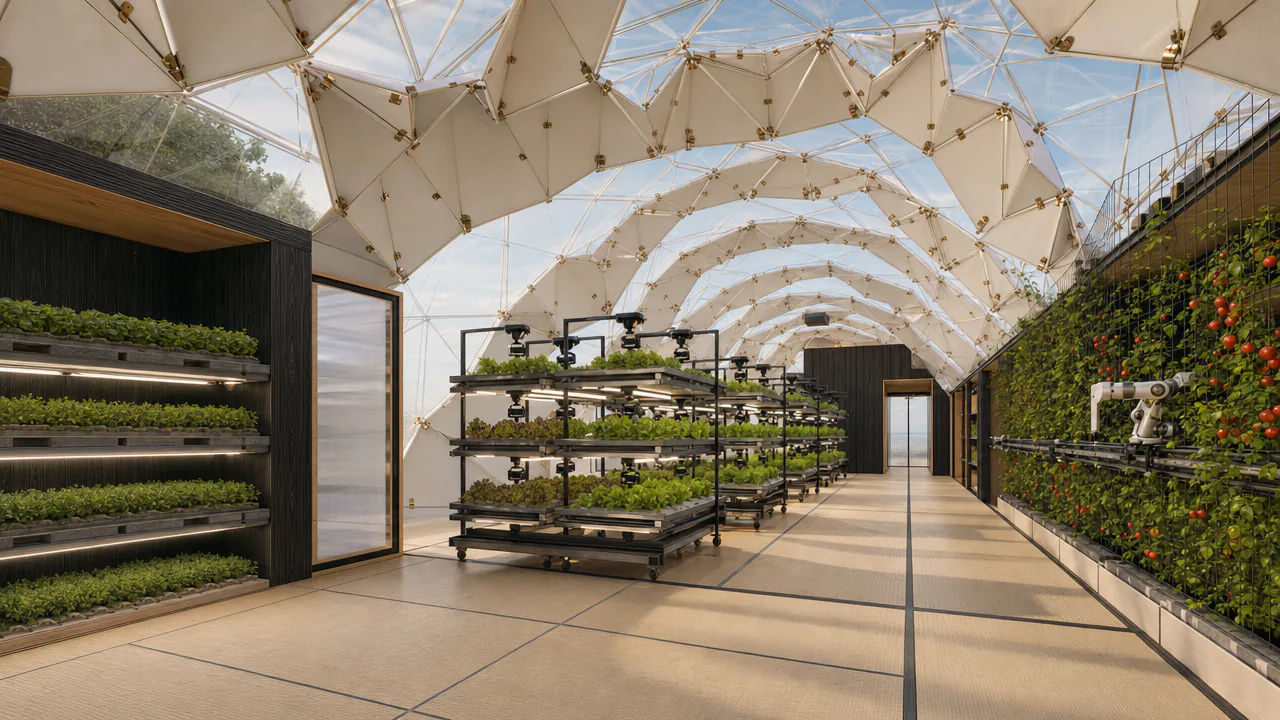 I10 · Autonomous farm interior
- Tray
- 910 × 455 mm half-jo, food-grade PP, NFT gullies moulded in
- Cassette
- 1 jo footprint · 4 tiers · 16 tray slots · 6.6 m² of canopy
- Spacing
- 32 plants in the nursery → 18 at about day 10 → 8 at about day 20
- Firmware
- Local-first (ESPHome + Home Assistant). The farm keeps running if Anyground disappears.
One tray’s 35 days, in 64 seconds.
This is a working model of one vault segment: two cassettes, five stations, a cart, two lift shuttles, a gantry, a rail arm and a cable robot. Every move follows a real path, and you can scrub to any instant. Click a part to read its spec, or open it up with Explode and Cutaway.
Drag to orbit · right-drag to pan · click a part · click, then scroll to zoom
3D needs WebGL.
The eight phases and all parts are listed below.
01 / 08 · Seeding station · Seeding gantry
Seed
A clean half-jo tray arrives with mineral plugs. The vacuum needle bar drops one pelleted seed per plug, a row of eight per stroke, from a swappable seed cartridge.
Timing is compressed: in the farm, each cassette has trays at every age at once, so all eight phases run every day. The model follows one tray from seed and one from harvest.
99 named partsOpen the parts index. Click a row to find the part in the model.
棚HATA-4 cassette21
動Robots and tray motion17
場Stations18
水Water and nutrient15
実Fruit wall11
畳JO-PORT and coupling10
折YOSHI-6G vault segment7
- 01Seed · Day 0 · Seeding gantryA clean half-jo tray arrives with mineral plugs. The vacuum needle bar drops one pelleted seed per plug, a row of eight per stroke, from a swappable seed cartridge.
- 02Germinate · Day 0–3 · Transfer cartThe cart rolls the tray into a dark, warm, misted chamber. Even germination before light is what makes the later schedule predictable.
- 03Transplant · Day 3 · Lift shuttle AThe cart meets the cassette’s lift shuttle. Forks slide under the tray, lift it to the nursery tier and push it onto the rollers. Re-spacing at about day 10 and day 20 uses the same moves onto wider-pitch trays.
- 04Monitor · Every hour · Cameras + gantrySixteen fixed cameras per cassette measure canopy area, colour and tipburn. The gantry surveys the fruit wall. The twin updates a probabilistic harvest date for every tray.
- 05Irrigate & dose · Continuous · Dosing pumpsNFT film runs past the roots; peristaltic pumps hold EC and pH. Recovered nitrogen arrives on zeolite cartridges from the urine loop. Transpiration condenses on the roof coil and comes back.
- 06Harvest · Day 35 · Lift shuttle B · rail armGreens are harvested by whole tray: the shuttle pulls a finished tray, the cart takes it to the band knife, the tote weighs it. On the fruit wall the arm air-pulses flowers and picks ripe trusses at known coordinates.
- 07Clean · Day 35 · Clean-in-placeRoots and plugs drop into the residue hopper. The empty tray is washed, rinsed and air-knifed before it may enter the nursery again.
- 08Recycle · Day 35 → 0 · Auger · KAMADOResidue rides the auger to the KAMADO bin, where black soldier fly larvae turn it into feed and frass. The clean tray returns to the seeding table with fresh plugs. The loop starts again.
Change the crop and the recipe rewrites itself.
A recipe is light, time and water. The cassette is fixed, so every number below comes from one formula on its 6.6 m² of canopy. Lettuce is anchored to measured vertical-farm medians. Other crops use planning values, tagged target, until the prototype logs them.
Crop
Site and climate
LED fixture efficacy
The anchor crop. Yield is the literature median band (48 papers / 70 company declarations); the company mean of 105 kg/m²/yr is upside only.
Plants per tray · nursery → mid → finish
Concept range 14–17 for indoor tiers
DLI ÷ photoperiod
6.6 m² × yield ÷ 52
Pass gate ≤ 15 · kill > 20
16.5 kWh/day
Gross at 140 g/L → net after recapture
6.6 m² × 17 mol/m²·d ÷ 2.7 µmol/J ÷ 3.6= 11.5 kWh light+ 4.9 kWh air, water, robots (light share 70 % at the lettuce reference)= 16.5 kWh/day ÷ 1.1 kg/day ≈ 15 kWh/kg
Indoor greens cost energy. So HATA sells where logistics cost more.
A small cassette is less efficient than a warehouse farm. The gate is set where it still pays: high-value crops at remote sites, hotels and polar stations, never commodity lettuce. Calorie crops go in daylight vaults and outdoor beds.
kWh per kg fresh weight · log scale
Papers 48.3 · company declarations 69.5. The company-declared mean of 105 is upside only claimed.
That is more than two PV wings and two fences supply (about 17 kWp), so off-grid farms get daylight vaults first and only as many cassettes as the PV can run.
EDEN ISS in Antarctica, at about 256 kWh/kg including heating, is the worst case we design against, not a benchmark we expect to hit.
Nitrogen arrives on stone. Water leaves as vapour and comes back.
Urine from the KAWAYA toilet passes a clinoptilolite bed that holds ammonium and potassium. The charged zeolite travels to the farm in sealed cartridges, where a salt rinse releases a liquid fertiliser for the dosing pumps. The roof coil recaptures transpiration. Residue goes to larvae.
How many cassettes can urine feed?
8.8 g N per person per day measured × capture target ÷ about 2.5 g N per kg of lettuce. Surplus nitrogen goes to outdoor beds or a fertiliser offtake.
Not on food yet. The 12-month yield test runs on mineral nutrient. Zeolite-charged substrate stays on a separate bench trial with pathogen and pharmaceutical assays until it passes. A sodium bleed protects the loop from salt.
A cassette plugs in like a tatami mat.
Each HATA-4 stands on one jo tile with a JO-PORT carrying DC, nutrient, condensate and data. Neighbouring cassettes bolt together through a tie plate. Their shuttle rails splice, so one shuttle can index trays across both, and the manifold joins through dry-break couplers without draining the loop.
- 1 Datum balls, hardened steel, 3-point kinematic seat · ≤ 0.5 mm repeatability target
- 2 Nutrient island, stainless dry-break coupler
- 3 Condensate island, back to the reservoir
- 4 DC island, blind-mate · 2 kW per port at 48 V
- 5 Data and passport tag, NFC + QR
- 6 V-blocks under the cassette base
- 7 Tie plate and shuttle-rail splice
- 8 Manifold quick coupler between cassettes
- 1SeatLowered onto three balls; the ±3 mm port float takes up the error.
- 2LockEdge keys cam in. Locks, not actuators, carry the load.
- 3HandshakeThe passport tag links the cassette to its fleet record.
- 4Leak test, then openTest port and pressure transducer prove the seal before any valve opens.
- 5Power and runDC on, recipe loaded, tray lanes registered on the 910 mm pitch.
Prove it in a reefer container, or sell it as a staffed workcell.
The test does not depend on any other unbuilt mechanism. It runs two cassettes, one fruit wall and one duckweed shelf, is commissioned by month 4 and then logs six months of production.
COMMERCIAL components · EXPERIMENTAL integration and autonomy
Build · 12 months
In a reefer container, independent of YOSHI, TSURU, JO-PORT and MOTTAINAI: two HATA-4 cassettes, one cherry-tomato (or strawberry with bumblebee fallback) fruit wall with rail arm, one duckweed shelf, local-first firmware. Commissioned by month 4, then 6 months of logged production on mineral nutrient. Urine-charged zeolite runs as a separate bench trial with pathogen and pharmaceutical assays before any edible harvest.
BOM USD 50,000-100,000 target
Test
Six months of continuous production with logged crew minutes, kWh/kg, pick success and fruit damage, pathogen incidents; separate zeoponic bench trial.
Pass
>= 6.5 kg greens/week/cassette (or the equivalent per m2 of finishing-tier area) at <= 15 kWh/kg; <= 30 crew min/week/cassette; pick success >= 65% with <= 5% fruit damage at fixed coordinates (80% stretch).
Kill
> 60 crew min/week/cassette, > 20 kWh/kg, or < 5 kg/week/cassette after two cycles: sell the farm as a staffed workcell (v2 position), not as autonomous.
Risks we name
- Energy cost of indoor greens (only high-value or remote-premium crops pay)
- Crop pathogens in closed systems
- Pick success below human level in cluttered canopies
- Food-safety and GAP certification of urine-derived substrate
- Vertical-farm sector failures colour investor perception
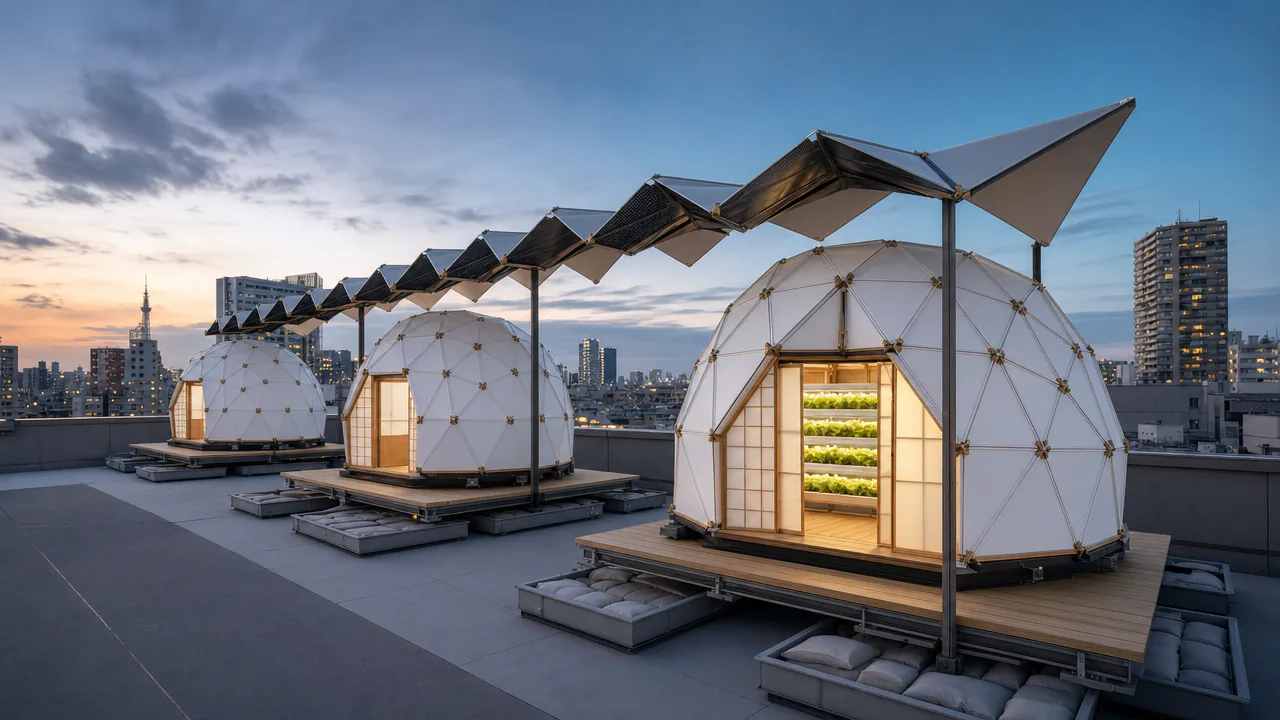
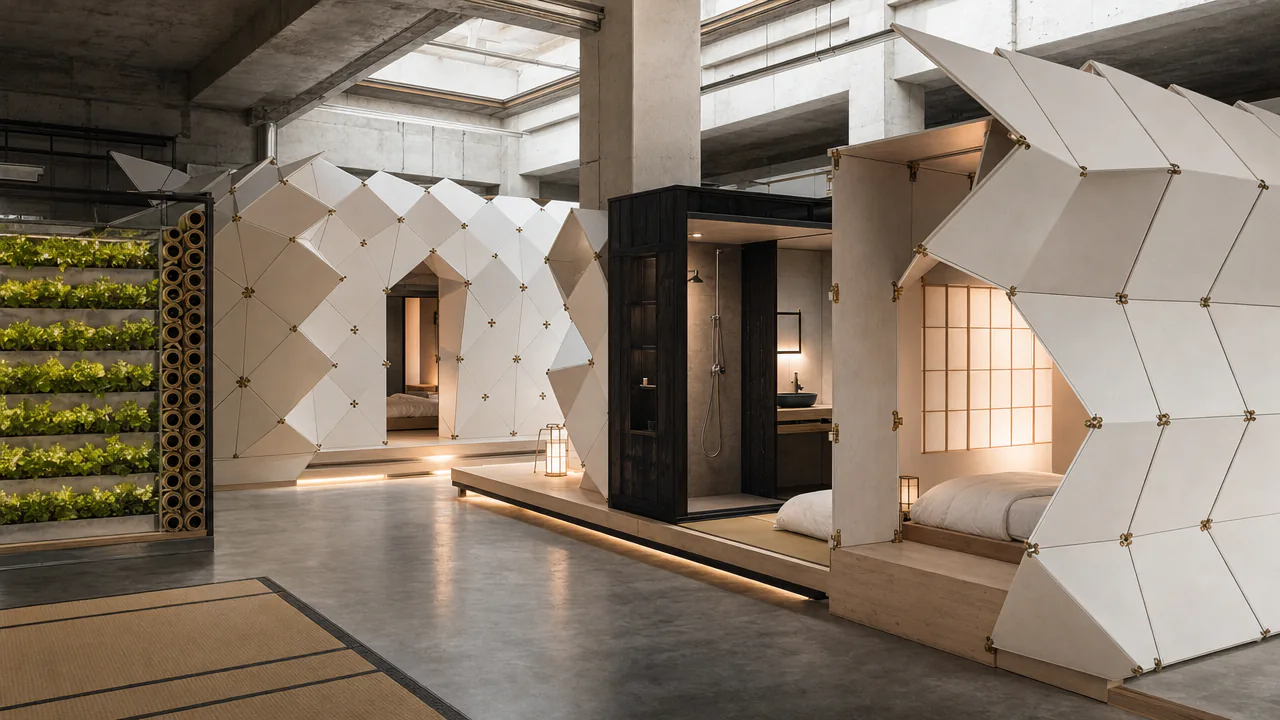
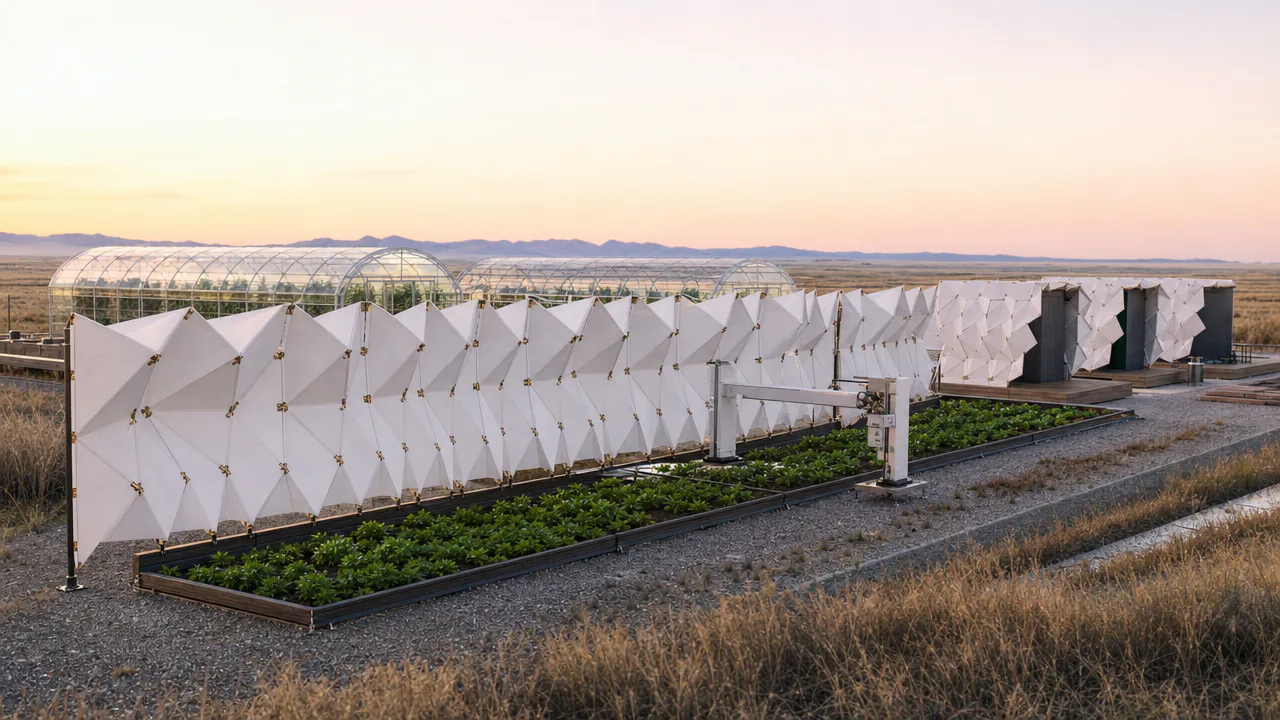
Where a HATA farm goes
08 Every number on this page
| Quantity | Value | Unit | Basis |
|---|---|---|---|
| Vertical-farm lettuce yield, medians (scientific literature 48.3, company declarations 69.5) | 48-70 | kg FW/m2/yr | measured |
| Vertical-farm lettuce yield, company-declared mean (upside only) | 105 | kg FW/m2/yr | claimed |
| Large vertical-farm energy intensity (0.08-0.13 kg/kWh; literature range 5-33 kWh/kg) | 8-12.5 | kWh/kg | measured |
| Water-use efficiency | about 140 | g FW/L | measured |
| HATA-4 cassette output | 6.1-8.9 | kg/week | calculated |
| HATA-4 lighting energy | about 11.5 | kWh/day | calculated |
| HATA-4 average power | about 600-800 | W | calculated |
| HATA-4 energy intensity | about 11-22, central about 15 | kWh/kg | calculated |
| EDEN ISS small sealed system (incl. Antarctic heating, mixed crops): worst case | about 256 | kWh/kg | calculated |
| EDEN next design: fresh veg per crew member | about 0.5 | kg/day | claimed |
| Duckweed yield, outdoor tank culture, sunlight, 10-20 g/L dairy manure (1979) | 14.9 | g dry/m2/day | measured |
| Duckweed yield planned under LED indoors | about 5-10 | g dry/m2/day | target |
| Strawberry harvesting robots in field tests (overall / picking-point step) | about 62 / about 84 | % success | reported |
| Labour share of vertical-farm costs | 1/4 to 1/3 | share | measured |
| Crew time per HATA cassette | <= 30 | min/week | target |
| Spread Techno Farm Keihanna design capacity (tray standardisation at scale, not low labour at cassette scale) | 30,000 | heads/day | reported |
Sources
- doi.org/10.1007/s13593-025-01055-w
- www.foodengineeringmag.com/articles/94320-japan-to-develop-fully-automated-lettuce-factory
- www.dw.com/en/robots-to-harvest-30000-lettuce-heads-a-day/a-36229269
- genesis.farm.bot/v1.8/assembly/intro/high-level-overview.html
- cms.tecnalia.com/uploads/2020/01/Catalogue_CableRobotics.pdf
- www.fertilizerdaily.com/20241125-four-growers-develops-robots-to-address-greenhouse-labor-shortages
- www.greenhousegrower.com/technology/greenhouse-tomato-pollinator-robot-coming-to-life
- verticalfarming.blog/oishii-series-c-vertical-farming-investors
- doi.org/10.3390/HORTICULTURAE4040035
- doi.org/10.1061/40479(204)106
- en.wikipedia.org/wiki/Daily_light_integral
- doi.org/10.1016/j.biosystemseng.2026.104532
- www.freshplaza.com/north-america/article/9136884/substantial-vegetable-harvest-in-antarctica
- doi.org/10.1111/J.1749-7345.1979.TB00076.X
- doi.org/10.1016/j.jclepro.2022.134894
- www.verticalfarmdaily.com/article/9728357/freight-farms-files-for-chapter-7-bankruptcy-leaving-growers-disconnected
- elevenflo.com/blog/plenty-unlimited-bankruptcy
- pitchbook.com/news/articles/bowery-farming-collapse-leaf-eating-pathogen-failed-acquisition
- www.agnavigator.com/Article/2024/11/05/What-does-Bowery-s-closure-tell-us-about-the-future-of-vertical-farming