Close and verify latches
After unfold, close each ridge splice latch, then confirm it with the Hall sensor. During commissioning, find leaks with the thermal camera while the KURA blower door pressurises the shell.
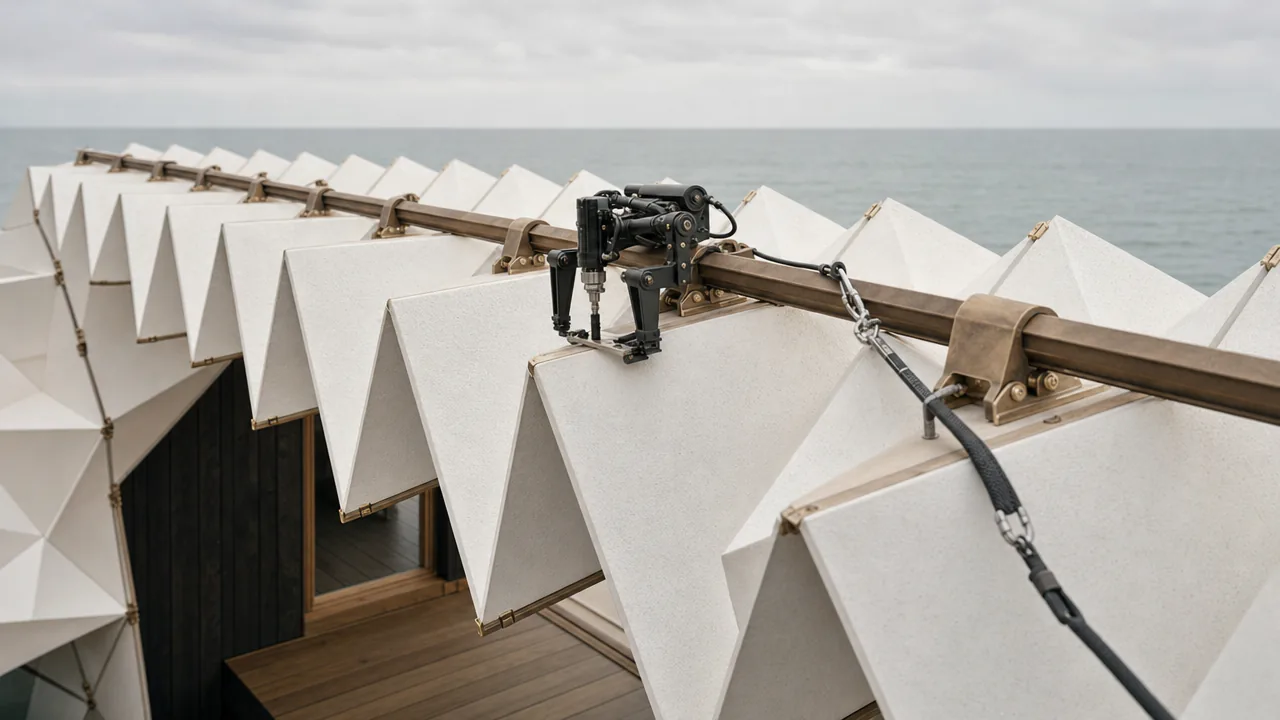
Latch driverA 25–35 kg inchworm robot that locks its feet into datum sockets bolted to the ridge beam every 910 mm. The building is its map and its fixture, so a small robot can do precise work.
Service robots fail in buildings because buildings are unpredictable. ORIJO is predictable by construction. TSURU locks one foot, flips the other over to the next socket, locks again, and then works from a locked foot. The planner on the left runs a shift of versioned task contracts; every number on the stage is computed from the pose you see.
Drag to orbit · click a part · playback about ×5 real time
From the drawn pose: g · Σ m · lever, for a 30 kg body. Design peak ×1.7 = 0 N·m, against joints sized ≥ 400 N·m and locks rated ≥ 600 N·m target.
Each step arrives 14 mm off-centre on purpose. The 20–30 mm tapered lead-in pulls it home before the petals lock.
0.91 m per step · 15–30 s per step = 0.03–0.06 m/s calculated.
The free foot flips over the locked one, as NASA's ARMADAS inchworm robots do. Only one foot is ever free, and a person never has to trust the robot's sense of where it is. The socket tells it.
The petals fold in, the lock sensor reads open, and the nose lifts clear of the cup. The other foot carries the whole robot through its lock: rated ≥ 0.6 kN·m and ≥ 3 kN fall-arrest target.
Two 550 mm links swing the free foot over the top to the next socket. It passes straight up at mid-swing, which keeps the lever on the locked foot short. With up to 8 kg at full swing, the peak is about 350–390 N·m calculated.
The nose drops into a tapered cup, which pulls it onto the datum. ARMADAS petal feet capture 3.0 cm of in-plane misalignment measured, so TSURU's 20–30 mm lead-in means it never has to know exactly where it is.
The petals open under the cup's undercut and a sensor confirms the lock. Only then can the other foot let go. Sockets are bolted through to the ridge beam, not to the skin, and are drained so they clean themselves.
The rail sits on one panel and is broken at every transverse crease, so the vault can still fold. Rail continuity is a named risk.
Stainless cups at 910 mm pitch, one per jo, are the same module the rest of ORIJO is laid out on.
A continuous trolley line runs along every rail TSURU uses outdoors. If the robot falls, the line catches it, not a foot.
One robot per contiguous rail network. A person carries it between modules in a 0.6 × 0.4 × 0.4 m case.
The first spec was a 25 kg body carrying 15 kg at full swing. That puts about 244 N·m on the locked foot before any dynamic factor. The adversarial review moved heavy payloads to double stance, with both feet locked. Try it.
M = g · (mbody · L/2 + mpayload · L) · factor, with L = 0.91 m. These are the same formula and inputs as the concept dossier calculated.
NASA's ARMADAS assemblers walk on the lattice they build and position themselves relative to it. Their error does not pile up step after step. It settles toward the tolerance of the parts. We borrow the architecture, not the scale.
0 re-tries (step missed the lead-in)
Precedent
SOLL-E is a 5-DoF bipedal inchworm. It made about 15,000 indoor moves on a 304.8 mm voxel lattice measured. Its successor weighs about 5.6 kg reported. TSURU is about five times heavier, because it works outdoors in wind and rain and carries cartridges.
What converges
In ARMADAS simulations, lattice RMS error falls toward the part error as the plates get thicker modelled. The toy model above shows the same idea. It is illustrative, not a TSURU measurement.
What does not
Accuracy is local. Socket-to-socket error is set by the socket and its lead-in. Hinge play adds several mm per joint, so building coordinates come from a survey after the vault is up, not from the robot.
Tasks arrive as versioned contracts with a pass test. TSURU only takes work it can reach from the ridge rail. Narrow scope is the design: scope creep toward a general-purpose robot is listed as a risk, not a roadmap.
After unfold, close each ridge splice latch, then confirm it with the Hall sensor. During commissioning, find leaks with the thermal camera while the KURA blower door pressurises the shell.
Latch driverSweep the crease membranes near the ridge with a thermal camera and log every frame to the module passport. A sensor trigger or the shikinen schedule turns a finding into a swap job.
Thermal cameraSwap cartridges through JO-PORTs and reload seed cartridges. The free foot can carry 5–8 kg at full swing. Up to 15 kg needs both feet locked.
GripperClean sensor windows and facets inside one bay of the rail. A ridge robot cannot reach the eaves, so PV and slope washing go to a separate brush crawler or to people.
Wiper padWho does what on a site
| Work | Done by | Basis |
|---|---|---|
| Ridge-adjacent contracts (latch, scan, swap, wipe) | TSURU, ≥ 95 % autonomous completion | target |
| Exceptions inside a contract | Remote operator over Starlink | target |
| Anything outside a contract | Local human runner, plus a quarterly runner visit | target |
| PV and slope washing | Separate brush crawler, or people | target |
| Ground and cluster inspection | Rented legged inspector or farm utility rover, on scheduled visits | target |
| Cartridge resupply at roadless sites | Heavy-lift drone: 65 kg over 12 km on dual battery | claimed |
| Moving the robot between modules | A person, carrying a 0.6 × 0.4 × 0.4 m case | target |
>50%
of the Henn-na Hotel's 243 robots were retired measured. They had been put on stage, at the front desk, with the luggage and in the rooms. ORIJO takes the opposite brief.
Source: Engadget, 16 January 2019.
Robots on stage fail. Robots in the walls serve.Kage no omotenashi · invisible care
Never automated in ORIJO
Automated, out of sight
The rule: autonomy lives back-of-house. Guests see doors, light, water and food, not robots. Every transformation also works by hand, so TSURU is an add-on and never the only way to do a job.
EXPERIMENTALTRL 3: lattice-walking robots are indoor prototypes; crease-rail service robot unbuilt
Risks we are designing against
What the adversarial review changed
ProblemSOLL-E precedent stretched
NowSOLL-E framed as architecture precedent (304.8 mm lattice, about 15,000 indoor actions; successor about 5.6 kg), not scale
ProblemStatics do not close at 25 kg / 15 kg
Now25–35 kg body, 5–8 kg at full swing, 15 kg only in double stance; ≥ 400 N·m joints; step 15–30 s (0.03–0.06 m/s)
ProblemSingle expanding pin cannot carry moment
Now2–3 point cone/petal lock, 20–30 mm lead-in, ≥ 0.6 kN·m, ≥ 3 kN fall-arrest; sockets bolted to ridge beam; drained; lock sensing
ProblemRails conflict with fold creases; accuracy only local
NowSegmented rail on one panel, broken at transverse creases; building coordinates from survey
ProblemReach cannot cover slopes
NowExterior tasks limited to ridge-adjacent; PV washing to brush crawler or people
Problem6–12 modules per robot unsupported
NowHuman-ferried; one robot per contiguous rail network
ProblemCable kit underspecified
NowMoved to month 12–24; anchors on fixed frames
ProblemFlyCart misquoted
NowDJI official: 65 kg/12 km dual, 85 kg dual max, 100 kg single; steps say up to 65 kg routinely
ProblemARMADAS precision number mischaracterised
NowRestated as simulation: lattice RMS error collapses toward part error
ProblemExterior operation unaddressed
NowFall-arrest trolley, weather, grit and ice tests
Problem12-month scope overloaded; no human baseline
Nowv0 on 7.28 m bench rail + 3.64 m shell rail, 2 tasks x 200 trials; BOM 40–80k + labour 0.3–0.5M; human baseline measured first
Verdict: fix. The full log is on Evidence.
| Quantity | Value | Basis | Source |
|---|---|---|---|
| SOLL-E: 5-DoF inchworm, about 15,000 indoor actions on a 304.8 mm voxel lattice (architecture precedent, not scale) | 5 DoF | measured | ntrs.nasa.gov/citations/20230005194 |
| ARMADAS foot petal capture of in-plane misalignment | 3.0 cm | measured | ntrs.nasa.gov/citations/20230005194 |
| SOLL-E successor robot mass | about 5.6 kg | reported | IEEE 11068540 |
| Lattice RMS error collapses toward part error as plate thickness grows (simulation) | qualitative | modelled | ntrs.nasa.gov/citations/20240000666 |
| Foot moment at the locked foot, 25 kg body + 15 kg at 0.91 m (rejected spec) | about 244 static, 370–490 with 1.5–2x factors N·m | calculated | 9.81 x (25 × 0.45 + 15 × 0.91) |
| Peak joint torque, 30–35 kg body + 8 kg at full swing | about 350–390 N·m | calculated | 9.81 x (m_body x 0.455 + 8 × 0.91) x 1.7 |
| Travel speed | about 0.03–0.06 m/s | calculated | 0.91 m per 15–30 s step |
| Industrial cable robot payload (rigid industrial frames) | up to 130 kg | measured | cms.tecnalia.com/uploads/2020/01/Catalogue_Cable… |
| DJI FlyCart 100: dual battery / dual battery max / single battery max | 65 kg for 12 km / 85 kg / 100 kg (short range) kg / km | claimed | DJI FlyCart 100 announcement and specifications (manufacturer) |
| Henn-na Hotel robots retired | > 50% of 243 robots | measured | engadget.com/2019-01-16-japan-robot-hotel-fires-… |
| Autonomous completion rate of contracted tasks | ≥ 95 % | target | Anyground gate |
| Robots per site | 1 per contiguous rail network, human-ferried between modules robots | target | Anyground |
Components
| Part | Material | Spec |
|---|---|---|
| TSURU body | Carbon/aluminium links, BLDC joints | 25–35 kg; 5–8 kg payload at full swing, 15 kg in double stance; 5 DoF; ≥ 400 N·m peak joints (target) |
| Foot lock | 2–3 point tapered cone or petal lock | ≥ 0.6 kN·m moment, ≥ 3 kN fall-arrest, 20–30 mm lead-in, lock-confirm sensor |
| Socket | Stainless cup bolted through to ridge beam | drained, self-cleaning; 910 mm pitch |
| Tool heads | Latch driver, thermal camera, cartridge gripper | tool changer on foot |
| Fall-arrest trolley | Stainless trolley on rail | continuous along exterior rails |
| Cable kit (month 12-24) | 4 winches, Dyneema | indoor bays only; anchors on fixed frames, not folding panels |
Sources
Images and video on this page are AI-generated concept visuals. The 3D model is a concept drawing: dimensions follow the dossier, and details such as link lengths and part masses are illustrative.