Default store
Heat-pump water tank
- Stores
- ≈ 23 kWhth calculated
- From PV
- ≈ 8 kWh at COP ≈ 3
- Heat per PV kWh
- 2.5–3 calculated
- Volume
- 300–500 L, 40 K swing
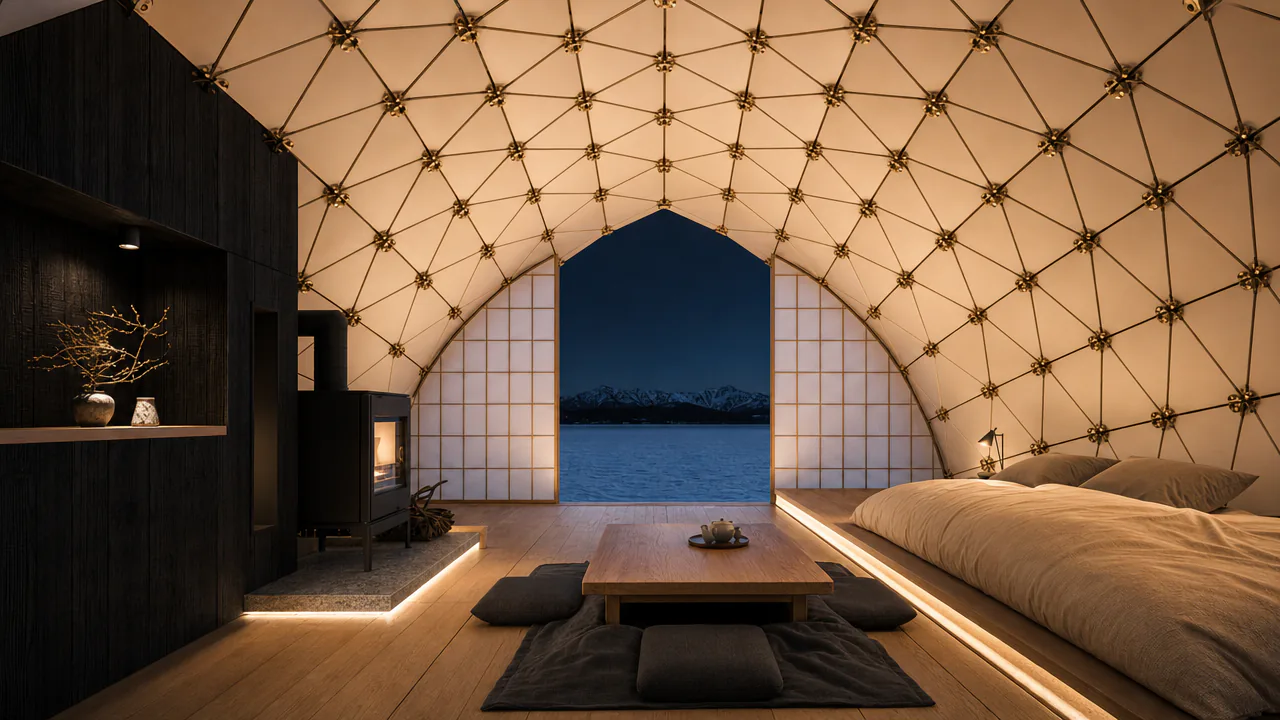
Five streams leave the house and come back as showers, fertiliser, larvae and greens. One 48–60 V DC spine runs every organ, banks spare sunshine as hot water, and warms the people at the kotatsu before it warms the room.
Mottainai means “what a waste”. Each drain is kept separate at the source, so each one can come back as an input or leave as a regulated export. Click any organ to see how it works and the numbers behind it. Change the household and the flows follow.
New water needed: 26 L/day calculated
The farm takes 2–4 %. The rest goes to beds or offtake.
Regenerated weekly in place with a KCl/NaCl rinse calculated
From 1–2 kg/day of residue target
MIZU ≤ 9.6 + condensing 2.7–6.3 calculated
The loop is built from parts that already run somewhere: WOTA’s grey-water units, ISS condensate recovery, NASA zeoponics and household larvae bins. The new part is how they are joined. Anything out of spec goes to the sanitary holding tank, so the loop fails safe.
Urine-diverting dry toilet (no blackwater), grey drains (kitchen sink via a grease interceptor), kitchen organics bin, crop residue chute, HRV/dehumidifier condensate line.
The MIZU organ runs biology, membrane, RO, UV and chlorine; up to 97% is reused with rainwater make-up (vendor spec); make-up water is logged separately; RO reject goes to solar membrane distillation, ornamental irrigation or the holding tank.
Urine is stabilised by storage or acidification so ammonium (NH4+) stays the dominant species, then passes a clinoptilolite exchange bed that captures NH4+ and K+ at 10-20 mg N/g. The bed is regenerated in place with a KCl or NaCl rinse, which produces a liquid NH4/K fertiliser; it is not a disposable pod. (Alternative: full nitrification to nitrate liquor used directly as hydroponic feed, the Aurin/VUNA route.)
Also feeds zeoponic seedling trays and substrate beds in HATA; surplus nitrogen goes to outdoor beds or to a fertiliser offtake, because one NFT rack uses only a few percent of household urine N.
Dried faeces from the ventilated chamber are composted thermophilically for non-food landscape, or incinerated or collected where regulation requires.
Kitchen and crop residue (about 1-2 kg/day for 4 people) feed a BSF larvae bin on a 10-14 day cycle; larvae feed fish or poultry, frass goes to outdoor beds.
Plant transpiration and breath are condensed by the dehumidifier and HRV and returned to the grey intake.
Sealed farm modules carry a bladder that absorbs pressure swings and receive the living unit's CO2-rich exhaust through a HEPA and activated-carbon stage, within a stated humidity budget (target about 1,000 ppm CO2 in the grow zone).
Recirculating nutrient is bled off on a sodium set point to the holding tank (urine carries about 2-4 g Na per person per day).
EC, pH, ORP, turbidity and Na online; quarterly lab panels for pathogens and pharmaceuticals; anything out of spec goes to the sanitary holding tank or septic connection.
Nitrogen, 4 people
12.8vs0.25–0.5
kg N a year in urine, against what one NFT lettuce rack takes up. Urine is a fertiliser surplus, not a farm input you can use up indoors. calculated
Every number behind the loop
| Number | Value | Basis |
|---|---|---|
| ISS water recovery with Brine Processorsource | 98 % | measured |
| Lunar Palace 365 material closure (abstract not independently retrieved)source | 98.2 % | reported |
| Lunar Palace urine recovery (abstract not independently retrieved)source | 99.7 % | reported |
| Lunar Palace solid-waste recovery (the hard part; abstract not independently retrieved)source | 67 % | reported |
| Urine nitrification energy (alternative route only)source | about 13 W per person primary (about 0.5 kWh/day electric for 4 people) W per capita | measured |
| WOTA Unit electric draw400 W x 24 h; vendor rating https://wota.co.jp/en/wota-unit/ | 400 W rated (more with heater), up to 9.6 kWh/day | calculated |
| Dehumidifier condensate energyresidential units give 1.5-3 L/kWh | about 0.3-0.7 kWh/L | calculated |
| Nitrogen in urinesource | 8.8 g N/person/day | measured |
| Zeolite exchange capacity needed for 4 people4 x 8.8 g N / 10-20 mg N per g zeolite | about 1.8-3.5 kg/day | calculated |
| Urine N excreted vs one NFT lettuce rack uptake (4 people)4 x 8.8 g x 365; rack uptake at about 2.5 g N per kg fresh weight | about 12.8 vs 0.25-0.5 kg N/yr | calculated |
| BSF pilot (FCR 1.7-3.6 on dry matter, so not a wet-to-wet figure)source | 190 kg food waste to 79 kg larvae kg | measured |
| BSF wet-basis bioconversion used for sizinghousehold-scale literature range; to be measured | 15-25 % | target |
| Biosphere 2 leak ratesource | < 10 %/yr | measured |
| Share of excreted urine N recovered into crops or exported productsAnyground | 20-50 % | target |
| Nitrogen mass-balance closureAnyground | within +/-10 % | target |
This is the service end of a home, cut open. LFP cycles every day inside the heated envelope. A small sodium-ion bank in the cold vestibule keeps comms alive if the heating fails. Spare sunshine runs a CO₂ heat pump into a 500 L tank. The optional sand hearth and the kotatsu put heat where people sit.
Drag to orbit · click a part · click, then scroll to zoom
3D needs WebGL.
Every part of the spine is listed below.
This runs the same model as the cutaway in 15-minute steps until the battery repeats day after day. Loads come from each module’s average power in the concept. When the sun is short, the firmware ladder sheds loads from the bottom up. A winter deficit at high latitude is planned for, not hidden.
Default case without JavaScript: TABI-NO-YADO hotel, mountain site, equinox. PV 68 kWh/day against 59 kWh/day of loads; heat pump banks 36 kWh of heat.
—
—
—
—
Firmware priority ladder · shed from the bottom
—
Sun hours, day length and heat demand vary by site and are not in the research sweeps. These planning values are stated here so you can check them. Replace them with a PVGIS run and a heat-loss calculation per site. Hot water is 1.5 kWhth per person per day. The heat-pump compressor input is limited to 2 kW, the hearth element to 3 kW. LFP runs between a 10 % floor and a 90 % soft cap before the surplus goes to heat. Tank standby loss is ignored. The anchors from the sources are: 0.2–0.6 kWh/kWp/day in December at about 60° N reported; polar night PV near zero; COP about 3, and 1.55–1.85 at −30 °C reported; and lunar fission at 1–10 kWe speculative.
| Environment | PV yield, kWh/kWp/day sum · equ · win | Daylight, h | Space heat, kWh/m²/day |
|---|---|---|---|
| E1 · Rooftop | 5 · 3.5 · 1.5 | 15 · 12 · 9.5 | 0 · 0.08 · 0.25 |
| E2 · Forest | 4 · 2.5 · 0.6 | 17 · 12 · 7 | 0 · 0.12 · 0.4 |
| E3 · Desert | 7 · 6 · 4.5 | 14 · 12 · 10.5 | 0 · 0.03 · 0.1 |
| E4 · Arctic / polar | 4 · 2 · 0 | 24 · 12 · 0 | 0.05 · 0.3 · 0.6 |
| E5 · Mountain | 5.5 · 4 · 2 | 15 · 12 · 9 | 0.02 · 0.18 · 0.45 |
| E6 · Coast / floating | 5.5 · 4 · 2.2 | 14.5 · 12 · 9.5 | 0 · 0.06 · 0.2 |
| E7 · Steppe / farmland | 5.5 · 3.8 · 1.2 | 16 · 12 · 8.5 | 0 · 0.12 · 0.45 |
| E8 · Lunar | fission 10 kWe | lunar night | 0.1 · 0.1 · 0.1 |
A kotatsu, a heated sleeping platform and a good HRV let the room sit 2–3 K cooler with the same comfort. The heat pump gets 2.5–3 kWh of heat from each PV kWh. A hot rock gets one. So the tank is the default store, and the hearth is sold for comfort, not for storage.
Default store
Comfort option
Rejected
heating energy saved in offices when footwarmers let the setpoint drop from 21.1 to 18.9 °C at equal comfort. modelled
residential saving from a 2–3 K setpoint drop, at about 5–10 % per K. calculated
heating saved by an ERV in Arctic locations. measured
keeps Starlink and sensors alive for 72 h. The 2–5 kWh sodium-ion bank in the cold locker carries it. calculated
The spine, step by step
The configurator picks panel class, kotatsu table, heated sleeping platform and HRV before any PV is sized, and plans a winter deficit at high latitude rather than a surplus.
MIURA wings over the engawa (about 4.5 kWp after facet, hinge and frame packing losses) and BYOBU vertical bifacial fences (snow-shedding, albedo gain); micro-hydro or small HAWT only as measured-site bonuses.
MPPTs feed a 48-60 V bus running in the floor cassettes to JO-PORT DC islands; point-of-load converters replace inverter stages; heavy loads stay within the house DC budget or move to 380 V DC or AC.
LFP inside the heated envelope for daily cycling; a 2-5 kWh sodium-ion bank in the unheated vestibule carries keep-alive loads (comms, sensors) down to its rated discharge floor so a heat-loss event never bricks the system.
Surplus PV runs a CO2 heat pump into a 300-500 L insulated water tank, about 23 kWh thermal from about 8 kWh of PV at COP about 3.
A 0.4-0.6 t sand or soapstone radiant hearth, core at or below 250 C, with 150 mm microporous insulation and a rockwool jacket, about 25 kWh thermal, a 12-24 h buffer. It stands on a dedicated pier or slab pad rated at least 10 kPa, off the floor cassettes; touchable faces stay at or below 45 C (ISO 13732-1); a summer vent or bypass dumps heat outside; fire separation as for a stove.
CO2 heat pump makes 70 C water; HRV with frost pre-heat; radiative-cooled roofs, windcatcher and night-sky radiator cool hot sites.
Firmware ladder - life safety (CO/CO2, smoke, comms) > water treatment > food (cold store, farm) > heat to people > comfort > guest extras - with forecast-driven load shifting.
Venus OS + Home Assistant run locally; MQTT telemetry over Starlink feeds the fleet dashboard; the site runs without the cloud.
| Number | Value | Basis |
|---|---|---|
| Stationary storage pack price (BNEF 2025)source | 70 USD/kWh | measured |
| Installed 48 V LFP system with charger and BMS (used for budgets)market range; replaces the pack price in all budgets | about 200-400 USD/kWh | reported |
| Bluetti Pioneer Na (900 Wh portable): charges at / discharges at / capacity at -20 Csource | >= -15 C / >= -25 C / about 80% C / % | claimed |
| Sand specific capacity (dry quartz sand, cp about 0.80 kJ/kgK; soapstone about 0.27)0.80 kJ/kgK x 1,000 kg / 3,600 | 0.22 kWh/K per tonne | calculated |
| Optional IRORI hearth thermal capacity (0.5 t, 230 K swing)0.5 x 0.222 x 230 | about 25 kWh thermal | calculated |
| Hearth standby loss at full chargeQ = U x A x dT, U = 1/(0.15/0.025 + 0.05/0.04) = 0.14 W/m2K, A about 4.5 m2 mean insulation area, dT 230 K | about 145 W (about 14%/day) W | calculated |
| Rejected 1.5 t core at 400 K: capacity / loss with 200 mm rockwool1.5 x 0.222 x 400; U about 0.4 W/m2K x 8 m2 x 380 K | about 133 / about 29 kWh/day (about 20%/day) kWh | calculated |
| Heat-pump water tank store0.5 m3 x 1.16 kWh/m3K x 40 K; COP about 3 | about 23 kWh thermal from about 8 kWh PV kWh | calculated |
| Heat delivered per PV kWh: resistive vs CO2 heat pumpCOP of the heat pump already in the BOM, lower at -25 C | 1.0 vs 2.5-3 kWh_th/kWh_e | calculated |
| Pornainen sand battery round-trip (heat-to-heat, 100 MWh, about 2,300 m3; does not scale down)source | 90 % | measured |
| Footwarmers in offices: setpoint 21.1 to 18.9 C at equal comfort (simulated savings)source | 38-75 % heating energy saved | modelled |
| Residential heating saving from a 2-3 K setpoint dropabout 5-10% per K | 10-30 % | calculated |
| ERV heating saving in Arctic locationssource | about 27 % | measured |
| Basic off-grid household load vs with air conditioningsource | 2,116 vs 11,822 kWh/yr | measured |
| Starlink Mini continuoussource | 400-450 Wh/day | measured |
| MIURA-W peak power26.5 m2 x 0.85 active area x 0.20 x 1 kW/m2 (STC assumption) | about 4.5 kWp | calculated |
| Winter PV yield at about 60 N in DecemberPVGIS order of magnitude; winter plan assumes a deficit | about 0.2-0.6 kWh/kWp/day | reported |
| 72 h keep-alive energy (Starlink about 0.45 + sensors about 0.3 kWh/day)0.75 kWh/day x 3 | about 2.3 kWh | calculated |
The grey loop and the batteries are bought, not invented. The new risks are urine-to-food, sodium-ion in the cold and a hot mass indoors. Each one has a pass gate and a kill rule written before the build starts.
M06 12-month prototype
BOMUSD 15,000-40,000
PILOT grey loop (WOTA Unit pre-mass-production; WOTA BOX commercial for showers)EXPERIMENTAL urine-to-zeolite and closed nitrogen loop
M08 12-month prototype
BOMUSD 20,000-45,000
COMMERCIAL components (LFP, Victron, CO2 heat pumps, tanks)EXPERIMENTAL Na-ion stationary integration and the small radiant hearth
Risks we carry
Sources · M06 + M08