Reserve a pilot slot

Fold flat. Land anywhere. Live, farm or host guests by the next sunrise.

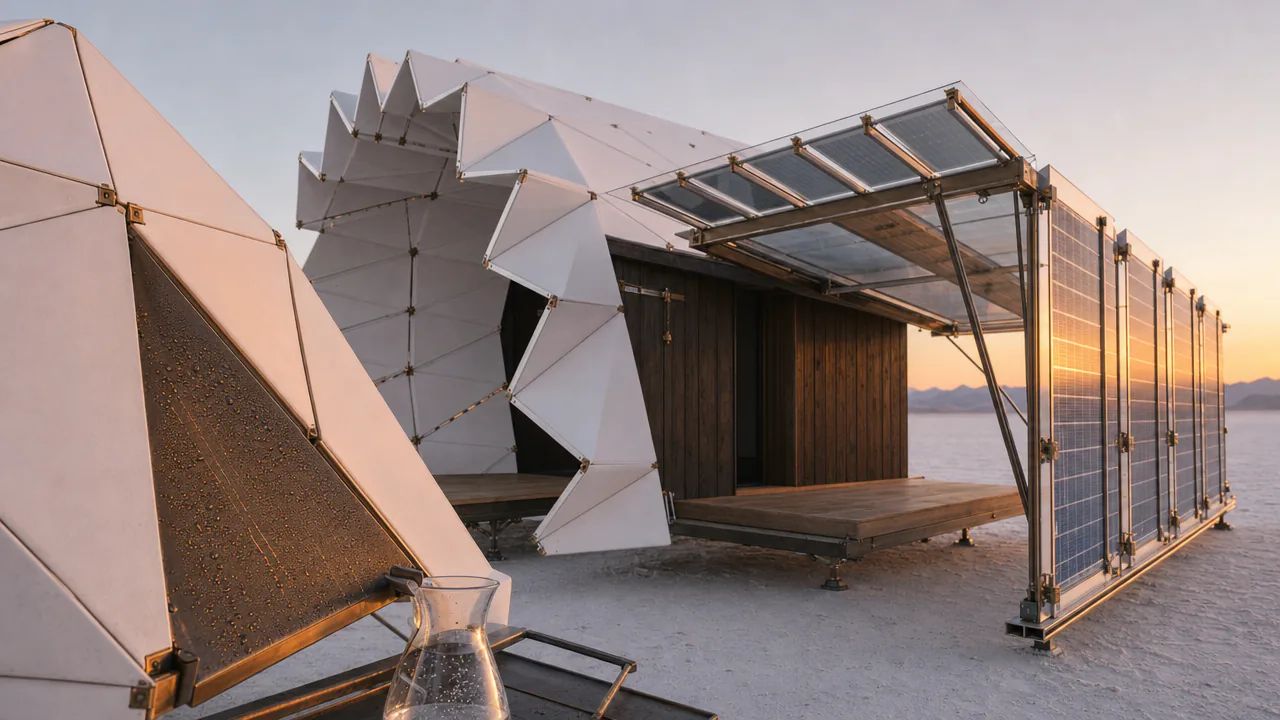
Energy layer concept visual
力Layer 1 The Autonomy Stack · self-powering

Energy. Fold-out PV, heat-first storage and a DC spine whose voltage itself enforces survival priorities.

7 subsystems26 projects28 papers28 numbers80 sources
L03 · concept visual · AI
力01 Thesis

A fully automated habitat energy layer is a PV-first DC microgrid that banks most surplus as heat, keeps a small cold-tolerant electrochemical floor for life safety, and lets forecast-driven control move deferrable loads (farm lighting, hot water, laundry) into sun hours. The non-obvious insight is that food, not people, dominates the load: one LED farm cassette (14–19 kWh/day) out-consumes a whole efficient 4-person home, and the vertical-farm insolvencies (Plenty Chapter 11, Bowery shutdown, Jones Food administration) show that electric-light food fails when its kWh are priced like storage. Shifting the crop photoperiod to PV hours, storing heat in water and sand at a fraction of battery cost, and encoding the priority ladder in bus voltage (so it survives controller failure) are all implementable with today's commodity hardware. Seasonal storage remains the honest gap: no home-scale technology approaches the ~$20/kWh threshold, so high-latitude sites need oversized PV, thermal mass and a declared backup.

14.4–19.2 vs about 14.5 kWh/day

One HATA-4 LED farm cassette vs a whole efficient 4-person home

70 USD/kWh

Stationary battery pack price 2025 (-45% y/y)

reportedbnef2025
about 23 kWh_th

Heat banked in a 500 L tank across 40 K (about 8 kWh_e at COP 3)

calculatedv3-concept
Slab 1 of the stack · see all eight

Maturity of options assessed

  • commercial 15
  • pilot 5
  • experimental 4
  • speculative 0
力02 Subsystem explorer

How the energy layer works, option by option.

Each subsystem lists the technologies the research found, with maturity, an estimated technology readiness level and the numbers that matter. Hover a TRL bar for the reason behind it.

ENERGY-S1 · function

Generation (fold-out PV first, site bonuses second)

Convert on-site flux (sun, wind, water, heat) into DC on the habitat bus with the lowest kg and crew-minutes per kWh.

How it works

Crystalline-silicon PV converts photons above the 1.12 eV bandgap into electron-hole pairs; MPPT converters hold each string at its maximum-power voltage and feed the DC bus directly. Bifacial cells also collect ground-reflected light on the rear, so a vertical east-west fence peaks in morning and evening and sheds snow, flattening the daily curve the battery must bridge. Fold-out arrays (Miura/flasher geometries in space, rail or hinge racks in containers) trade a small packing-loss for deploy times of hours. Small wind and micro-hydro produce at night and in winter but are steeply site-specific (power scales with v^3 and head x flow), so they are measured-site bonuses, not baseline. On the Moon the same bus accepts a fission or regenerative-fuel-cell source.

COMMERCIALTRL 9

Fold-out rigid PV wings / container arrays

Rigid c-Si modules on hinged or rail racks that unfold from a transport envelope

  • 40–160 kWp per container claimedMobile PV container portfolio range (HighJoule; only HJFoldSolar is described as foldable)mobilesolarcontainer
  • 140 kWp claimedLargest portable Solarcontainer shown operatingyt-solarcontainer
  • 4.5 kWp per 26.5 m² wing targetORIJO MIURA-W wing (v3)v3-concept

Best for desertsteppecoastrooftopmountain

Limits Wind loading and hinge fatigue; packing loss reduces kWp per m²; snow and dust need cleaning or tilt.

Container PV products (40–160 kWp per box) are sold and deployed; only the ORIJO Miura integration is new.

COMMERCIALTRL 9

Vertical bifacial E-W fence (BYOBU-PV)

Bifacial modules on vertical posts, faces east and west; doubles as windbreak and snow fence

  • up to +10 % per kWp; up to 1200 kWh/kWp claimedAnnual yield vs south-facing (Germany)next2sun
  • 1.00 / 1.18 - measuredSugar-beet LER under vertical bifacial (2021/2022)reher2024

Best for steppearcticmountainfarm

Limits Needs rows spaced for machinery; lower peak power at noon; rear gain depends on albedo (snow helps, dark soil does not).

Next2Sun-class parks of MW scale operate in Germany/Austria; Belgian field trials measured crop LER.

COMMERCIALTRL 8

Elevated agrivoltaic canopy

PV raised above crops; partial shade lowers heat and water stress

  • 160 / 186 % measuredHeggelbach land use efficiency 2017 / 2018fraunhofer2019
  • 1285.3 kWh/kWp measuredHeggelbach specific yield 2018fraunhofer2019
  • 33 / 46 % measuredWheat yield loss under elevated AV, Belgium 2022 / 2023reher2024

Best for steppedesertfarm

Limits Crop-specific: shade-tolerant crops win, cereals can lose 30–46%; costlier structure.

Heggelbach 194 kWp research plant ran multiple seasons; commercial build-out under way in DE/FR/IT.

COMMERCIALTRL 9

Small wind (HAWT on KRES-7 mast)

Rotor extracts kinetic energy, P = 0.5 rho A Cp v^3

  • up to 156 % measuredYield gain from tuning one locally built turbine (Scoraig trials)leary2020

Best for arcticcoastmountainsteppe

Limits Real-world output often deviates from manufacturer curves; maintenance of moving parts; ice; noise near guests.

Mature product class, but field yields vary widely from rated claims.

EXPERIMENTALTRL 5

Space fission (Kilopower / FSP)

HALEU or HEU fast/moderated core, sodium heat pipes to Stirling converters

  • 1.5–5.0 kWt measuredKRUSTY thermal power rangekrusty2020
  • about 25 % measuredKRUSTY overall system efficiencykrusty2020
  • 40 kWe, 10 yr, < 6000 kg - targetFSP requirementfsp-wiki

Best for lunar

Limits Regulatory, fuel, launch mass; 1 km+ separation from crew; radiator area.

KRUSTY (2018) was a one-off 28 h ground nuclear test of a prototype in a relevant environment (TRL 5); no flight-qualified or lunar-environment unit exists. FSP/LR-1 remains a design and procurement programme.

史03 Projects · including failures

Who has tried this, and what happened.

26 projects and companies, oldest first. 5 of them closed, failed or went bankrupt; they are kept in, because investors learn more from them than from the successes.

WhenProjectWhatStatusOutcome or lesson
2009-presentPrincess Elisabeth AntarcticaInternational Polar Foundation / BELARE · Belgium (Antarctica)Wind + solar polar research station on a micro smart grid with lead-acid batteries and backup generators; up to 16 scientists in summeractiveA priority-ladder smart grid plus a passive envelope makes zero-emission polar operation possible; batteries are still lead-acid and a generator remains as backup. pea-wikiv3-concept
2010-present (Chapter 11 May-Aug 2024)Ambri liquid-metal batteryAmbri · USACa-alloy / molten salt / antimony high-temperature grid batteryrestructuredChapter 11 in May 2024; assets sold via a Section 363 sale to a consortium of its pre-bankruptcy lenders (Gates Frontier, Paulson, Fortistar et al.) and the company emerged in Aug 2024 as a 'leaner' firm still aiming to commercialise. Lesson stands: capital-intensive manufacturing scale-up outran financing and equity holders were reset. 2026 operating status not confirmed in this sweep. ambri-pvmag2024
2012–2025Natron EnergyNatron Energy · USASodium-ion (Prussian blue) cells; $40 M Michigan facility opened April 2024failedCeased operations 3 Sept 2025 citing funding and commercialisation; chemistry promise does not guarantee vendor survival. sodium-wiki
2012–2015Bosch DC microgrid demonstrationsBosch / NREL · USA380 V DC commercial-building microgrid with PVclosedSimulated 6–8% better use of PV energy than AC; gain is real but modest, so DC must be justified by simplicity and resilience too. fregosi2015
2014-present (Chapter 11 March-May 2025)Plenty UnlimitedPlenty · USAVertical farming, ~$1 bn raised, $1.9 bn peak valuationrestructuredClosed Compton leafy-greens farm Dec 2024 citing rising California energy and operating costs; prepackaged Chapter 11 filed 23 March 2025, existing equity cancelled; plan effective 29 May 2025 and Plenty continues as a smaller company around its Richmond, Virginia strawberry farm. The leafy-greens vertical-farm business failed; the company did not disappear. plenty-elevenflo
2015–2018KRUSTY / KilopowerNASA / DOE / LANL / NNSS · USAGround nuclear test of a 1 kWe-class heat-pipe reactor with Stirling convertersresearch28 h test, 1.5–5.0 kWt, fuel about 880 C, about 25% system efficiency; reactor self-regulated through simulated failures. krusty2020kilopower-wikikrusty-ntrs2018yt-krusty
2015-presentNext2Sun vertical agri-PV parksNext2Sun · GermanyVertical bifacial E-W fences on farmland (e.g. 3.5 MWp Merzig-Wellingen)activeMorning/evening production complements south-facing PV; farming continues between rows. next2sun
2015–2024Bowery FarmingBowery · USAVertical farming, >$700 M raised, $2.3 bn valuationclosedCeased all operations Nov 2024 after a failed sale, entering an assignment for the benefit of creditors (Sherwood Partners); a $150 M KKR loan, difficulty securing financing and weaker premium-produce demand were cited. bowery-yahooplenty-elevenflo
2015–2020Showa Station clean microgrid studyJARE / Japanese universities · Japan (Antarctica)Distributed diesel + renewables microgrid studies to cut fuel at Showa BaseresearchPolar stations remain mostly diesel; renewables penetration is studied incrementally. showa2020
2016-presentHeggelbach agrivoltaic research plantFraunhofer ISE / Hofgemeinschaft Heggelbach · Germany194 kWp elevated agri-PV over a third of a hectare of arable cropsactiveLand use efficiency 160% (2017) and 186% (2018 hot summer); celery +12%, clover -8%. Results are from 2017–2018; operation status in 2026 not re-confirmed in this sweep. fraunhofer2019trommsdorff2021
2016-presentSolarContainer / foldable PV containersVarious (e.g. Solarcontainer (AT), HighJoule HJFoldSolar) · Austria / globalContainerised PV arrays that unfold on rails or hinges, 10–160 kWpshippedProves fold-out PV logistics; shows hours-scale deployment; most are generator substitutes, not integrated habitats. mobilesolarcontaineryt-solarcontainerpat-US10666185B2
2016TenFold self-deploying solar panelTenFold Engineering · USAHydraulically unfolding PV structure democlosedSelf-deploying demo existed a decade ago; current status not confirmed in this sweep. yt-tenfold
2019–2023Belgian arable agrivoltaic pilotsKU Leuven et al. · BelgiumVertical bifacial, tracked and elevated AV over sugar beet and wheatresearchVertical LER 1.00–1.18; elevated over wheat lost 33–46% yield (LER 0.97–1.09); construction soil compaction mattered. reher2024
2020–2030Fission Surface Power (FSP) / Lunar ReactorNASA / DOE · USA40 kWe, 10-year lunar reactor (< 6 t); Phase 1 $5 M contracts 2022 (Lockheed Martin, Westinghouse, IX); 2025 directive raised target to ≥ 100 kW ready for launch late 2029researchLunar baseline power is shifting to fission; habitat power bricks must be source-agnostic. Wikipedia (accessed 2026–10–29) reports NASA said in March 2026 that Lunar Reactor-1 (LR-1) development would be informed by a Space Reactor-1 mission planned for Dec 2028 (secondary source). fsp-wikifsp40-ntrs2022sciam2025
2020sVinci Energies 'Wave' DC buildingVinci Energies / Current/OS · France350 V DC network for IT and 48 V lighting without invertersactiveClaimed 20% energy saving; DC buildings are real but still showcase projects. currentos
2020–2024SkyCool radiative cooling panels at Ft MooreSkyCool Systems / ARPA-E · USAPDRC panels pre-cooling condenser fluid of building cooling systemspilotField demonstration completed (report 2024); savings figures not extracted in this sweep. skycool2024
2023–2026Form Energy iron-air deploymentsForm Energy · USA100-hour iron-air batteries for utilities (Great River Energy MN, Xcel 10 MW projects) and data centresshippedFirst commercial units began deploying Oct 2025 at Great River Energy (Minnesota); >$1.2 bn raised (Latitude Media); 2026 deals include Google (300 MW / 30 GWh, Minnesota data centre) and Crusoe (12 GWh, deliveries from 2027) per Wikipedia. Multi-day storage is a utility asset, not a house appliance. form-latitude2025form-wikiyt-form
2023–2026Antora Energy thermal batteriesAntora Energy · USACarbon-block thermal batteries for industrial heat and poweractiveRaised $550 M oversubscribed Series C (31 July 2026) after $150 M Series B (2024); reports a 5 GWh system in South Dakota and a US factory opened 2024 (company statements via Mercom); validates investor appetite for thermal storage. antora-news2026
2023–2024OrigamiSat-2 / PowerCube deployable arraysJAXA programme / DCUBED · Japan / GermanyOrigami membrane perovskite array on a 3U CubeSat; 100 W array stowed in 1UresearchOrigami PV is maturing in space; terrestrial fold-out arrays can borrow hinge and stowage logic. dcubed2023hanaflex2015
2024–2027Peak Energy sodium-ion BESSPeak Energy · USAGrid sodium-ion storage; 3.5 MWh Watkins CO system; 4 GWh/yr Sacramento factory planned, shipments Q1 2027pilot> 6 GWh of commitments to 2030; production not yet started, so supply for small buyers is 2027+. peak-pvmag2026
2024–2025Jones Food CompanyJones Food Company · UK14,500 m² vertical farm powered only by renewable electricityfailedPlaced into administration April 2025 without having made a profit: green electricity did not fix unit economics. vf-wiki
2025-presentPornainen Sand BatteryPolar Night Energy / Loviisan Lampo · Finland1 MW / 100 MWh crushed-soapstone heat store for a district-heating networkactiveSurvived a very cold, price-volatile winter; oil boiler did not run; wood chips cut 60% and emissions 70%. Heat-out thermal storage is commercially proven. pne-essnews2025pne-ie2026pne-newatlas2025yt-pne
2025–2027Lahti Energia Vaaksy sand batteryPolar Night Energy / Lahti Energia · Finland2 MW / 250 MWh natural-sand store, > 500 CpilotScale-up 2.5x in capacity within two years of the first unit; expected completion summer 2027. pne-essnews2025
2025-presentRondo heat battery at Holmes WesternRondo Energy · USA100 MWh brick heat battery fed by 20 MW off-grid solar, delivering steamactiveOff-grid solar can directly drive a firm heat supply through cheap thermal storage. RTE > 97% and 'daily automatic operation since Oct 2025' are company claims reported by pv magazine; the facility keeps its gas boilers alongside. rondo-pvmag2025
2025–2026CATL Naxtra sodium-ionCATL · China175 Wh/kg sodium-ion cells in mass production; passenger EV from mid-2026shippedCold-tolerant chemistry (claimed > 90% capacity at -40 C) is now a commodity option for unheated keep-alive banks. catl-newatlas2026sodium-wiki
2025DESALRO 2.0 SWROITC DESAL+ Living Lab · Spain (Gran Canaria)2,500 m³/day seawater RO plant (design scaled up to 5,000 m³/day)activeRecord 1.794 kWh/m³ at 40% recovery (Feb 2025): desalination energy is small next to farm lighting. penate2026

Failures, read for lessons

  1. Plenty (Chapter 11 March 2025, equity cancelled; emerged May 2025 as a smaller strawberry grower), Bowery (ceased operations Nov 2024, ABC process), Jones Food Company (administration April 2025)

    WhyElectric-light food at 10–18 kWh/kg priced against field produce; rising energy and operating costs (Plenty explicitly cited California energy costs); debt-funded scale before unit economics; Jones Food was 100% renewable-powered and still unprofitable.

    Lesson for AnygroundNever size LED cassettes to the commodity lettuce market. Daylight vaults first, LED cassettes only for remote-premium crops, and schedule lighting to PV hours so a farm kWh costs PV LCOE, not battery LCOS.

  2. Natron Energy sodium-ion (ceased operations Sept 2025)

    WhyFunding and commercialisation challenges despite a new $40 M plant.

    Lesson for AnygroundDual-source every chemistry; keep the DENCHI cabinet chemistry-agnostic at 48 V with a standard CAN/BMS interface.

  3. Ambri liquid-metal battery (Chapter 11 May 2024; emerged Aug 2024 under lender ownership)

    WhyHigh-temperature novel chemistry needed a costly factory before revenue; fundraising environment tightened.

    Lesson for AnygroundBuy storage that is already a commodity; innovate in integration, folding and control, not cell chemistry.

  4. Elevated agrivoltaics over wheat (Belgium 2022–2023)

    WhyCereal yield fell 33–46%; LER dipped to 0.97 in 2023; construction compacted soil.

    Lesson for AnygroundPut PV where it does not shade staple crops: vertical fences, vault ridges, deck canopies; keep heavy machinery off growing beds during unfolding.

  5. Small wind performance gaps (Scoraig trials, many urban rooftops)

    WhyField output deviates from claimed power curves; turbulence and siting dominate.

    Lesson for AnygroundWind on KRES-7 only after 3–6 months of mast anemometry; never in the baseline sizing.

  6. Diesel-dependent polar stations (Showa, Canadian Arctic communities)

    WhyReliability culture and winter darkness keep diesel as primary; renewable integration is incremental.

    Lesson for AnygroundAt > 66 deg latitude, plan a winter fuel or biomass backup and heat storage honestly; publish the diesel hours as a KPI rather than claiming zero.

  7. Seasonal hydrogen in homes

    WhyRound trip roughly a third (textbook range, not sourced here), high capex and maintenance; few homes outside demonstrations.

    Lesson for AnygroundTreat H2 as an option for KITA research stations only; the default seasonal store is oversized PV + thermal + demand ladder.

文04 Key papers

The science underneath, 28 papers.

Newest first. Each line states the finding that the dossier relies on.

  1. 2026

    Can sunlight replace LEDs in vertical farms? A critical assessment of optical-fiber daylighting strategies

    Ceccanti F, Bischi A, Antonelli M, Baccioli A · arXiv · model

    Hybrid daylight strategies save about 50% electricity (min 3.16 kWh/kg); fibre delivery efficiency is only 19–27%.

  2. 2026

    The worldwide lowest specific energy consumption measured in a seawater desalination plant

    Penate-Suarez B, et al. · Energy Conversion and Management: X · field-trial

    SWRO measured 1.794 kWh/m³ at 40% recovery (Feb 2025).

  3. 2025

    Vertical farming: productivity, environmental impact, and resource use. A review

    Pennisi G, Gianquinto G, Marcelis LFM, Martin M, Orsini F · Agronomy for Sustainable Development · review

    Lettuce yields 60–105 kg FW/m²/yr at 0.08–0.13 kg FW/kWh with about 2.9 kg CO₂ per kg FW.

  4. 2025

    The emergence of indoor agriculture as a driver of global energy demand

    Mills E · npj Sustainable Agriculture · review

    Meta-analysis of 116 studies: CEA supplies < 1% of US food yet uses more energy than all open-field farming; solar-powering it needs about 3x the land of open-field farming.

  5. 2025

    First look at safety and performance evaluation of commercial sodium-ion batteries

    Carter R, Waller GH, Jacob C, et al. · Energies · experiment

    Independent abuse and performance testing of commercial Na-ion cells (26 citations); numbers not extracted.

  6. 2024

    Benchmarking energy efficiency in vertical farming: Status and prospects

    Miserocchi L, Franco A · Thermal Science and Engineering Progress · review

    Current vertical farms use 10–18 kWh per kg lettuce (850–1150 kWh/m²/yr); a technical benchmark of 3.1–7.4 kWh/kg is projected.

  7. 2024

    The dark side of lighting: a critical analysis of vertical farms' environmental impact

    Stanghellini C, Katzin D · Journal of Cleaner Production · review

    Urban vertical farming is unlikely to be more climate-friendly than long-distance transport; greenhouses may outperform it.

  8. 2024

    Potential of sugar beet and wheat production in vertical bifacial, tracked, or elevated agrivoltaic systems in Belgium

    Reher T, Lavaert C, Willockx B, et al. · Applied Energy · field-trial

    Sugar beet under vertical/tracked AV lost 11–19% yield; LER 1.00–1.22; wheat under elevated AV lost 33–46%.

  9. 2024

    Safe seasonal energy and hydrogen storage in a 1:10 single-household-sized pilot reactor based on iron

    (Sustainable Energy & Fuels 2024) · Sustainable Energy & Fuels · experiment

    Iron-based seasonal H2 storage demonstrated in a 0.21 m³ pilot reactor.

  10. 2023

    Temporal and spatial variability of energy intensity for atmospheric water generators

    Brenes AT, Chini CM · Environ. Res.: Infrastruct. Sustain. · model

    Refrigeration AWGs use 0.02–3.64 kWh/L and solar sorption AWGs 3.19–5.29 kWh/L across the US (1985–2019 weather).

  11. 2022

    A deployable 40 kWe lunar fission surface power concept

    Oleson S, Packard T, Turnbull E, Gibson M, et al. · NETS-2022 (NASA NTRS) · model

    HALEU YH-moderated heat-pipe reactor with Stirling converters, placed ≥ 1 km from users, transmitting at ± 2800 VDC.

  12. 2021

    Combining food and energy production: design of an agrivoltaic system applied in arable and vegetable farming in Germany

    Trommsdorff M, et al. · Renewable and Sustainable Energy Reviews · field-trial

    Heggelbach design and results (403 citations); press release reports land use efficiency 160–186%.

  13. 2021

    The design space for long-duration energy storage in decarbonized power systems

    Sepulveda NA, Jenkins JD, Edington A, Mallapragada DS, Lester RK · Nature Energy · model

    LDES energy-capacity cost must be ≤ $20/kWh to cut electricity cost ≥ 10%, and ≤ $1/kWh to fully displace firm generation.

  14. 2021

    Technical feasibility evaluation of a solar PV based off-grid domestic energy system with battery and hydrogen energy storage in northern climates

    Puranen P, Kosonen A, Ahola J · Solar Energy · model

    Finnish off-grid PV + battery + H2 + ground-source heat pump feasibility (155 citations); numbers not retrieved.

  15. 2020

    Results of the KRUSTY Nuclear System Test

    Poston DI, Gibson MA, Sanchez RG, McClure P · Nuclear Technology · experiment

    28 h test at 1.5–5.0 kWt, fuel about 880 C, each 80 We-rated Stirling made about 90 We, system efficiency about 25%.

  16. 2020

    Integration of daytime radiative cooling and solar heating for year-round energy saving in buildings

    Li X, Sun B, Sui C, et al. (Hsu PC) · Nature Communications · experiment

    Switchable device: 71.6 W/m² cooling, 643.4 W/m² heating; 19.2% simulated US HVAC saving.

  17. 2020

    The Scoraig wind trials: in situ power performance measurements of locally manufactured small wind turbines

    Leary J, Piggott H, Howell R · Wind Engineering · field-trial

    Seven small turbines over- and under-performed predictions about equally; tuning raised one turbine's yield up to 156%.

  18. 2019

    A review on recent sizing methodologies of hybrid renewable energy systems

    (Energy Convers. Manag. review) · Energy Conversion and Management · review

    Review of HRES sizing (LPSP/LOLP, metaheuristics); 486 citations; no single number extracted.

  19. 2019

    Using reinforcement learning for maximizing residential self-consumption — results from a field test

    Soares A, Geysen D, Spiessens F, et al. · Energy and Buildings · field-trial

    One of few RL field tests (battery, DHW, flexible loads); quantitative result not retrieved in this sweep.

  20. 2019

    Economic model predictive control of combined thermal and electric residential building energy systems

    (Applied Energy 2019) · Applied Energy · model

    EMPC co-optimises PV, battery and heat pump; 113 citations; numbers not extracted.

  21. 2019

    Performance of heat pump integrated phase change material thermal storage for electric load shifting

    (Energy and Buildings 2019) · Energy and Buildings · experiment

    PCM store on heat pump enables load shifting (101 citations); numbers not extracted.

  22. 2019

    Autonomous deployment of a solar panel using elastic origami and distributed shape-memory-polymer actuators

    (Phys. Rev. Applied) · Physical Review Applied · experiment

    Origami solar panel self-deploys with distributed SMP actuators instead of motors (147 citations).

  23. 2019

    Renewable energy integration in diesel-based microgrids at the Canadian Arctic

    (Proc. IEEE 2019) · Proceedings of the IEEE · review

    Review of renewable penetration in Arctic diesel microgrids; numbers not extracted.

  24. 2018

    Plant factories versus greenhouses: comparison of resource use efficiency

    Graamans L, Baeza E, van den Dobbelsteen A, Tsafaras I, Stanghellini C · Agricultural Systems · model

    Landmark comparison (518 citations) of plant-factory vs greenhouse energy use across climates; abstract numbers not retrieved in this sweep.

  25. 2015

    A comparative study of DC and AC microgrids in commercial buildings across different climates and operating profiles

    Fregosi D, Ravula S, Brhlik D, et al. · IEEE ICDCM · model

    DC microgrids use PV energy about 6–8% more efficiently than AC.

  26. 2014

    Passive radiative cooling below ambient air temperature under direct sunlight

    Raman AP, Anoma MA, Zhu L, Rephaeli E, Fan S · Nature · experiment

    Landmark first demonstration of sub-ambient daytime radiative cooling (3,609 citations); figures not retrieved in this sweep.

  27. 2008

    Analysis of stationary, photovoltaic-based surface power system designs at the lunar south pole

    Freeh JE · AIAA SPACE 2008 · model

    For 5 kW sunlit / 2 kW night, PV + regenerative fuel cells are significantly lighter than PV + batteries.

  28. 1996

    Methodology for optimally sizing the combination of a battery bank and PV array in a wind/PV hybrid system

    Borowy BS, Salameh ZM · IEEE Trans. Energy Conversion · model

    Landmark LOLP sizing method using 30 years of hourly wind and irradiance data (1035 citations).

数05 Numbers ledger

Every number, with its basis.

Measured, reported, claimed, calculated or target: the basis travels with the value.

QuantityValueUnitBasisSources
Vertical-farm specific energy, lettuce (current facilities)Literature review of existing farms; = 850–1150 kWh/m²/yr10–18kWh/kg FWreportedmiserocchi2024
Vertical-farm technical energy benchmarkmodelled result in the cited study; Projected with best equipment and control3.1–7.4kWh/kg FWreportedmiserocchi2024
Vertical-farm energy use efficiencyEquivalent to 7.7–12.5 kWh/kg0.08–0.13kg FW/kWhreportedpennisi2025
Vertical-farm lettuce yieldCultivation-area basis60–105kg FW/m²/yrreportedpennisi2025
ORIJO HATA-4 cassette implied specific energy14.4–19.2 kWh/day x 7 / 6.1–8.9 kg/week = 11.3–22.0 kWh/kg (full range; v3 concept.json states 'about 11–22, central about 15'); overlaps and partly exceeds EN01 10–18about 11–22 (central about 15)kWh/kgcalculatedv3-concept
Hybrid daylight + LED minimum SEECmodelled result in the cited study; About 50% electricity saving vs LED-only for hybrid strategies; daylight-only reaches 1.81 kWh/kg but with 52% lower productivity; fibre useful-PAR delivery 19–27% (arXiv preprint, not peer reviewed)3.16kWh/kgreportedceccanti2026
Stationary battery pack price 2025-45% vs 2024; all-segment average $108/kWh70USD/kWhreportedbnef2025
Utility 4 h BESS LCOS 2025Unsubsidized, utility-scale standalone 100 MW / 4 h, Lazard LCOS v10.0 (2025). Same chart: 2 h 129–277; C&I 1 MW/2 h 319–506; residential 6 kW/4 h 547–860 USD/MWh115–254USD/MWhreportedlazard2025-pdf
LDES cost threshold for ≥ 10% system cost reductionmodelled result in the cited study; Grid capacity-expansion modelling≤ 20USD/kWh (energy capacity)reportedsepulveda2021
Form Energy discharge durationIron-air, first commercial units Oct 2025100hclaimedform-latitude2025
Sand battery round-trip (heat-to-heat) efficiencyInteresting Engineering 2026: 80–90% round trip, about 85% recovered after weeks; New Atlas 2025 quoted 90%; company figures, not independently measured80–90%claimedpne-ie2026pne-newatlas2025
Pornainen sand battery500–600 C at full charge (Pornainen operates at 500 C); 80–100 C district-heat output (Interesting Engineering 2026). Size and mass from ESS News 2025.1 MW / 100 MWh, ~2000 t soapstone-reportedpne-essnews2025pne-ie2026
Heat in a 500 L tank across 40 K500 × 1.163 × 40 = 23.3 kWh_th; ~8 kWh_e at COP 3about 23kWh_thcalculatedv3-concept
CATL Naxtra sodium-ion energy density / -40 C retentionNew Atlas 2026: >90% at -40 C, still operates at -50 C; Wikipedia: 93% at -30 C and >10,000 cycles; all manufacturer claims. Vehicle (Changan Nevo A06) launch mid-2026 announced; delivery not confirmed in this sweep175 Wh/kg / > 90%-claimedcatl-newatlas2026
DC vs AC PV utilisation gainmodelled result in the cited study; Bosch commercial-building simulation6–8%reportedfregosi2015
Agrivoltaic land use efficiency, Heggelbach194 kWp, 1285.3 kWh/kWp in 2018160 (2017) / 186 (2018)%measuredfraunhofer2019
Vertical bifacial agrivoltaic LER, sugar beetBelgium 2021–2022; tracked 1.17–1.221.00–1.18-measuredreher2024
KRUSTY thermal power / system efficiency28 h nuclear test, March 20181.5–5.0 kWt / about 25%-measuredkrusty2020
FSP requirement40 kW at 120 Vdc per Phase 1 RFP (Wikipedia); implied specific power about 6.7 W/kg (calculated 40,000 W / 6,000 kg)40 kWe, 10 yr, < 6000 kg, < 5 rem/yr at 1 km-targetfsp-wiki
NASA 2025 lunar reactor directiveSolicitation within 60 days of directive≥ 100 kW, ready for launch late 2029-targetsciam2025
PDRC typical cooling powerHumidity and cloud weaken effect100–150 (10–40 tropical)W/m²reportedpdrc-wiki
SWRO record specific energyGuinness World Record, Feb 2025; 40% recovery, 37 g/L feed at 22 C; product TDS < 200 mg/L1.794kWh/m³measuredpenate2026
Atmospheric water generator energy intensitymodelled result in the cited study; = 20–5,290 kWh/m³, i.e. 10–3000x SWRO0.02–3.64 (refrigeration); 3.19–5.29 (solar sorption)kWh/Lreportedbrenes2023
DHW heat for 4 people at 50 L/person/day, 10 to 55 C200 L x 1.163 Wh/(L K) x 45 K; = 3.5 kWh_e at COP 310.5kWh_th/daycalculated
Global PV installed in 2025Estimate; cumulative nearly 3 TW end-2025 (IEA PVPS Snapshot 2026 report page)about 698GWreportediea-pvps2026
Residential standalone BESS LCOS 2025 (6 kW / 4 h, unsubsidized)About 4–5x utility-scale 4 h LCOS (115–254): home-scale stored kWh are expensive, which supports shifting loads into PV hours rather than through the battery547–860USD/MWhreportedlazard2025-pdf
2018 IFC lithium/sodium ESS threshold triggering ESS provisionsLead-acid/NiCd 70 kWh; other 10 kWh; 2018 IRC (RB171–16): battery systems > 1 kWh must be UL 9540 listed and may not be installed in habitable space20kWhreportednicolello-ess
NFPA 855 (2020) aggregate ESS limits in dwellingsUNVERIFIED: search snippets only; must be read from NFPA 855 / IRC R328 before design freeze. A 4-person ORIJO home with 1–2 days of LFP (about 15–30 kWh) plus a sodium locker sits near these caps40 (utility closets) / 80 (garages, outdoors)kWhreportednfpa855-snippet
段06 Autonomy ladder

From manual to Earth-independent, in human minutes.

Human minutes per week for this layer at each level (log bars). The unified site-level scale is on the Autonomy Stack page.

  1. L0

    Diesel genset plus manual switching; occupants refuel and reset

    Generator, fuel logistics

    180 min/wk
  2. L1

    PV + battery with commodity inverter-charger; humans monitor SOC and shed loads by hand

    LFP, MPPT, Victron-class gear

    60 min/wk
  3. L2

    Rule-based priority ladder and remote telemetry; heat-pump tank absorbs surplus automatically

    Venus OS / Home Assistant, CO₂ heat pump, MQTT over satellite

    20 min/wk
  4. L3

    Forecast-driven MPC across battery, tank, farm lighting and laundry; fleet digital twin flags degradation

    Weather API, grey-box models, MPC solver on edge computer

    8 min/wk
  5. L4

    Self-diagnosing site: voltage-droop hardware fallback, robot cleans arrays and swaps faulty modules on the jo grid

    TSURU service robot, hot-swappable 48 V modules, solid-state breakers

    3 min/wk
  6. L5

    Fleet-level learning re-sizes and re-provisions sites (ships extra wing or battery before winter) without human planning; lunar variant runs unattended through the night

    Fleet RL tuning, predictive logistics, source-agnostic power brick (PV or fission)

    1 min/wk

ORIJO roadmap for this layer

  • 2027 L2 · v3 Phase 1 Bench
  • 2029 L3 · v3 Phase 3 Catalogue (first IE homes, HATA-MURA farms)
  • 2032 L4 · v3 Phase 4 Extreme (KITA winter-over)
結07 Interfaces

What crosses to the other layers.

Flows into and out of this layer from the synthesis, coloured by currency.

  • Structure →PV mounting area on MIURA-W wings and BYOBU fences; DC harness through hingesabout 4.5 (MIURA-W); about 4 (BYOBU-PV) kWp per wing target
  • → StructureHeat to the envelope; FLIP-FOLD and radiant floors0–15+ (desert summer 0; arctic 15+) kWh_th/day assumed
  • → WaterElectricity for MIZU treatment, pumps, UV; low-grade heat for sorbent regeneration2–4.3 MIZU (home) + 1.4 KUMO fans; heat 2.7–4.7 kWh_th per AWH litre kWh/day calculated
  • → LoopHeat for larvae/compost/AD; power for dosing pumps and blowersabout 1.6 (KAMADO-B 40 W + KAWAYA-U 25 W) kWh/day calculated
  • → GrowLED, fan and pump electricity; photoperiod scheduled into PV hours14.4–19.2 full cassette (9.2 lighting at DLI 15) kWh/day per HATA-4 calculated
  • → BuildPre-charged unfold buffer for winches and robots<0.01 potential energy; peak power is the sizing case kWh per unfold calculated
  • → CareRobot charging on JO-PORT docksabout 0.25 (TSURU-class patrol at 60 W) kWh/week calculated
  • → MindSOC, PV forecast, bus voltage as public priority signalabout 40 (DENCHI, MPPT, tank, ports) telemetry points assumed
  • Water →Thermal storage in water tanks; recycler waste heat14–23 per 300–500 L tank kWh_th calculated
  • Loop →Exothermic heat (larvae, compost, digesters) into the hydronic tank20–60 (compost/BSF heating demand, reversible in summer) W reported
  • Grow →Deferrable load and reject heat from LEDs and dehumidifiers9.2 lighting per HATA-4, almost all leaves as heat kWh/day calculated
  • Build →Commissioning order and unfold power peaksPV wing unfold about 1 h of attendance person-h target
  • Care →PV cleaning (recovered yield), battery/inverter organ swaps3–4 global soiling loss average (more in deserts) % of PV yield calculated
  • Mind →Dispatch plan, shed tiers, DLI-to-sun schedule5–15 min decision cycle reported
折08 ORIJO design

The recommended stack and what we would build next.

What ORIJO adopts from the state of the art, the new mechanisms this layer adds and the 12-month prototype for each, with its pass and kill criteria.

SubsystemORIJO choiceWhy
GenerationMIURA-W rigid fold-out wings + BYOBU-PV vertical bifacial fences; wind/hydro only after site measurementCommodity c-Si at a fraction of storage cost; fences add morning/evening and snow-season yield and LER ≥ 1 where farmed.
Daily storageDENCHI-B: LFP 20–40 kWh inside + 2–5 kWh sodium-ion in unheated lockerLFP is $70/kWh at pack level (2025); Na-ion claims > 90% capacity at -40 C for keep-alive loads.
Heat bankCO₂ heat pump into 300–500 L stratified tank (14–23 kWh_th); optional sand hearth at cold sitesThermal kWh are far cheaper than electrochemical kWh and most habitat demand is heat.
SeasonalOversize PV and curtail into heat; fuel/biomass backup above the Arctic Circle; no hydrogen by defaultLDES only pays below ~$20/kWh; no home-scale product meets it today.
Distribution48–60 V DC spine in floor cassettes; 380 V DC island for hotel kitchens and compressors; solid-state breakersFewer conversions (6–8% better PV use) and voltage-droop priority that works without software.
ControlRule ladder (L2) at launch, MPC (L3) after 12 months of fleet data; RL only for parameter tuningField evidence for RL is thin; MPC is well studied; ladder guarantees life safety.

01 New mechanism

HIKARI-DOKI (photoperiod-to-sun scheduler)

Farm-lighting controller that shifts the LED photoperiod into PV hours and treats lighting as the largest deferrable load

How it works

Each HATA cassette receives a daily light-integral target (mol/m²/day) instead of a clock schedule. The MPC fills the target first from daylight (vault glazing), then from LEDs during PV surplus, and only then from battery, with a hard rule that the dark period stays continuous. Because lighting dominates vertical-farm electricity, moving it into sun hours cuts the battery energy that cassettes need overnight to pumps and fans only.

12-month prototype
One HATA-4 cassette on a 6 kWp PV + 15 kWh LFP test bench with DLI sensors and MPC on a Raspberry-Pi-class edge computer
BOM
USD 18,000–30,000 (estimate; bench PV, LFP, LED fixtures, sensors)
Test
A/B against fixed 16 h night-weighted schedule over two 5-week lettuce cycles
Pass
Battery throughput attributable to the cassette falls ≥ 50% with fresh-weight yield within 10% of control
Kill
Yield loss > 15% or tipburn/bolting incidence doubles

02 New mechanism

DENATSU-ROPE (voltage-rope priority ladder)

Hardware priority ladder: every JO-PORT has its own bus-voltage shed and restore thresholds

How it works

The 48–60 V bus voltage is a public signal of storage state. Each port's point-of-load converter carries a fixed threshold pair (e.g. comfort sheds at 49.5 V, farm at 48.5 V, water at 47.5 V, life safety never) with hysteresis, so the ladder holds even if the MPC computer, network and cloud are down — the karakuri principle applied to electricity. Software only moves thresholds within safe bands.

12-month prototype
Six programmable DC-DC port modules on a 48 V bench bus with LFP + electronic load emulating KURA, HATA, MIZU, comms
BOM
USD 3,000–6,000 (estimate)
Test
Drain storage under scripted loads with controller unplugged; inject faults (short, sensor loss)
Pass
Shed order correct in 100% of 200 trials; no oscillation; life-safety port uninterrupted
Kill
Chatter or mis-ordering that cannot be fixed with hysteresis within 6 months

03 New mechanism

IRORI-KURA tank (heat-pump heat bank with reject-heat cascade)

500 L stratified tank fed by CO₂ heat pump, LED/compressor reject heat and sorption-AWH regeneration loop

How it works

Top of the tank is held at 60–65 C for DHW; the middle feeds radiant floors and kotatsu; the cold bottom accepts low-grade reject heat (LED drivers, larvae digester, fridge condensers) and pre-heats the AWH sorbent bed. Surplus PV runs the heat pump first, so heat demand becomes the habitat's cheapest storage.

12-month prototype
Instrumented 500 L tank + air-to-water CO₂ heat pump + 2 kW reject-heat loop on the bench
BOM
USD 8,000–15,000 (estimate)
Test
Cold-chamber runs at +10, -10, -25 C ambient; measure seasonal COP and stratification
Pass
Delivered heat ≥ 2.5x PV electricity at -10 C; DHW at 55 C+ available 99% of hours
Kill
Seasonal COP < 2 at the target climates

04 New mechanism

BYOBU-MAKI (fence-wing pair)

Configurator rule pairing south-tilted MIURA wings with E-W vertical bifacial BYOBU fences to flatten daily and winter output

How it works

Wings dominate noon and summer; fences dominate morning/evening and snow-albedo days. The configurator picks the mix per latitude to minimise battery kWh for a given LOLP, using hourly simulation rather than rule-of-thumb autonomy days.

12-month prototype
2 kWp wing + 2 kWp fence test rig at two climates with separate MPPT logging
BOM
USD 6,000–10,000 per site (estimate)
Test
12-month logging; feed into LOLP simulator
Pass
Fence lowers required battery kWh by ≥ 15% at the cold site for equal LOLP
Kill
< 5% battery reduction

Sizing reference

PV_kWp = E_day / (PSH_design x PR); C_bat_kWh = A x E_firm / (DoD x eta_bat); Q_tank = V x 1.163 x dT (Wh). PR 0.75, DoD 0.9, eta_bat 0.95 assumed (calculated, not sourced).

home 4p

loads kwh day

plug light cook comms HRV
5 (assumed, DC appliances)
DHW heat pump
3.5 (calculated EN24, COP 3)
space heat temperate winter avg
5 (assumed; 0 in desert summer, 15+ arctic)
water recycler and pumps
1 (assumed)
total firm plus heat
14.5
pv
14.5 / (4 PSH x 0.75) = 4.8 kWp; at a 1.5 PSH winter month = 12.9 kWp → MIURA-W 4.5 + BYOBU 4 kWp covers temperate shoulder seasons, not mid-winter at 50 N
battery
2 days x 10 kWh firm (excluding deferrable heat) / (0.9 × 0.95) = 23 kWh → DENCHI-B 20–40 kWh
heat tank
300–500 L = 14–23 kWh_th, roughly 1.3–2 days of DHW
basis
calculated from assumed loads; validate with hourly LOLP per site

hotel 6key

loads kwh day

per occupied key incl DHW
8 (assumed)
six keys
48
two KURA cores
7.2 (v3 target 150 W each)
lounge HVAC kitchen
8 (assumed)
one HATA cassette
14.4–19.2 (v3)
total
about 78–82
pv
80 / (4 × 0.75) = 26.7 kWp needed vs about 17 kWp in v3 T2 default (2 MIURA-W + 2 BYOBU-PV) → add 2 wings or 1 more fence pair, or drop the cassette at low-sun sites
battery
1 day of firm load (~50 kWh) / 0.855 = 58 kWh → 3 DENCHI-B (60–120 kWh) is consistent
basis
calculated; occupancy-weighted, so the controller should pre-heat tanks on check-in forecasts

farm module

loads kwh day

per HATA4 cassette
14.4–19.2 (600–800 W avg, v3)
output
6.1–8.9 kg/week per cassette (v3) → about 11–22 kWh/kg (calculated: 100.8–134.4 kWh/week / 6.1–8.9 kg/week; central about 15), overlapping and at the top end exceeding the 10–18 kWh/kg literature range (EN01)
pv
17 / (4 × 0.75) = 5.7 kWp per cassette (desert PSH 6: 3.8 kWp; winter 50 N PSH 1.5: 15 kWp)
battery
With HIKARI-DOKI scheduling, night load is pumps/fans only; assume 30% of daily energy at night → 17 × 0.3 / 0.855 = 6 kWh per cassette vs 20 kWh without shifting (calculated, assumption to be tested)
basis
calculated from v3 targets; lighting share at night is an assumption
問09 Open problems

What is not solved yet.

  1. No small-format LDES product near $20/kWh: the winter deficit at > 50 deg latitude still needs fuel, biomass or grid.
  2. Certified 48–60 V DC appliances (induction hob, washer, CO₂ heat pump) are scarce; inspectors lack DC residential codes.
  3. Long-term field data for sodium-ion in outdoor cold lockers (calendar ageing, BMS behaviour at -40 C) are thin and vendor survival is uncertain.
  4. Vertical-farm electricity per kg must fall toward the 3–7 kWh/kg benchmark before LED cassettes make sense outside remote-premium sites.
  5. Hinge-routed DC harnesses on fold-out arrays: fatigue life over thousands of fold cycles and wind gusts is not characterised.
  6. PDRC durability (dust, dew, UV) and seasonal switching in real buildings remain unproven at scale.
  7. RL controllers lack safety certification paths; MPC needs per-site calibration that must be automated across a fleet.
  8. Lunar night (about 14 Earth days) without fission still forces heavy regenerative fuel cells or batteries; fission timeline depends on policy.
  9. Several numbers here (Lazard LCOS, IEA PVPS totals) were taken from search snippets, and several landmark papers (Graamans 2018, Raman 2014, Puranen 2021) were not read beyond metadata.
  10. Residential ESS aggregate caps (NFPA 855 / IRC R328, about 40–80 kWh by location, unverified) bound how much storage a single home may hold. [gaps-2026–10–29]
検10 Verification

Checked adversarially.

Claims re-checked
22
Confirmed
16
Corrected
11
Unverifiable
7

Largely sound. No fabricated DOIs or sources found among those checked; all opened paper DOIs resolve to the stated titles/authors and the headline numbers match abstracts. Main defects were overstated failure statuses (Ambri and Plenty restructured rather than gone), one narrowed self-calculated range (EN05), one maturity overstatement (space fission), and several numbers previously resting on search snippets that are now confirmed from primary pages (Lazard LCOS, IEA PVPS, Antora).

Corrections made (11)
  • EN05 / orijo_design farm_module output: HATA-4 implied specific energyabout 15–16.5 kWh/kg, 'inside' the 10–18 literature range → about 11–22 kWh/kg (central about 15), overlapping and at the top end exceeding 10–18
  • EN08 Lazard 2025 LCOS 115–254 USD/MWhsearch-snippet only, primary not read (src-lazard2025) → confirmed from Lazard LCOE+ June 2025 PDF p.19 (utility-scale standalone 100 MW / 4 h, unsubsidized); residential 547–860 USD/MWh added as EN26
  • P10 Ambri statusfailed; 'assets sold to lenders' → restructured: Chapter 11 May 2024, 363 sale to lender consortium, emerged Aug 2024; 2026 status not confirmed
  • P21 Plenty statusfailed → restructured: Chapter 11 23 Mar 2025, equity cancelled, plan effective 29 May 2025; continues with Richmond VA strawberry farm
  • Space fission (Kilopower/FSP) maturityPILOT, TRL 5 → EXPERIMENTAL, TRL 5 (single ground prototype test; no flight unit)
  • Thesis wording 'vertical-farm bankruptcies (Plenty, Bowery, Jones Food)'bankruptcies → insolvencies (Plenty Chapter 11, Bowery shutdown/ABC, Jones Food administration)
  • EN12 Pornainen temperaturesattributed only to src-pne-essnews2025, which does not state temperatures → temperatures sourced to src-pne-ie2026
  • EN25 IEA PVPS 698 GWGoogle snippet, homepage URL → confirmed on Snapshot 2026 report page (estimate; cumulative nearly 3 TW)
  • P06 Antora $550 Mheadline only, read_primary false → confirmed Series C 31 Jul 2026, with company-reported 5 GWh South Dakota system
  • Fold-out container PV key number 40–160 kWp'foldable PV container range' from snippet → HighJoule portfolio range; only the HJFoldSolar model is described as foldable
  • P24 DESALRO 2.0 capacity2,500–5,000 m³/day plant → 2,500 m³/day plant; design scaled to 5,000 m³/day
Could not verify (7)
  • EN11 sand-battery round-trip 80–90%: company figure relayed by press; no independent measurement found
  • Rondo RTE > 97% and daily automatic operation (company claim via pv magazine)
  • Ambri, Heggelbach and Rondo operating status in 2026 (no 2026 primary source found; energy serp budget exhausted)
  • src-gridtechpedia 'DC microgrids TRL 7' (Google snippet; URL truncated, not opened)
  • Hydrogen home systems 'several commercial products' and ~1/3 round trip (textbook, unsourced; flagged in file)
  • Scoraig 'up to 156%' (PA18), Elicit-only records PA19-PA28, patents and YouTube sources were not re-opened in this pass
  • CATL Naxtra vehicle deliveries (announced for mid-2026; delivery not confirmed)

Certification route

  • C-E1USA · in force; editions vary by jurisdiction

    UL 9540 / UL 9540A, IFC and IRC battery provisions, NFPA 855

    2018 IRC: systems > 1 kWh UL 9540 listed, not in habitable space; 2018 IFC Li/Na threshold 20 kWh; NFPA 855 (2020) aggregate 40/80 kWh by location (unverified)

    For ORIJO: DENCHI-B lockers sit outside the habitable volume (wing or plinth bay), are UL 9540 listed, and the per-home kWh total is a design constraint, not only a cost choice.

典11 Sources

80 sources, linked.

Raw data: /d/layers/energy.json. Search log and method: Evidence.

  1. src-miserocchi2024Miserocchi & Franco (2024) Benchmarking energy efficiency in vertical farming: Status and prospects, Thermal Sci. Eng. Prog. 58:103165 · paper · read
  2. src-pennisi2025Pennisi, Gianquinto, Marcelis, Martin, Orsini (2025) Vertical farming: productivity, environmental impact, and resource use. A review, Agron. Sustain. Dev. 45:57 · paper · read
  3. src-stanghellini2024Stanghellini & Katzin (2024) The dark side of lighting: a critical analysis of vertical farms' environmental impact, J. Clean. Prod. 458:142359 · paper · read
  4. src-mills2025Mills (2025) The emergence of indoor agriculture as a driver of global energy demand, npj Sustainable Agriculture 3 · paper · read
  5. src-ceccanti2026Ceccanti, Bischi, Antonelli, Baccioli (2026) Can sunlight replace LEDs in vertical farms? arXiv:2607.24385 · paper · read
  6. src-graamans2018Graamans, Baeza, van den Dobbelsteen, Tsafaras, Stanghellini (2018) Plant factories versus greenhouses: comparison of resource use efficiency, Agric. Syst. 160:31–43 (metadata only; abstract not retrieved) · paper
  7. src-engler2021Engler & Krarti (2021) Review of energy efficiency in controlled environment agriculture, RSER (Scholar snippet) · paper
  8. src-reher2024Reher et al. (2024) Potential of sugar beet and wheat production in vertical bifacial, tracked, or elevated agrivoltaic systems in Belgium, Applied Energy 359:122679 · paper · read
  9. src-fraunhofer2019Fraunhofer ISE press release (2019) Agrophotovoltaics: high harvesting yield in hot summer of 2018 (Heggelbach) · agency · read
  10. src-trommsdorff2021Trommsdorff et al. (2021) Combining food and energy production: design of an agrivoltaic system applied in arable and vegetable farming in Germany, RSER 140:110694 (metadata only) · paper
  11. src-next2sunNext2Sun vertical bifacial agri-PV product site · company · read
  12. src-fregosi2015Fregosi et al. (2015) A comparative study of DC and AC microgrids in commercial buildings across different climates and operating profiles, IEEE ICDCM · paper · read
  13. src-currentosCurrent/OS Foundation website (DC microgrid set of rules, reference projects) · standard · read
  14. src-emergeEMerge Alliance standards page · standard · read
  15. src-gridtechpediaINL GridTechPedia: DC microgrids (Google snippet: TRL 7) · agency
  16. src-sepulveda2021Sepulveda, Jenkins, Edington, Mallapragada, Lester (2021) The design space for long-duration energy storage in decarbonized power systems, Nature Energy 6:506–516 · paper · read
  17. src-bnef2025BloombergNEF (2025) Lithium-ion battery pack prices fall to $108 per kilowatt-hour · company · read
  18. src-lazard2025RTO Insider (2025–06–17) Lazard: Solar and Wind Retain Lowest LCOEs (search snippet carried the LCOS range; article body fetched did not) (superseded by src-lazard2025-pdf) · news
  19. src-form-latitude2025Latitude Media (2025–10–29) Form's first 100-hour batteries are hitting the grid · news · read
  20. src-form-wikiWikipedia: Form Energy · company · read
  21. src-pne-newatlas2025New Atlas (2025–08–27) The world's largest sand battery just went live in Finland · news · read
  22. src-pne-essnews2025ESS News (2025–11–25) Finland's Polar Night to build 250 MWh sand battery for district heating provider · news · read
  23. src-pne-ie2026Interesting Engineering (2026–04–28) The world's largest sand battery just survived its worst-case winter · news · read
  24. src-rondo-pvmag2025pv magazine (2025–10–21) Rondo Energy's 100 MWh heat battery powered by 20 MW of onsite solar · news · read
  25. src-antora-news2026Mercom (2026–07–31) Thermal battery company Antora Energy raises $550 million (Series C) · news · read
  26. src-catl-newatlas2026New Atlas (2026–04–28) Production EV packing sub-zero-operation sodium-ion batteries on its way (CATL Naxtra) · news · read
  27. src-sodium-wikiWikipedia: Sodium-ion battery (CATL, Faradion 0 V shipping, Natron closure, IRENA cost projection) · company · read
  28. src-peak-pvmag2026pv magazine USA (2026–07–13) Peak Energy to build 4 GWh grid-scale sodium-ion BESS factory in California · news · read
  29. src-carter2025Carter et al. (2025) First look at safety and performance evaluation of commercial sodium-ion batteries, Energies 18(3):661 (Scholar snippet) · paper
  30. src-krusty2020Poston, Gibson, Sanchez, McClure (2020) Results of the KRUSTY Nuclear System Test, Nuclear Technology · paper · read
  31. src-kilopower-wikiWikipedia: Kilopower (KRUSTY test facts and citations) · agency · read
  32. src-krusty-ntrs2018Gibson et al. (2018) The Kilopower Reactor Using Stirling TechnologY (KRUSTY) Nuclear Ground Test Results and Lessons Learned, NTRS 20180005435 · agency · read
  33. src-fsp40-ntrs2022Oleson et al. (2022) A deployable 40 kWe lunar fission surface power concept, NETS-2022, NTRS 20220004670 · agency · read
  34. src-fsp-wikiWikipedia: Fission Surface Power (requirements, Phase 1 awards) · agency · read
  35. src-sciam2025Scientific American (2025–08–05) NASA's plan for a nuclear reactor on the Moon could be a lunar land grab · news · read
  36. src-freeh2008Freeh (2008) Analysis of stationary, photovoltaic-based surface power system designs at the lunar south pole, AIAA 2008–7810 · paper · read
  37. src-pea-wikiWikipedia: Princess Elisabeth Antarctica · agency · read
  38. src-pdrc-wikiWikipedia: Passive daytime radiative cooling (review of cited literature) · web (encyclopedia) · read
  39. src-li2020Li et al. (2020) Integration of daytime radiative cooling and solar heating for year-round energy saving in buildings, Nature Communications 11 · paper · read
  40. src-raman2014Raman, Anoma, Zhu, Rephaeli, Fan (2014) Passive radiative cooling below ambient air temperature under direct sunlight, Nature 515 (metadata only) · paper
  41. src-skycool2024SkyCool Systems (2024) Reduced Energy Demand for Cooling with the Sky, ARPA-E AR0001251, OSTI 2562668 · agency · read
  42. src-soares2019Soares et al. (2019) Using reinforcement learning for maximizing residential self-consumption: results from a field test, Energy and Buildings 207:109608 (metadata only) · paper
  43. src-empc2019Economic model predictive control of combined thermal and electric residential building energy systems, Applied Energy (2019) 10.1016/J.APENERGY.2019.01.097 (Elicit record) · paper
  44. src-lmpc2023A learning-based model predictive control strategy for home energy management systems, IEEE Access (2023) (Elicit abstract) · paper
  45. src-brenes2023Brenes & Chini (2023) Temporal and spatial variability of energy intensity for atmospheric water generators, Environ. Res.: Infrastruct. Sustain. 3(2) · paper · read
  46. src-penate2026Penate-Suarez et al. (2026) The worldwide lowest specific energy consumption measured in a seawater desalination plant, Energy Convers. Manag. X 30:101682 · paper · read
  47. src-yang2024Yang, Chen, Deng, Wang (2024) Heat-pump-coupled sorbent system toward efficient atmospheric water production and indoor air conditioning, Cell Rep. Phys. Sci. (Scholar snippet) · paper
  48. src-leary2020Leary, Piggott, Howell (2020) The Scoraig wind trials: in situ power performance measurements of locally manufactured small wind turbines, Wind Engineering 45(3) · paper · read
  49. src-plenty-elevenfloElevenFlo (2026–01–03) Plenty Unlimited: $1.9B-peak vertical farmer reorganizes in 53 days · news · read
  50. src-bowery-yahooYahoo Finance / Agriculture Dive (2024–11–07) Celebrity-backed indoor farming company Bowery closes · news · read
  51. src-ambri-pvmag2024pv magazine USA (2024–08–05) Liquid metal battery storage specialist Ambri emerges from restructuring · news · read
  52. src-vf-wikiWikipedia: Vertical farming (Jones Food Company administration 2025; LED efficiency) · news · read
  53. src-puranen2020Puranen, Kosonen, Ahola (2021) Technical feasibility evaluation of a solar PV based off-grid domestic energy system with battery and hydrogen energy storage in northern climates, Solar Energy 213:246–259 (metadata only) · paper
  54. src-iron-h2-2024Safe seasonal energy and hydrogen storage in a 1:10 single-household-sized pilot reactor based on iron (2024) Sustainable Energy & Fuels, 10.1039/d3se01228j (Elicit record) · paper
  55. src-dcubed2023Prototyping and engineering model test campaign of the 100 W 1U PowerCube deployable solar array (2023) AIAA 2023–2696 (Elicit record) · paper
  56. src-hanaflex2015HanaFlex: a large solar array for space applications (2015) SPIE 10.1117/12.2177730 (Elicit record) · paper
  57. src-smp-origami2018Autonomous deployment of a solar panel using elastic origami and distributed shape-memory-polymer actuators (2019) Phys. Rev. Applied 11:064069 (Elicit record) · paper
  58. src-co2hp-hotel2024Reddy et al. (2024) CO₂ heat pump integrated thermal storage for domestic hot water in hotels, J. Building Eng. (Scholar snippet) · paper
  59. src-co2hp-cold2025Comprehensive performance and economic analyses of transcritical CO₂ heat pump water heater suitable for cold regions (2025) Energies 18:3070 (Elicit record; page returned 403) · paper
  60. src-pcmhp2019Performance of heat pump integrated phase change material thermal storage for electric load shifting (2019) Energy and Buildings, 10.1016/J.ENBUILD.2019.02.026 (Elicit record) · paper
  61. src-arctic2019Renewable energy integration in diesel-based microgrids at the Canadian Arctic (2019) Proc. IEEE, 10.1109/JPROC.2019.2932743 (Elicit record) · paper
  62. src-showa2020Study of a clean microgrid for the Japanese Antarctica Showa Base (2020) E3S Web Conf. 160:01001 (Elicit record) · paper
  63. src-borowy1996Borowy & Salameh (1996) Methodology for optimally sizing the combination of a battery bank and PV array in a wind/PV hybrid system, IEEE Trans. Energy Conv. (Elicit record, 1035 citations) · paper
  64. src-sizing-review2019A review on recent sizing methodologies of hybrid renewable energy systems (2019) Energy Convers. Manag. 112027 (Elicit record) · paper
  65. src-mobilesolarcontainerHighJoule mobilesolarcontainer.com product page (portfolio 10 kW-1 MW, 40–160 kWp; HJFoldSolar with foldable mounting frames) · company · read
  66. src-iea-pvps2026IEA PVPS Snapshot of Global PV Markets 2026 (report page: ~698 GW new PV in 2025; cumulative nearly 3 TW, up from 2.3 TW end-2024) · agency · read
  67. src-pat-US10666185B2US10666185B2 Photovoltaic power apparatus for rapid deployment (PV array housed in standardized container) · patent
  68. src-pat-US11489485B2US11489485B2 Foldable solar power system · patent
  69. src-pat-US12375026B2US12375026B2 Mount for vertical photovoltaic modules (dual-use agrivoltaic) · patent
  70. src-pat-US12111078B2US12111078B2 Heating system with thermal battery loop · patent
  71. src-pat-JP7823213B2JP7823213B2 Carnot battery and energy storage system (electric heat to hot air to high-temperature store) · patent
  72. src-yt-pneYouTube: Polar Night Energy — What is a Sand Battery? (company explainer) · video
  73. src-yt-krustyYouTube: Kilopower successfully demonstrated at the NNSS · video
  74. src-yt-solarcontainerYouTube: Largest portable Solarcontainer in the world (140 kWp) · video
  75. src-yt-tenfoldYouTube: TenFold — Self-Deploying Solar Panel · video
  76. src-yt-formYouTube: Form Energy's Virtual Lab Tour · video
  77. src-v3-conceptAnyground ORIJO v3 concept.json (internal; M08 IRORI spine, DENCHI-B, HATA-4, BYOBU-PV, MIURA-W) · company · read
  78. src-lazard2025-pdfLazard (June 2025) Levelized Cost of Energy+ (LCOE+), Levelized Cost of Storage Version 10.0, p.19 'LCOS Comparison ($/MWh)' · company · read
  79. src-nicolello-essNicolello (WSAFC, c. 2018) Fire Safety for New Battery Technologies (slides; 2018 IFC thresholds and 2018 IRC RB171–16 battery rules; PDF text read) · presentation · read
  80. src-nfpa855-snippetCentral Hudson (3 Mar 2020) Energy Storage Testing, Codes and Standards — NFPA 855 (2020) dwelling limits 40 kWh utility closets / 80 kWh garages and outdoors (search snippet only, not read) · snippet