Reserve a pilot slot

Fold flat. Land anywhere. Live, farm or host guests by the next sunrise.

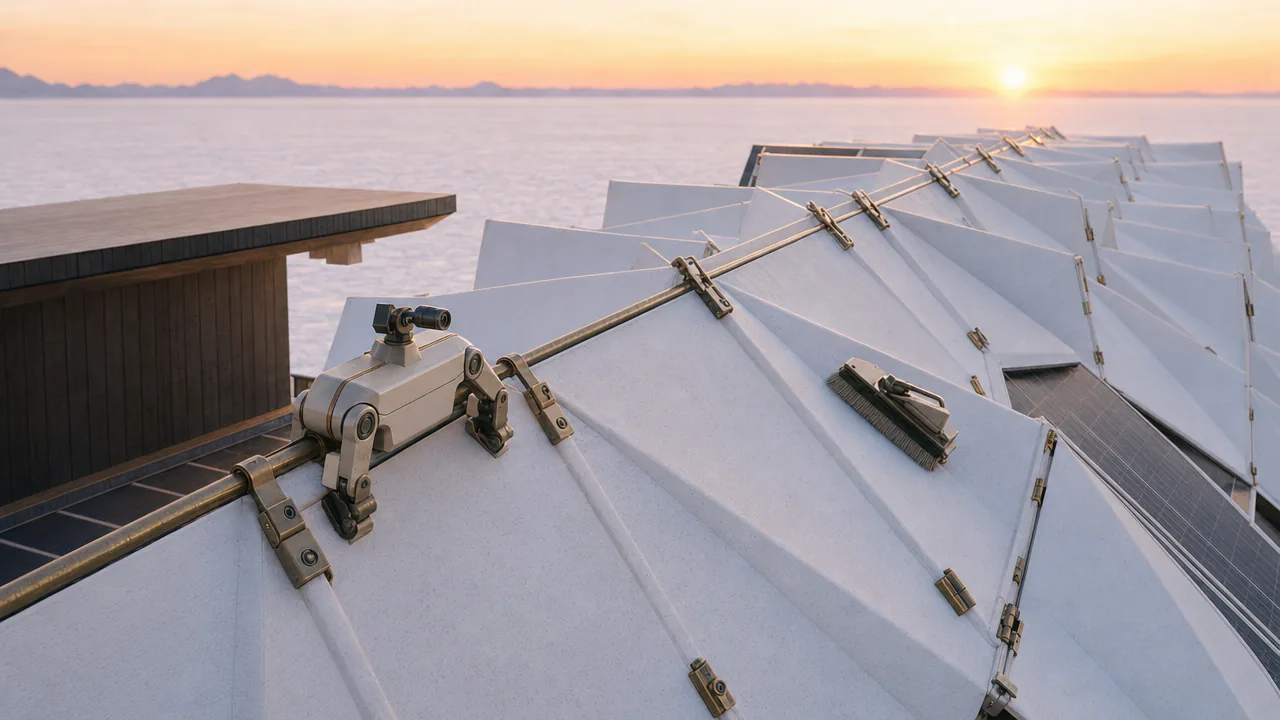
Care layer concept visual
守Layer 6 The Autonomy Stack · self-maintaining

Care. Make the building the robot's map and fixture, swap whole organs, and keep a remote human for exceptions.

8 subsystems28 projects29 papers31 numbers70 sources
L05 · concept visual · AI
守01 Thesis

A fully automated habitat does not mean a humanoid fixing everything; it means few, captive robots doing scheduled tasks on fixtures the building provides, organ-level swaps instead of repairs, a fleet ledger that learns real failure rates, and a remote operator for the few percent of exceptions. The most scaled autonomous maintenance robots today (row-captive waterless PV cleaners with billions of cleanings) succeed because they are mechanically constrained, not because they are smart. Space shows the same pattern: Canadarm2/Dextre work because ORUs were designed for robots, and Astrobee needed crew for only about 20% of its console time. The non-obvious insight is that design for robot maintenance is mostly the building's job: datum sockets, rails, one handle standard, and coarse ORU granularity turn hard perception and manipulation into easy positioning. General-purpose home manipulators (NEO, Helix, LBMs) are improving fast, but in 2026 they still run on teleoperation, so ORIJO should treat them as an upgrade path, not a dependency.

3.89 billion panel cleanings

Ecoppia row-captive waterless PV robots, cumulative panels cleaned

about 80 %

Astrobee console time without crew (>1,200 console h vs ~220 crew h)

calculatedastrobee-tfr
18 %

ISS ECLSS ORUs that failed more often than predicted (6% by >4x)

measuredowens-iss
Slab 6 of the stack · see all eight

Maturity of options assessed

  • commercial 11
  • pilot 13
  • experimental 4
  • speculative 0
守02 Subsystem explorer

How the care layer works, option by option.

Each subsystem lists the technologies the research found, with maturity, an estimated technology readiness level and the numbers that matter. Hover a TRL bar for the reason behind it.

CARE-S1 · function

Sense and patrol (inspection)

Detect degradation (leaks, hot joints, corrosion, cracks, loose latches, soiling) before it becomes failure, on a schedule and on demand.

How it works

A sensor head is carried past every asset on a repeatable route, and each reading is registered to the asset's ID so trends, not snapshots, drive work orders. Thermal imagers read emitted long-wave IR to find resistive hot spots and blocked flow; ultrasonic microphones (to hundreds of kHz) pick up gas leaks and partial discharge that are inaudible; contact ultrasonic transducers measure wall thickness by time-of-flight on steel. The carrier choice is a trade between access and repeatability: fixed sensors are cheapest per reading but blind between points; legged robots climb stairs built for humans; magnetic crawlers hold contact for UT on steel; drones see envelopes and roofs. In ORIJO the building's own crease rails and 910 mm datum sockets make the route mechanically repeatable, so a rail-captive head returns to within the socket tolerance every time and image differencing becomes trivial.

COMMERCIALTRL 9

Legged inspector (ANYmal, Spot)

Quadruped carrying thermal, zoom, ultrasonic-acoustic and gas payloads on autonomous routes with dock recharge

  • 90 (90–120 min walking, 2 km) min reportedANYmal runtimeanymal-spec
  • 100 min reportedANYmal 70% quick chargeanymal-spec
  • 0–384 kHz reportedANYmal ultrasonic mic rangeanymal-spec
  • 90 / 60 min reportedSpot runtime / rechargespot-spec
  • 14 kg reportedSpot payloadspot-spec

Best for E7 steppe/farm clustersE3 desert sites with many moduleshotel clusters (rented per visit)

Limits Runtime 90 min sets a duty cycle of roughly 1:1 run:charge for Spot; IP54 (Spot) is marginal for driving rain and snow; capital cost too high to dedicate to one home.

Sold and operated on offshore, energy and manufacturing sites; >1,500 Spot units in customer hands (claimed).

EXPERIMENTALTRL 3

Rail-captive sensor head (TSURU / crease rail)

Robot locks to datum sockets on the ridge rails; the structure is the map

Best for all ORIJO environments with YOSHI ridgesE4 polar and E5 mountain where walking outside is unsafe

Limits Sees only what is ridge-adjacent; one robot per contiguous rail network; untested in icing.

Concept from v3 M09 with analogues (ARMADAS lattice robots, BMU gantries, Ecoppia row robots) but no ORIJO hardware built.

COMMERCIALTRL 9

Magnetic / climbing crawler (Gecko TOKA class)

Magnetic wheels hold sensor arrays (UT, EMAT, visual) against steel walls, tanks, boiler tubes

  • 125 USD million reportedGecko Series Dgecko-trr
  • 1.25 USD billion reportedGecko valuationgecko-trr

Best for steel tanks, ASHI steel legs, battery cabinet enclosures (rare in ORIJO)

Limits Needs ferrous substrate; ORIJO panels are LVL/composite, so relevance is limited to steel legs and tanks.

Gecko serves US Navy, power and refinery customers at unicorn scale; $300M Navy IDIQ (claimed).

COMMERCIALTRL 8

Inspection drone

Photogrammetry and IR thermography of envelopes and roofs

  • 269 papers measuredRobotic built-environment inspection papers reviewedhalder

Best for E1 rooftopE7 farmland clusterspost-storm envelope surveys

Limits Wind, snow, rules on unattended flight; sees surfaces only, cannot touch or fix.

Widely used for building energy audits (Rakha 2018 review); autonomous dock-in-a-box products exist but regulation limits unattended BVLOS flight.

PILOTTRL 7

Intra-vehicular free flyer (Astrobee)

Fan-propelled cube robots that dock to recharge and survey a habitat interior

Best for E8 lunar / TSUKI interiors

Limits Microgravity only; localization in a changing interior was its biggest continuing challenge.

Operating on ISS since 2019 for research; not an operational caretaker yet.

史03 Projects · including failures

Who has tried this, and what happened.

28 projects and companies, oldest first. 1 of them closed, failed or went bankrupt; they are kept in, because investors learn more from them than from the successes.

WhenProjectWhatStatusOutcome or lesson
2000–2026ISS ECLSS logistics and maintenance (MADS)NASA · USBayesian failure-rate updating for ORUsactiveOperations revealed underestimated failure rates (one ORU 7.8x) and saved 3.9–6.0 t spares for Mars-class missions. owens-iss
2001–2026Canadarm2 + Dextre (Mobile Servicing System)CSA / MDA / NASA · CARelocatable arm and two-armed dexterous robot that replace ORUs outside the ISSactiveMost robotic ops are ground-commanded; ORU design (grapple fixtures, standard bolts) is what made robot maintenance possible. mss-wikiyt-dextreoos-ma
2002–2026RoombaiRobot · USConsumer floor-cleaning robotsrestructured (bankruptcy; acquired by contract manufacturer)Filed Chapter 11 on 2025–12–14; emerged by Jan 2026 as a privately held, wholly owned subsidiary of its contract manufacturer and lender Shenzhen Picea, still selling and supporting Roombas. The independent company failed; the product survived as a commodity. Lesson: a one-task home robot is a manufacturing-cost game. irobot-mdirobot-trr
2004–2008SIRIUScFraunhofer IFF · DEFully automated gantry + facade robot for an 80 m, 4,000 m² facaderesearchShowed that the gantry (positioning, power, safety) is half the system; no scale-up evidence found. sirius
2013–2026TOKA / Komodo crawlers + CantileverGecko Robotics · USWall-climbing inspection robots and an analytics platform for power, refining and naval assetsactiveData platform plus robots won defence contracts ($71M, expanded to a $300M IDIQ) and a $1.25B valuation; the money is in the data layer, not the robot alone. gecko-trrgecko-site
2013–2026Relay (ex-Savioke)Relay Robotics · USHotel and hospital delivery robotactiveSavioke's assets were acquired by an undisclosed buyer and relaunched as Relay Robotics in May 2022; hospitality stayed the core market, with hospitals (10 at launch) and real estate as adjacent markets. Single-task delivery needed new verticals to grow. relay-trr
2014–2026E4 / T4 / H4 waterless PV cleaningEcoppia · ILRow-captive nightly microfibre + airflow PV cleaning robotsactiveThe most scaled fully autonomous maintenance robot found: captive to fixed geometry, so perception is minimal. Template for ORIJO surface robots. ecoppia-siteecoppia-keturayt-ecoppia
2014Ketura solar parkEcoppia / Arava Power · IL100 robots clean a 20-acre PV park nightly without watershippedReplaced roughly nine water washes a year (each up to five days) with zero-water nightly cleaning. ecoppia-ketura
2014Ecuador irrigation canalTU Delft / partners · ECFirst field application of bacterial self-healing concrete with natural fibresresearchField use in an Andean canal where about 70% of water was lost through unlined walls. jonkers-ecuador
2015–2026Henn-na HotelH.I.S. Group · JPRobot-staffed hotel with 243 robotsactive (scaled back)Decommissioned about half of 243 robots in 2019 because they created more work for humans; the chain survived by keeping robots as novelty/check-in features with human staff behind them (25 locations listed in Oct 2026). Guest-facing robots without a human backup fail; robots as an attraction plus humans as the service can persist. henn-futurismhenn-vergehenn-bhimastahenn-site
2015–2026Basilisk self-healing concreteBasilisk (TU Delft spin-off) · NLBacteria-based healing agent, repair mortar and liquid repairactiveCommercial for sub-millimetre cracks in water-exposed concrete; field projects claimed. basiliskwiktor
2015–2016HobbitTU Wien et al. · ATAssistive manipulation robot in 16 private homesresearchReal homes exposed misinterpretation failures that never appeared in labs. hobbit
2015–2018SYMPARTNERTU Ilmenau / MetraLabs · DECompanion robots in 20 senior households, one week each, unsupervisedresearchSeniors adapted quickly; robustness under domestic conditions was the hard part. sympartner
2016–2026ANYmal / ANYmal XANYbotics (ETH Zurich spin-off) · CHAutonomous quadruped inspector with thermal, acoustic and gas payloads; Ex-proof variantactiveOffshore HVDC field trials showed legged robots can patrol human-built plants; product runtime still ~90 min, so docks are essential. anymal-specanymal-hvdcanybotics-60m
2017–2026ServiBear Robotics (LG Electronics 51%) · US/KRRestaurant and hospitality serving robotsactiveConsolidated into a large manufacturer (LG call option to 51% exercised 2025–01–22); KED Global reports it sounding out PE firms for up to 400 billion won (~$300M) pre-IPO funding ahead of a potential Nasdaq listing (2026–09–07, reported, not confirmed by the company). bear-ravebear-ked
2017–2020MoveCareEU H2020 consortium · EUAssistive robots in 10 older adults' apartments for 130 weeksresearchRemote supervision increased acceptance. Long-term autonomy needs a human channel. luperto
2019–2026OzmoSkyline Robotics · US/ILKUKA arm on a building maintenance unit cleaning a 45-storey Manhattan facadepilotClaims ~3x speed but still needs a rooftop supervisor; lidar struggles on transparent glass, so ultrasonic sensors were added. ozmo-trryt-ozmo
2019–2026AstrobeeNASA Ames · USThree free-flying IVR robots with dock recharge on ISSactive>165 operations; ~80% of console time without crew; biggest problem was localization in a changing interior; too many ORUs hurt the design. astrobee-nasaastrobee-tfr
2019–2023ISAACNASA · USIntegrated autonomous caretaking: robots + spacecraft systems + groundresearchFrames caretaking for uncrewed phases; Gateway planned to be uncrewed >85% of the time. isaacastrobee-tfr
2020–2026SpotBoston Dynamics (Hyundai) · USCommercial quadruped for inspection, data capture and manipulationshipped>1,500 units in customer hands (claimed); AB InBev cut average repair times from months to 13 days (claimed). Value comes from repeatable routes feeding work orders. spot-specspot-retro
2020–2026Stretch 3Hello Robot · USLightweight wheeled mobile manipulatorshippedSold to research ($24,950); vendor says consumer home market is not ready yet. Shows a low-mass, low-force design that is safe in homes. stretch-spectrum
2020–2029+Canadarm3 / GatewayCSA / MDA / NASA · CA/US8.5 m arm plus dexterous arm and ORU/tool caddy, some tasks autonomousresearchDelivery no earlier than 2029; CSA states intent to repurpose investments to the next lunar phase, so the Gateway path is uncertain. canadarm3gateway-nasa
2023–2026NEO1X Technologies · NO/USHome humanoid sold at $20,000 or $499/month with remote 'Expert Mode' teleoperationpilotTeleoperation openly offered as the bridge to autonomy; WSJ found it mostly teleoperated. Honesty about remote operators is now a product feature. neo-newatlasneo-kalilyt-neo-wsj
2023–2026Large Behavior ModelsToyota Research Institute · USMultitask diffusion-transformer policies pretrained on ~1,700 h of demosresearchFinetuning needs under 30% of task data in sim to match single-task (interpolated estimate); the paper cites ~1,800 controlled real-world trials (elsewhere ~2,700 rollouts) to evaluate rigorously. Published in Science Robotics (2026–04–15). lbm
2023–2026DigitAgility Robotics · USBipedal tote-handling humanoid at GXO, Schaeffler, Amazon, Toyotaactive>65,000 operating hours; Digit 5 claims a 9-minute charge. Fast charging changes how many robots a job needs. digit5
2025–2026Helix / Figure 03Figure AI · USDual-system VLA (7B planner at 7–9 Hz, 80M controller at 200 Hz) for humanoidspilot~500 h of teleop data trained a generalist upper-body controller; no public success-rate numbers. figure-helix
2025pi0.5Physical Intelligence · USVLA co-trained on heterogeneous robots and web data, tested cleaning unseen homesresearchOpen-world generalisation to new homes is now demonstrated in research; reliability for unattended use is not. pi05
2026Walden RoboticsWalden Robotics (origin claim 'spun out of a Toyota lab' unverified) · USGeneral-purpose industrial robots; $300M seedunverifiedHeadline only: a Business Wire release (2026–07–15) title says it launched with $300M; the page returned 403 and the round type, investors and founders could not be verified. Do not cite as evidence. walden

Failures, read for lessons

  1. Henn-na Hotel decommissioned about half of its 243 robots (2019)

    WhyGuest-facing robots handled only scripted cases (foreign passports, local questions); luggage robots reached about a quarter of rooms; failures created more human work.

    Lesson for AnygroundKeep robots back-of-house and out of guest moments; budget a human runner for the hotel; never deploy a robot whose failure mode is a guest waiting.

  2. iRobot filed Chapter 11 (Dec 2025) and was taken over by its contract manufacturer

    WhyA narrow single-task consumer robot commoditised; the Amazon acquisition collapsed in 2024 and competitors undercut it.

    Lesson for AnygroundDo not sell the robot; sell uptime of the building (lease/service). Robots are cost lines inside the SHIKINEN lease.

  3. Savioke relaunched as Relay Robotics after acquisition (2022)

    WhyUndisclosed acquirer formed a new entity; hotel delivery alone was a small market, so it expanded into hospitals and real estate while keeping hospitality as core.

    Lesson for AnygroundSingle-task hotel robots need long corridors and volume; a 6-key ORIJO hotel has neither.

  4. 1X NEO revealed as heavily teleoperated in the WSJ test (2025)

    WhyGeneral home autonomy is not ready; the company openly uses remote operators.

    Lesson for AnygroundDesign for teleoperation from day one, with consent, privacy zones and logged interventions; market honest 'robot plus remote human' service.

  5. Astrobee: too many components designed as ORUs

    WhyCaptive fasteners, access geometry, mass and size grew; team judged that a few larger replaceable sub-assemblies would capture most of the benefit.

    Lesson for AnygroundSwap at organ level (one JO-PORT organ = one ORU) and at wear-part level only.

  6. Astrobee: modularity broken by unspecified interface properties (EMI on power bus, nozzle noise amplified by plenum)

    WhyPower-quality and acoustic requirements were never defined at the module interface.

    Lesson for AnygroundJO-PORT spec must include DC ripple/EMI limits, acoustic and thermal limits, not just geometry and connectors.

  7. Astrobee: localization was the biggest continuing challenge

    WhyThe ISS interior changes constantly, so maps went stale faster than planned.

    Lesson for AnygroundUse fixtures (datum sockets, rails, docks) as the map; never rely on visual maps of rooms that guests rearrange.

  8. ISS ECLSS: some ORU failure rates were badly underestimated (one ~7.8x)

    WhyPre-flight reliability predictions lacked operating data.

    Lesson for AnygroundStart each organ type with pessimistic priors, log every failure across the fleet, and size site spares from posteriors.

  9. Hotel staff shelve robots after adoption (robot usage resistance)

    WhyRobot-related extra workload, low usability, techno-insecurity.

    Lesson for AnygroundMeasure staff minutes added by robots, not only saved; a robot that adds work is removed.

  10. Gateway/Canadarm3 programme uncertainty (2025–2026)

    WhyArtemis architecture changes; CSA states intent to repurpose Canadarm3 investments.

    Lesson for AnygroundDo not anchor the TSUKI roadmap to a single agency programme; reuse terrestrial service grammar.

  11. Ozmo still needs a rooftop supervisor; lidar failed on glass

    WhyTransparent surfaces defeat lidar; safety at height requires a human.

    Lesson for AnygroundAdd contact or ultrasonic sensing for glazing (YOSHI-6G); keep facade work on rails, not free-flying.

文04 Key papers

The science underneath, 29 papers.

Newest first. Each line states the finding that the dossier relies on.

  1. 2026

    Astrobee: Free-Flying Robots for the International Space Station

    Alexandrov, Barlow, Bualat, Fong, Smith et al. · IEEE Trans. Field Robotics · field-trial

    Over 1,200 h of console support needed only ~220 h of crew (~80% crew-free); 4 hardware problems across ~379 robot and dock sessions.

  2. 2025

    A Careful Examination of Large Behavior Models for Multitask Dexterous Manipulation

    TRI LBM Team (Barreiros et al.) · arXiv 2507.05331 / Science Robotics 2026 · experiment

    Finetuned LBMs match single-task performance on unseen sim tasks with under 30% of the task data (interpolated estimate), using about 1,695 h of pretraining demos (~545 h TRI + ~1,150 h OXE).

  3. 2025

    pi0.5: a Vision-Language-Action Model with Open-World Generalization

    Physical Intelligence (Black, Brown et al.) · arXiv · experiment

    Co-training on heterogeneous robot and web data lets the model do multi-step tasks in homes not seen in training (no single headline number).

  4. 2024

    DROID: A Large-Scale In-The-Wild Robot Manipulation Dataset

    Khazatsky, Pertsch, Nair et al. · RSS · experiment

    The dataset holds 76k demonstrations collected in diverse real environments, improving policy robustness.

  5. 2023

    Robots in Inspection and Monitoring of Buildings and Infrastructure: A Systematic Review

    Halder, Afsari · Applied Sciences · review

    A content analysis of 269 papers found nine robot types, with UAVs most common, then UGVs.

  6. 2023

    PV module vibration by robotic cleaning

    Figgis, Bermudez, Garcia · Solar Energy · field-trial

    Field measurement at Qatar's QEERI of module vibration induced by cleaning robots (full text not accessed; values not verified).

  7. 2023

    Diffusion Policy: Visuomotor Policy Learning via Action Diffusion

    Chi, Xu, Feng et al. · RSS / IJRR · experiment

    Across 15 tasks from 4 benchmarks (IJRR version; 12 tasks in the RSS 2023 version), it averages 46.9% better than the prior state of the art.

  8. 2023

    Advances in Space Robots for On-Orbit Servicing: A Comprehensive Review

    Ma, Jiang, Liu, Xie · Advanced Intelligent Systems · review

    Names five key challenges, including multifunctional end-effectors and ground teleoperation with long delays.

  9. 2022

    The perils of hotel technology: The robot usage resistance model

    Fu, Zheng, Wong · Int. J. Hospitality Management · model

    Staff resistance comes from excessive robot-related workload, techno-insecurity and low usability, so robots get shelved after adoption.

  10. 2022

    User feedback and remote supervision for assisted living with mobile robots: long-term autonomy field study

    Luperto, Romeo, Monroy et al. · Robotics and Autonomous Systems · field-trial

    A 130-week study in 10 older adults' apartments found remote supervision increased acceptance.

  11. 2022

    A Digital Twin predictive maintenance framework of air handling units based on AFDD

    Hosamo, Svennevig, Svidt, Han · Energy and Buildings · field-trial

    Combines APAR fault rules, ML condition prediction and maintenance planning, validated on Aug 2019-Oct 2021 data from a Norwegian building.

  12. 2022

    Application of an adapted FMEA framework for robot-inclusivity of built environments

    Ng, Yeo, Ng, Budig et al. · Scientific Reports · model

    Most service-robot failures trace to poor furniture design, missing clearances and hazard indicators, and sub-optimal interior planning.

  13. 2022

    A review on self-healing polymers for applications in spacecraft and construction of roads

    Goyal, Agarwal, Bhatnagar · J. Applied Polymer Science · review

    Compares the healing efficiency and limits of extrinsic and intrinsic self-healing polymers for space and roads.

  14. 2021

    ANYmal in the Field: Solving Industrial Inspection of an Offshore HVDC Platform with a Quadrupedal Robot

    Gehring, Fankhauser, Isler et al. · Field and Service Robotics (FSR 2019), Springer Proceedings in Advanced Robotics 2021 · field-trial

    First North Sea HVDC platform trial of autonomous legged inspection (abstract only; numbers not verified).

  15. 2021

    The Robot Household Marathon Experiment

    Kazhoyan, Stelter, Kenfack et al. · ICRA · experiment

    Tested extended fully autonomous pick-and-place and container opening in a household and reported the limits hit.

  16. 2021

    ISAAC: An integrated system for autonomous and adaptive caretaking

    Smith, Bualat et al. · ISS R&D Conference · experiment

    Uses Astrobee and Robonaut as analogues to integrate IVR robots with spacecraft systems for uncrewed caretaking (no metrics given).

  17. 2020

    Her Name Was Chloe and She Delivers Stuff to Your Room

    Salminen, Milenkovic · NordiCHI · field-trial

    Of 1,289 TripAdvisor reviews of six robot hotels, 92% were positive, mostly about novelty; failures show human backup is needed.

  18. 2020

    Scaled Autonomy: Enabling Human Operators to Control Robot Fleets

    Swamy, Reddy, Levine, Dragan · ICRA · experiment

    Learning which robot most needs a human lets one operator supervise more robots than unaided attention allows.

  19. 2019

    Techno-Economic Assessment of Soiling Losses and Mitigation Strategies for Solar Power Generation

    Ilse, Micheli, Figgis et al. · Joule · model

    Even with optimized cleaning, soiling cuts global solar output by at least 3–4%, worth 3–5 billion EUR a year in 2018, projected to rise to 4–7% by 2023.

  20. 2019

    What causes the adoption failure of service robots? A case of Henn-na Hotel

    Bhimasta, Kuo · UbiComp/ISWC Adjunct · field-trial

    A thematic analysis of 250 negative reviews found six failure themes, including the need for human intervention, usefulness and embodiment.

  21. 2019

    Results of Field Trials with a Mobile Service Robot for Older Adults in 16 Private Households

    Bajones, Fischinger, Weiss et al. · ACM THRI · field-trial

    All 16 users interacted with Hobbit daily over multiple weeks; real homes exposed misinterpretation failures.

  22. 2019

    Living with a Mobile Companion Robot in your Own Apartment: 20-week field study with 20 seniors

    Gross, Scheidig, Muller et al. · ICRA · field-trial

    Two robots served 20 single-person households (ages 62–94) for a week each with no on-site support.

  23. 2019

    On-orbit service (OOS) of spacecraft: A review of engineering developments

    Li, Cheng, Liu et al. · Progress in Aerospace Sciences · review

    Reviews OOS from Hubble's five servicing missions through ETS-VII and Orbital Express (384 citations).

  24. 2018

    Review of UAS applications in the built environment: towards automated building inspection procedures using drones

    Rakha, Gorodetsky · Automation in Construction · review

    Proposes a standard drone IR energy-audit procedure, tested on the Syracuse University campus (465 citations).

  25. 2018

    International Space Station Operational Experience and its Impacts on Future Mission Supportability

    Owens, de Weck · ICES-2018–198 · model

    18% of ECLSS ORUs fail more often than predicted (6% by more than 4x) and 26% are twice as reliable; corrected rates save 3.9–6.0 t of Mars spares.

  26. 2013

    Climbing robots for maintenance and inspections of vertical structures: a survey

    Schmidt, Berns · Robotics and Autonomous Systems · review

    Landmark survey of adhesion and locomotion principles for climbing robots (282 citations); not read in full here.

  27. 2011

    Quantification of crack-healing in novel bacteria-based self-healing concrete

    Wiktor, Jonkers · Cement and Concrete Composites · experiment

    Landmark bacterial healing study (1,177 citations); the healed crack-width values were not verified here.

  28. 2008

    Kinematics, sensors and control of the fully automated facade-cleaning robot SIRIUSc

    Elkmann, Lucke, Kruger et al. · Industrial Robot · field-trial

    A fully automated gantry plus robot system was built for an 80 m, 4,000 m² facade.

  29. 2006

    Crew maintenance lessons learned from ISS and considerations for future manned missions

    Bertels · SpaceOps 2006 · field-trial

    Search snippet says ISS crews had spent over 4,000 hours on maintenance by 2006 (full text not accessed; treat as unverified).

数05 Numbers ledger

Every number, with its basis.

Measured, reported, claimed, calculated or target: the basis travels with the value.

QuantityValueUnitBasisSources
Global solar output lost to soiling even with optimized cleaningWorth 3–5 billion EUR a year; sets the value of PV cleaning robots3–4 (4–7 projected for 2023)% of productioncalculatedilse-joule
Ecoppia cumulative panels cleaned / sessionsCompany counters on 35+ sites and 5,000+ MW; an embedded figure says 4,000 MW (inconsistent)3.89e9 / 10.51e6panels / sessionsclaimedecoppia-site
Ketura robot coverage rate (per robot)Times of Israel: each robot covers about 100 ft2 of panel per minute; 100 robots clean the 20-acre park nightly with zero water, replacing about nine water washes a year (each up to five days)~100 (about 9.3)ft2/min (m²/min)reportedecoppia-ketura
Dust efficiency loss quoted by Ecoppia (2014)Upper-bound desert claim; contrast with the 3–4% global average in NUM-01up to 35%claimedecoppia-ketura
Spot runtime / recharge / payloadIP54, -20 to 55 C; run:charge about 1.5:190 / 60 / 14min / min / kgreportedspot-spec
Spot units in customer handsCompany page 2026>1,500robotsclaimedspot-spec
Spot industrial assets inspected in 2022AB InBev: average repair time from 'a few months' to 13 days>130,000assetsclaimedspot-retro
ANYmal battery runtime and quick charge10 kg extra payload; IP67; customer claims +1.5% production uptime90 run / 100 to 70% / 180 fullminreportedanymal-spec
Digit 5 charge time / runtime / run:chargeDigit 4 for comparison: 1–2 h charge, ~4 h runtime, 2:1. Digit 4: >65,000 operating hours at customer sites and >100,000 totes at ~98% task accuracy at GXO Flowery Branch9 min; ~90 min; 10:1min; min; ratioclaimeddigit5
Gecko Robotics valuation / Series DSeries D and valuation reported by The Robot Report 2025–06–12. Navy figures are company press releases (claimed): $71M deal 2026–03–17; IDIQ expanded to $300M 2026–10–20 with 'savings up to $8M per ship'1.25 / 0.125USD billionreportedgecko-trrgecko-site
Henn-na Hotel robots decommissionedLuggage robots could reach only about a quarter of rooms; in-room assistant woke guests on snoringabout half of 243robotsreportedhenn-futurism
Robot-hotel reviews that were positiveMostly novelty-driven; failures stress human backup92% of 1,289 reviewsmeasuredchloe
Ozmo speed vs manual window cleaning45-storey tower, rooftop supervisor still present~3xratioclaimedozmo-trr
1X NEO price / mass / battery / noiseRemote 'Expert Mode' teleoperation; WSJ: mostly teleoperated during visit20,000 USD or 499 USD/month; 30 kg; ~4 h; 22 dBmixedclaimedneo-newatlasneo-kalil
Helix model splitRuns on two onboard embedded GPUs7B @ 7–9 Hz planner; 80M @ 200 Hz controller; ~500 h teleop data; 35 DoFparams / Hz / hreportedfigure-helix
LBM data needed to match single-task performance on unseen sim tasksInterpolated from sim data-fraction sweeps (paper's own wording), not a direct real-world measurement. Pretraining ~1,695 h (~545 h TRI + ~1,150 h OXE); real SetBreakfastTable: LBM with 15% of the data beat single-task with 100% (single-task empirical success was 0)<30% of task-specific datacalculatedlbm
Diffusion Policy average improvement15 tasks, 4 benchmarks (IJRR 2024 version; the RSS 2023 arXiv version reports 12 tasks with the same 46.9%)46.9%measureddp
Astrobee console hours vs crew hoursNearly 80% of console time without crew; >165 real-time operations, >90 guest-science sessions>1,200 / ~220hmeasuredastrobee-tfr
Astrobee hardware problems per sessionTable X: Dock 164 sessions/2 problems, Batteries 164/0, Bumble 135/0, Honey 59/1, Perching Arms 23/0, Queen 21/1. 379 counts Dock + 3 robots only; sessions overlap across rows, so treat as an indicative rate, not an MTBF4 / 379 (about 1.1); 4 / 566 (about 0.7) if all Table X rows are countedproblems / sessions (%)calculatedastrobee-tfr
Astronaut time per SPHERES session (pre-Astrobee)Astrobee's dock-recharge, fan propulsion design was driven by removing this burden~4hreportedastrobee-tfr
Planned Gateway uncrewed share (as cited by Astrobee team)Stated in the Astrobee TFR paper (its ref. [29]); NASA's Gateway page (2026–07–23) gives no percentage and notes Artemis architecture updates of Feb 2026, so the programme is uncertain>85% of timereportedastrobee-tfr
ISS ECLSS ORU failure-rate surprisesBayesian updates of on-orbit data18% worse; 6% >4x worse; 26% ≥ 2x better; max 7.8x worse% of ORUsmeasuredowens-iss
Spares mass saved by ISS-informed failure rates (1,200-day Mars mission)Also uncovered underestimates worth an order of magnitude in risk3.9–6.0tcalculatedowens-iss
Canadarm2 length / joints / max payloadWalks end over end between grapple fixtures (analogue for TSURU)17.6 / 7 / 116,000m / joints / kgreportedmss-wiki
Canadarm3 large arm length; deliveryIncludes ORU and tool caddy; some tasks autonomous8.5 m; NET 2029m; yearreportedcanadarm3
Self-healing concrete crack widthBasilisk; activation needs waterup to 1mmclaimedbasilisk
Long-term home robot field study lengthRemote supervision raised acceptance130weeks (10 apartments)measuredluperto
iRobot Chapter 11 filing; Picea unsecured claimCombined debt and assets 480.3 M USD at 2025–06–28; taken over by its contract manufacturer2025–12–14; 98.9date; USD millionreportedirobot-md
Stretch 3 price / massResearch market; vendor says consumer homes are not its market yet24,950 / 24.5USD / kgreportedstretch-spectrum
Remote-operator capacity for ORIJO homesFormula in sizing_reference.home_4p; assumes 5% intervention rate at 5 min each (target, unvalidated)~200homes per operator FTEcalculatedastrobee-tfrscaled-aut
Spot Explorer kit list priceRobot, two batteries, charger, tablet, cases, SDK; US commercial/industrial sale only at launch; current pricing is by quote74500USD (2020)reportedspot-slashdot
段06 Autonomy ladder

From manual to Earth-independent, in human minutes.

Human minutes per week for this layer at each level (log bars). The unified site-level scale is on the Autonomy Stack page.

  1. L0

    All inspection, cleaning and repair done by residents or tradespeople on call.

    Manuals, tools

    ~120–180 (estimate for an off-grid home with PV, water treatment and farm; unsourced, to be measured) min/wk
  2. L1

    Sensors and alarms: fixed IoT sensors and a dashboard tell people what to do.

    IoT sensors, rule-based FDD

    ~90 (estimate) min/wk
  3. L2

    Captive single-task robots: PV/glazing row robots, robot vacuum, scheduled cartridge reminders.

    Ecoppia-class row robots, docks

    ~60 (estimate) min/wk
  4. L3

    Rail-captive service robot does inspections and organ/cartridge swaps at standard ports; remote operator handles exceptions.

    TSURU, JO-PORT, failure ledger, remote ops centre

    ~20 on site + ~6 remote (target, see sizing) min/wk
  5. L4

    Mobile manipulator handles open-ended indoor tasks with learned policies; teleop fallback below 1% of tasks.

    LBM/VLA policies, Stretch/humanoid, fleet learning

    ~10 on site + ~3 remote (target) min/wk
  6. L5

    Self-maintaining: robots swap organs, receive drone resupply and service each other; humans only for depot repair and renewal.

    Heavy-lift drone resupply, robot-serviceable robots, self-healing seals

    ~0 on site; depot time per swapped organ (speculative) min/wk

ORIJO roadmap for this layer

  • 2027 L1 · v3 Phase 1 Bench
  • 2029 L3 · v3 Phase 3 Catalogue (first IE homes, HATA-MURA farms)
  • 2032 L4 · v3 Phase 4 Extreme (KITA winter-over)
結07 Interfaces

What crosses to the other layers.

Flows into and out of this layer from the synthesis, coloured by currency.

  • Structure →Datum sockets every 910 mm, crease rails, robot-readable latch flagsabout 8 per 7.28 m ridge line sockets per YOSHI-4 ridge calculated
  • Energy →Robot charging on JO-PORT docksabout 0.25 (TSURU-class patrol at 60 W) kWh/week calculated
  • Water →Cartridge swaps (filters, UV, membranes, sorbent, pump tubing)about 1.5 (12 consumables, mean 8-week interval) swaps/week target
  • Loop →Sealed waste cassettes to swap (zeolite, BSF trays, compost bins)12–25 kg zeolite/week calculated
  • Grow →Rail arm and cassette service; shared dock and rail profile30–45 at L3 (target ≤ 30) human min/week per cassette target
  • Build →Installs rails, sockets, docks; hands over as-built point cloudone survey per deployment - design rule
  • → StructureLatch audits, seal and hinge thermal scans, leg re-levelling2 × 15 min patrols/day target
  • → EnergyPV cleaning (recovered yield), battery/inverter organ swaps3–4 global soiling loss average (more in deserts) % of PV yield calculated
  • → WaterFilter/membrane/UV/sorbent cartridge swaps10 robot min/swap target
  • → LoopZeolite and BSF cassette swaps; odour patrol (NH3/VOC)1 (zeolite cartridge 20–25 kg) swaps/week target
  • → GrowRail-arm and UV-bar upkeep, tray jam clearingincluded in 30–45 per cassette human min/week target
  • → BuildRe-levelling, refold before storms, depot repair of swapped organs0.5 with organ swap vs 24–72 with on-site repair MTTR h target
  • → MindIntervention logs as demonstrations; failure ledger; teleop sessionsabout 6 remote min/week per home calculated
  • Mind →Work orders, spare forecasts, remote-assistance routingabout 200 at 6 remote min/week; 40–160 at L3 15–60 min homes per operator FTE calculated
折08 ORIJO design

The recommended stack and what we would build next.

What ORIJO adopts from the state of the art, the new mechanisms this layer adds and the 12-month prototype for each, with its pass and kill criteria.

SubsystemORIJO choiceWhy
CARE-S1 Sense and patrolFixed sensors at every JO-PORT + TSURU-mounted thermal/acoustic head on crease rails; rent legged inspectors per cluster visitRail-captive gives repeatable viewpoints without mapping; legged robots are COMMERCIAL but too costly per home.
CARE-S2 Surface keepingEcoppia-style waterless helix-microfibre crawler on MIURA/BYOBU rows, docked at hinge endsMost proven autonomous maintenance robot; zero water fits desert sites.
CARE-S3 Swap-in maintenanceOrgan-level ORUs at JO-PORT + wear-part cartridges with one handle standardISS/Dextre shows ORUs enable robot maintenance; Astrobee shows the right granularity is coarse.
CARE-S4 Mobile manipulationNo humanoid in v1; wheeled Stretch-class manipulator only in KURA and farm bays from the Catalogue phase; hotel housekeeping stays humanHome autonomy is still teleop-heavy (NEO); Henn-na shows guest-facing failure costs.
CARE-S5 PrognosticsFleet Bayesian failure ledger (DAICHO) + rule-based FDD for HRV/heat pumpIdentical organs across sites make posteriors converge fast; ISS saved tonnes of spares this way.
CARE-S6 Remote opsMADOGUCHI remote ops desk with goal-level commands and intervention loggingAstrobee: ~80% of operations need no person on site; logged interventions become training data.
CARE-S7 Passive durabilityBacterial self-healing concrete for ASHI pads and tanks; sacrificial wipers/seals elsewhereCheap reduction in task count; self-healing polymers are not yet proven outdoors.
CARE-S8 DocksJO-PORT docks on DC spine; prefer fast-charge chemistriesRun:charge ratio sets robot count; Digit 5 shows 10:1 is possible.

01 New mechanism

KAWARI handle (替わり, 'replacement')

One robot-graspable handle and lead-in standard for every swappable organ, cartridge and robot wear part across water, energy, grow and loop layers.

How it works

A 60-degree cone pin plus a flat-faced T-handle sits on the cartridge's front face. TSURU or a person pushes it into a socket whose cone gives about 15 mm capture, after which two balls seat in V-grooves to fix position and a quarter-turn captive bolt preloads it. Dry-break couplers mate only after the datum is seated. An NFC tag in the handle carries the passport ID, and a reed switch confirms lock. The design follows ISS ORU/grapple practice at organ granularity, not component granularity.

12-month prototype
3 socket variants (water filter, sorbent tray, battery module dummy) and 20 cartridges; a UR-class arm and a human test both
BOM
USD 8,000–12,000 (estimate)
Test
2,000 insert/remove cycles by arm with ± 10 mm and ± 3 deg initial error; 200 human swaps by untrained users; leak test at couplers
Pass
≥ 99.5% first-try seat by arm; median human swap ≤ 90 s; zero coupler leaks at 3 bar
Kill
<98% arm seat rate after two design iterations, or human swap >3 min

02 New mechanism

HOKI crease broom (箒, 'broom')

Waterless PV and glazing crawler that rides the MIURA wing hinge rail, parks in a JO-PORT dock at the wing root.

How it works

A helical microfibre cylinder (Ecoppia/Evermore principle) rotates while the carriage travels along the fold line, generating a directional airflow that pushes dust to the low edge. The rail is the hinge line, so the crawler needs only end-stops and a gap sensor. Because MIURA wings fold, the crawler docks before folding and the dock doubles as its storm shelter. Cleaning is triggered when a reference cell shows a soiling ratio below a threshold.

12-month prototype
One 6 m MIURA-wing mock-up with 6 PV modules and reference cell; crawler with 1.8 m helical microfibre cylinder
BOM
USD 6,000–9,000 (estimate)
Test
Desert dust deposition chamber or field site, 90 nights; measure soiling ratio, module vibration (accelerometer) and brush wear
Pass
Keeps soiling loss <2% between cycles; module acceleration below manufacturer limit; brush life ≥ 6 months
Kill
Soiling loss >4% or visible microcracks in EL imaging after 90 nights

03 New mechanism

DAICHO ledger (台帳, 'register')

A fleet-wide Bayesian failure-rate ledger and spares planner for every ORIJO organ passport.

How it works

Each organ type starts with a pessimistic prior failure rate and error factor (ISS MADS practice). Operating hours without failure and each failure update a gamma-Poisson posterior. Site spares are sized so that the probability of sufficiency over the resupply interval is at least 99%, and swap intervals move with the posterior. Remote-operator interventions and robot task failures are logged in the same ledger, so robots get MTBF too.

12-month prototype
Software on existing telemetry from 2 pavilion sites plus bench rigs; import ISS-style priors
BOM
USD 15,000–30,000 (engineering time, estimate)
Test
Back-test on bench failure data; compare spares predicted vs consumed over 12 months
Pass
Predicted spares cover ≥ 99% of demand with <30% excess mass
Kill
Insufficient failure events to update priors (keep as a manual log until the fleet is >20 sites)

04 New mechanism

MADOGUCHI desk (窓口, 'service window')

Remote operations centre where one operator supervises many sites' robots with goal-level commands.

How it works

Robots stop in a safe state below a confidence threshold and post a ticket with video and a suggested action. A scaled-autonomy scheduler ranks tickets by urgency and expected operator time. The operator issues goal-level commands (pose, which cartridge, abort) rather than joystick control, which tolerates satellite latency. Every resolved ticket is stored as a demonstration for policy finetuning, and residents can see and veto camera access through privacy zones.

12-month prototype
One desk, 3 test robots (TSURU mock, HOKI, rented quadruped), Starlink link
BOM
USD 20,000–40,000 excluding robots (estimate)
Test
8 weeks of 24/7 operation across 2 sites; log interventions, latency, resolution time
Pass
Intervention rate ≤ 5% of tasks; median resolution ≤ 5 min; zero privacy-zone violations
Kill
Interventions >20% of tasks after 8 weeks, or operator load >30 min per site per week

05 New mechanism

MIMAMORI head (見守り, 'watching over')

A 3 kg sensor head (thermal camera, ultrasonic microphone, VOC/NH3 gas, RGB) carried by TSURU along ridge rails twice a day.

How it works

At each datum socket the head captures a fixed-pose thermal and acoustic frame. Because the pose repeats to within socket tolerance, frame-to-frame differencing reveals new hot joints, leaks and latch gaps without a learned map. Anomalies above baseline create a DAICHO ticket.

12-month prototype
Head on a manual rail trolley over a YOSHI mock-up with seeded faults (heated connector, 0.5 L/h leak, loose latch)
BOM
USD 4,000–7,000 (estimate)
Test
60 days, 2 patrols/day, randomised seeded faults
Pass
Detects ≥ 90% of seeded faults within 24 h with <1 false alarm per week
Kill
<70% detection or >5 false alarms per week

Sizing reference

home 4p

formula
H_site = sum(tasks_human x min) ; R_robot = patrols/day x 7 x t_patrol + swaps/week x t_swap + PV passes/week x A_pv / r_clean ; H_remote = N_tasks x p_int x t_int ; homes_per_operator = (2,400 min/week x utilisation) / H_remote

inputs

patrols per day
2 (target)
t patrol min
15 (target)
swaps per week
1.5 (assume 12 consumables, mean interval 8 weeks; target)
t swap robot min
10 (target)
A pv m2
25 (assumed home array; set by energy layer)
r clean m2 per min
9.3 (Ketura, reported)
PV passes per week
7 in desert, 1 elsewhere
p int
0.05 (target)
t int min
5 (target)
operator utilisation
0.5 (target)

results

robot minutes per week
210 patrol + 15 swaps + ~19 PV (desert) = ~245 min (calculated)
robot energy kWh per week
~0.25 at 60 W (calculated)
remote operator min per week
~23 tasks x 0.05 × 5 = ~6 min (calculated)
resident min per week
~20: receive and stow consumables delivery, approve swaps (target, matches KURA-3 crew_minutes_week 20)
homes per operator FTE
2,400 × 0.5 / 6 = ~200 (calculated)
basis
calculated from targets; only r_clean is a reported external number

hotel 6key

formula
turnovers/week = keys x occupancy x 7 / mean_stay ; H_housekeeping = turnovers x t_turn ; plus home-style care stack for the building

inputs

keys
6
occupancy
0.7 (assumed)
mean stay nights
2 (assumed)
t turn min
25 (target for a one-jo room designed for fast turnover; industry benchmarks not verified in this sweep)

results

turnovers per week
6 × 0.7 × 7 / 2 = 14.7 (calculated)
housekeeping human min per week
14.7 × 25 = ~370 (calculated); robots do not remove this in 2026
building care human min per week
~30 on site + ~10 remote (target)
robot role
Back-of-house only: patrol, PV, cartridge swaps, night floor vacuum; no guest-facing robots (Henn-na lesson)
basis
calculated from assumptions; housekeeping time is the dominant term and must be measured at the Pavilion phase

farm module

formula
H = HATA robot service + cassette swaps + inspection exceptions ; robot uptime A = MTBF / (MTBF + MTTR)

inputs

HATA robot MTBF h
unknown; start prior 500 h (pessimistic target)
MTTR h with swap
0.5 (target via KAWARI organ swap)
MTTR h with repair on site
24–72 (estimate, remote site)

results

availability with swap
500 / 500.5 = 99.9% (calculated)
availability with on site repair
500 / (500 + 48) = ~91% (calculated)
human min per week
~30 (target)
basis
calculated; the point is that swap-based MTTR, not MTBF, dominates availability at remote sites
問09 Open problems

What is not solved yet.

  1. No public long-run reliability data (MTBF, interventions per hour) for home mobile manipulators or humanoids; vendors publish demos, not failure logs.
  2. Rail-captive robots in icing, snow load and sand: no field data for crease-rail locomotion (TSURU) in E3/E4/E5.
  3. PV cleaning-induced module vibration and microcracks: the trade-off between cleaning frequency and module life is not quantified for lightweight folding PV wings.
  4. Hotel room turnover remains human; bed-making and bathroom cleaning robots are not commercial. Real minutes per turnover must be measured in the Pavilion phase.
  5. Teleoperation economics and privacy: the cost per remote intervention, latency tolerance over satellite links, and consent models for cameras in homes and guest rooms.
  6. Interface specifications beyond geometry (EMI, ripple, acoustic, thermal) for JO-PORT, the gap Astrobee hit.
  7. Self-healing polymers for outdoor hinge membranes: UV, cold-cycling and multi-cycle healing are unproven.
  8. Fleet failure ledger needs enough identical units (>20 sites) before posteriors beat priors; early sites will run on pessimistic guesses.
  9. Regulatory status of unattended drone inspection and heavy-lift resupply varies by country.
  10. Gateway's uncertainty removes the main near-term public testbed for IVR caretaking; terrestrial analogues (ORIJO polar stations) may be the better testbed.
検10 Verification

Checked adversarially.

Claims re-checked
34
Confirmed
27
Corrected
19
Unverifiable
4

Substantially sound. No fabricated sources or DOIs found; numbers match primary sources with correct units. Corrections were about status currency (Henn-na still operating, iRobot restructured not dead), one overstated pivot (Relay), one unsupported detail (Ozmo sill sensors), one basis downgrade (LBM <30% is an interpolated sim estimate), one maturity downgrade (Astrobee ground ops PILOT 8), and the Walden item, which stays unverified.

Corrections made (19)
  • NUM-03Ketura robot coverage rate (ambiguous whether park or robot rate) → per-robot rate, ~100 ft2/min (~9.3 m²/min); sizing r_clean is therefore per robot
  • NUM-099 min; 10:1 → 9 min charge; ~90 min runtime; 10:1 (Digit 4: ~4 h run, 2:1) — runtime added so the ratio is not read as longer endurance
  • NUM-10 contextJune 2025; US Navy IDIQ expanded to $300M with claimed savings up to $8M per ship → Series D and valuation reported by The Robot Report 2025–06–12. Navy figures are company press releases (claimed): $71M deal 2026–03–17; IDIQ expanded to $300M 2026–10–20 with 'savings up to $8M per ship'
  • NUM-16 basismeasured → calculated (interpolated, sim only)
  • NUM-17 context15 tasks, 4 benchmarks → 15 tasks, 4 benchmarks (IJRR 2024 version; the RSS 2023 arXiv version reports 12 tasks with the same 46.9%)
  • NUM-19From Table X: Dock 164 sessions/2, Bumble 135/0, Honey 59/1, Queen 21/1 (omitted Batteries and Perching Arms rows) → 4 / 379 (about 1.1); 4 / 566 (about 0.7) if all Table X rows are counted
  • NUM-21 sources['src-astrobee-tfr', 'src-gateway-nasa'] → ['src-astrobee-tfr'] only — NASA Gateway page does not state >85%
  • PRJ-06 sensorsClaims ~3x speed but still needs a rooftop supervisor; lidar fails on glass and needed extra ultrasonic and sill sensors. → Claims ~3x speed but still needs a rooftop supervisor; lidar struggles on transparent glass, so ultrasonic sensors were added.
  • PRJ-08 statusfailed / 2015–2019 → active (scaled back) / 2015–2026: Henn na Hotel chain lists 25 locations with front-desk and dinosaur robots in Oct 2026
  • PRJ-09Savioke was acquired and relaunched as Relay in 2022 and pivoted toward hospitals; single-task hotel delivery was not enough on its own. → Savioke's assets were acquired by an undisclosed buyer and relaunched as Relay Robotics in May 2022; hospitality stayed the core market, with hospitals (10 at launch) and real estate as adjacent markets. Single-task delivery needed new verticals to grow.
  • failures: Savioke whyHotel delivery alone did not sustain the business; pivot to hospitals. → Undisclosed acquirer formed a new entity; hotel delivery alone was a small market, so it expanded into hospitals and real estate while keeping hospitality as core.
  • PRJ-10Consolidated into a large manufacturer (LG 51% in Jan 2025); pursuing ~$300M pre-IPO round (2026, not verified). → Consolidated into a large manufacturer (LG call option to 51% exercised 2025–01–22); KED Global reports it sounding out PE firms for up to 400 billion won (~$300M) pre-IPO funding ahead of a potential Nasdaq listing (2026–09–07, reported, not confirmed by the company).
  • PRJ-11 statusfailed / 2002–2025 → restructured: emerged from Chapter 11 as Picea subsidiary (TRR 2026–01–23); Roomba line continues
  • PRJ-15Finetuning needs under 30% of task data in sim to match single-task; ~1,800 real-world trials needed to evaluate rigorously. → Finetuning needs under 30% of task data in sim to match single-task (interpolated estimate); the paper cites ~1,800 controlled real-world trials (elsewhere ~2,700 rollouts) to evaluate rigorously. Published in Science Robotics (2026–04–15).
  • PRJ-28Spun out of a Toyota lab / active → status unverified; Toyota origin and 'seed' removed as unverified
  • PAP-04 year2019 → 2021 (published; conference 2019)
  • CARE-S6 Ground-operator model maturityCOMMERCIAL 9 → PILOT 8
  • CARE-S3 Canadarm2+Dextre trl_whyOperational on ISS since 2001 (arm) and 2008 (Dextre). → added caveat: operational agency system, not commercially sold
  • CARE-S5 Bayesian ledger trl_whyUsed operationally by ISS logistics and maintenance. → Used operationally by ISS logistics (MADS); the method is mature but has no off-the-shelf product for building fleets, so ORIJO's DAICHO implementation is TRL ~4.
Could not verify (4)
  • item: PRJ-28 Walden Robotics $300M seed / Toyota origin · reason: Business Wire page blocked (403); layer SERP budget exhausted; only the URL title supports $300M
  • item: PAP-06 Figgis 2023 vibration values · reason: full text not accessed (already flagged)
  • item: PAP-22 Bertels >4,000 crew maintenance hours · reason: DOI resolves, full text not accessed (already flagged)
  • item: Brush-crawler PV robot specs (SolarCleano) · reason: no source in file

Certification route

  • C-C1international · ISO 13482 predates learned behaviours

    ISO 13482:2014 (personal care robots), ISO 10218–1/-2:2025 (industrial robots)

    Hazard analysis, speed/force limits, protective stops

    For ORIJO: Rail-captive TSURU and tray shuttles are easier to certify than free-roaming humanoids: fixed paths, guarded zones.

典11 Sources

70 sources, linked.

Raw data: /d/layers/care.json. Search log and method: Evidence.

  1. src-gecko-trrGecko Robotics reaches unicorn status with latest funding (The Robot Report, 2025–06–12) · news · read
  2. src-gecko-siteGecko Robotics home page (news items: US Navy $71M deal, IDIQ expansion to $300M) · company · read
  3. src-gecko-cnbcGecko Robotics raises $125 million in deal valuing startup over $1 billion (CNBC) · news
  4. src-pat-geckoEP3974823B1 Inspection robot (Gecko Robotics, priority 2016) · patent
  5. src-anymal-specANYbotics ANYmal product page · company · read
  6. src-anybotics-60mANYbotics raises $60M to expand inspection robot deployments worldwide (The Robot Report, 2024–12–12) · news
  7. src-anymal-hvdcGehring et al., ANYmal in the Field: Solving Industrial Inspection of an Offshore HVDC Platform with a Quadrupedal Robot (FSR 2019) · paper
  8. src-spot-specBoston Dynamics Spot product page · company · read
  9. src-spot-retroA Retrospective on Uses of Boston Dynamics' Spot Robot (Boston Dynamics blog, 2024) · company · read
  10. src-ecoppia-siteEcoppia home page (fleet counters) · company · read
  11. src-ecoppia-keturaWorld's first self-cleaning solar park in the Arava Valley (Times of Israel, 2014–03–25) · news · read
  12. src-pat-evermoreWO2023181015A1 Waterless solar panel cleaning robot with helix shaped microfiber elements (Evermore United SA) · patent · read
  13. src-pat-ecoppia-pidWO2019186347A1 Solar panel waterless cleaning system with PID recovery · patent
  14. src-ilse-jouleIlse et al., Techno-Economic Assessment of Soiling Losses and Mitigation Strategies for Solar Power Generation, Joule 2019 · paper · read
  15. src-figgis-vibFiggis, Bermudez, Garcia, PV module vibration by robotic cleaning, Solar Energy 2023 · paper
  16. src-ozmo-trrSkyline Robotics deploys Ozmo window cleaning robot in New York City (The Robot Report, 2024–08–28) · news · read
  17. src-siriusElkmann et al., Kinematics, sensors and control of the fully automated facade-cleaning robot SIRIUSc for the Fraunhofer headquarters, Industrial Robot 2008 · paper · read
  18. src-henn-futurismJapan's Robot Hotel Just Laid Off Half Its Robots (Futurism, 2019–01–15) · news · read
  19. src-henn-vergeJapan's robot hotel lays off half the robots after they created more work for humans (The Verge, 2019–01–15) · news
  20. src-henn-bhimastaBhimasta & Kuo, What causes the adoption failure of service robots? A case of Henn-na Hotel in Japan (UbiComp Adjunct 2019) · paper · read
  21. src-chloeSalminen & Milenkovic, 'Her Name Was Chloe and She Delivers Stuff to Your Room' (NordiCHI 2020) · paper · read
  22. src-rurmFu, Zheng, Wong, The perils of hotel technology: The robot usage resistance model (IJHM 2022) · paper · read
  23. src-relay-trrSavioke is now Relay Robotics (The Robot Report, 2022–05–02) · news · read
  24. src-bear-raveLG Buys Most of Bear Robotics (rAVe Pubs, 2025–01–30) · news · read
  25. src-bear-kedLG Electronics-owned Bear Robotics eyes up to $300 mn pre-IPO funding (KED Global, 2026–09–07) · news
  26. src-irobot-mdRoomba maker files for Chapter 11 bankruptcy (Manufacturing Dive, 2025–12) · news · read
  27. src-irobot-trriRobot emerges from Chapter 11 as restructured Picea U.S. subsidiary (The Robot Report, 2026–01–23) · news
  28. src-neo-newatlas1X's first robot housekeeper is available to pre-order in the US (New Atlas, 2025–10–29) · news · read
  29. src-neo-kalilIs 1X's $20K Humanoid Robot for Home Too Good to Be True? (mikekalil.com, 2025–10–29) · news · read
  30. src-yt-neo-wsjI Tried the First Humanoid Home Robot. It Got Weird. (WSJ, YouTube) · video
  31. src-figure-helixHelix: A Vision-Language-Action Model for Generalist Humanoid Control (Figure, 2025–02–20) · company · read
  32. src-stretch-spectrumStretch 3 Brings Us Closer to Realistic Home Robots (IEEE Spectrum, 2024–02–15) · news · read
  33. src-digit5Agility Robotics Unveils Digit 5 (AI Insider, 2026–09–15) · news · read
  34. src-lbmTRI LBM Team, A Careful Examination of Large Behavior Models for Multitask Dexterous Manipulation (arXiv 2507.05331; Science Robotics 2026) · paper · read
  35. src-dpChi et al., Diffusion Policy: Visuomotor Policy Learning via Action Diffusion (RSS 2023 / IJRR 2024) · paper · read
  36. src-pi05Physical Intelligence, pi0.5: a Vision-Language-Action Model with Open-World Generalization (arXiv 2504.16054) · paper · read
  37. src-droidKhazatsky et al., DROID: A Large-Scale In-The-Wild Robot Manipulation Dataset (RSS 2024) · paper · read
  38. src-scaled-autSwamy, Reddy, Levine, Dragan, Scaled Autonomy: Enabling Human Operators to Control Robot Fleets (ICRA 2020) · paper · read
  39. src-lupertoLuperto et al., User feedback and remote supervision for assisted living with mobile robots: a field study in long-term autonomy (RAS 2022) · paper · read
  40. src-hobbitBajones et al., Results of Field Trials with a Mobile Service Robot for Older Adults in 16 Private Households (ACM THRI 2019) · paper · read
  41. src-sympartnerGross et al., Living with a Mobile Companion Robot in your Own Apartment: 20-week field study with 20 seniors (ICRA 2019) · paper · read
  42. src-marathonKazhoyan et al., The Robot Household Marathon Experiment (ICRA 2021) · paper · read
  43. src-astrobee-nasaNASA Ames Astrobee page · agency · read
  44. src-astrobee-tfrAlexandrov et al., Astrobee: Free-Flying Robots for the International Space Station (IEEE Trans. Field Robotics 2026, NTRS 20260001396) · paper · read
  45. src-isaacSmith et al., ISAAC: An integrated system for autonomous and adaptive caretaking (ISSRDC 2021, NTRS 20210020134) · agency · read
  46. src-gateway-nasaNASA Gateway Space Station reference page (updated 2026–07–23) [no uncrewed-share figure on page] · agency · read
  47. src-canadarm3About Canadarm3 (Canadian Space Agency) · agency · read
  48. src-mss-wikiMobile Servicing System (Wikipedia; secondary summary of NASA/CSA data) · agency · read
  49. src-yt-dextreDextre changes a pump on the International Space Station (CSA animation, YouTube 2015) · video
  50. src-owens-issOwens & de Weck, International Space Station Operational Experience and its Impacts on Future Mission Supportability (ICES-2018–198, NTRS 20200002558) · paper · read
  51. src-bertelsBertels, Crew maintenance lessons learned from ISS and considerations for future manned missions (SpaceOps 2006) · paper
  52. src-oos-liLi et al., On-orbit service (OOS) of spacecraft: A review of engineering developments (Prog. Aerospace Sci. 2019) · paper · read
  53. src-oos-maMa et al., Advances in Space Robots for On-Orbit Servicing: A Comprehensive Review (Adv. Intell. Syst. 2023) · paper · read
  54. src-halderHalder & Afsari, Robots in Inspection and Monitoring of Buildings and Infrastructure: A Systematic Review (Appl. Sci. 2023) · paper · read
  55. src-rakhaRakha & Gorodetsky, Review of UAS applications in the built environment: towards automated building inspection (Autom. Constr. 2018) · paper · read
  56. src-hosamoHosamo et al., A Digital Twin predictive maintenance framework of air handling units based on AFDD (Energy & Buildings 2022) · paper · read
  57. src-rifmeaNg et al., Application of an adapted FMEA framework for robot-inclusivity of built environments (Sci. Rep. 2022) · paper · read
  58. src-schmidt-bernsSchmidt & Berns, Climbing robots for maintenance and inspections of vertical structures: a survey (RAS 2013) · paper
  59. src-basiliskBasilisk self-healing concrete product site · company · read
  60. src-wiktorWiktor & Jonkers, Quantification of crack-healing in novel bacteria-based self-healing concrete (Cem. Concr. Compos. 2011) · paper
  61. src-jonkers-ecuadorSierra Beltran, Jonkers et al., Field application of self-healing concrete with natural fibres as linings for irrigation canals in Ecuador (2015) · paper · read
  62. src-shp-reviewGoyal et al., A review on self-healing polymers for applications in spacecraft and construction of roads (J. Appl. Polym. Sci. 2022) · paper · read
  63. src-yt-ecoppiaEcoppia H4: autonomous robotic cleaning for fixed tilt and single axis trackers (YouTube) · video
  64. src-yt-ozmoMeet Ozmo: The World's First Robotic-armed Window-Cleaning Robot (YouTube) · video
  65. src-yt-anymal-dockPrototype Docking Station for ANYmal (YouTube) · video
  66. src-spot-dhlHyundai to buy 'tens of thousands' of Boston Dynamics robots (The Robot Report, 2025–04–04) · news
  67. src-waldenWalden Robotics Launches with $300 Million (Business Wire, 2026–07–15) [page blocked (403); unverified] · news
  68. src-v3-conceptAnyground ORIJO v3 concept.json (M04 JO-PORT, M09 TSURU, TSURU-1, KURA-3) · company · read
  69. src-henn-siteHenn na Hotel official site (hotel list, technology section) · company · read
  70. src-spot-slashdotSlashdot (16 Jun 2020) Boston Dynamics starts selling its Spot robot for $74,500 (Spot Explorer kit contents) · news · read