Reserve a pilot slot

Fold flat. Land anywhere. Live, farm or host guests by the next sunrise.

層v4 The Autonomy Stack

Eight layers. One grid.A space that runs itself.

A fully automated space is not one machine but eight layers that trade energy, water, nutrients, labour and information through standard sockets on one 910 × 1820 mm grid.

554 unique sources219 papers195 projects and companies207 sourced numbers357 web · 119 literature searches, logged
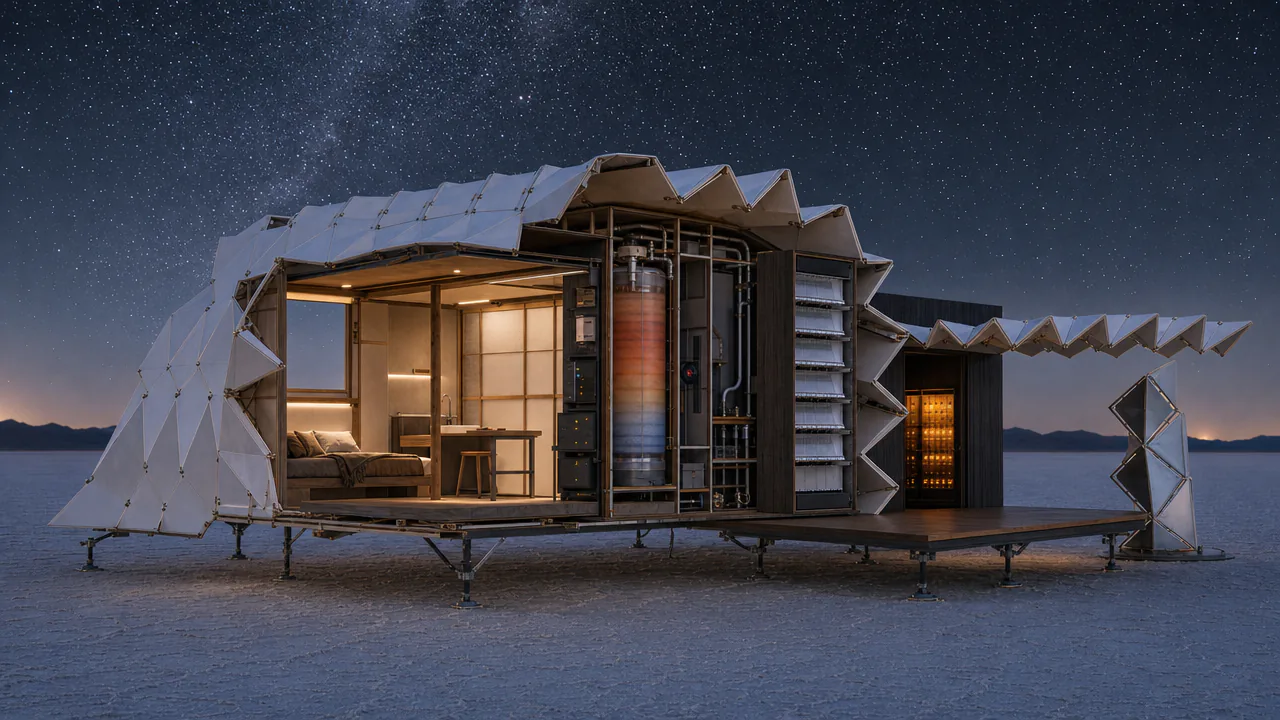
LV1 · 24 hours of an autonomous desert home · concept film · AI
層01 The stack

Not one machine. Eight layers on one footprint.

How an ORIJO space anywhere powers, waters, builds, maintains, feeds, closes and governs itself — a synthesis of seven verified v4 layer dossiers and the v3 concept. A layer can only be as autonomous as the layers beneath it allow. Pick a slab.

Hover or tap a slab · arrow keys step
形Structurethe fixture 力Energyself-powering 水Waterself-watering 環Loopself-closing 農Growself-feeding 建Buildself-building 守Careself-maintaining 心Mindself-governing

Layer 0 · the fixture

Shell: the folded ORIJO body

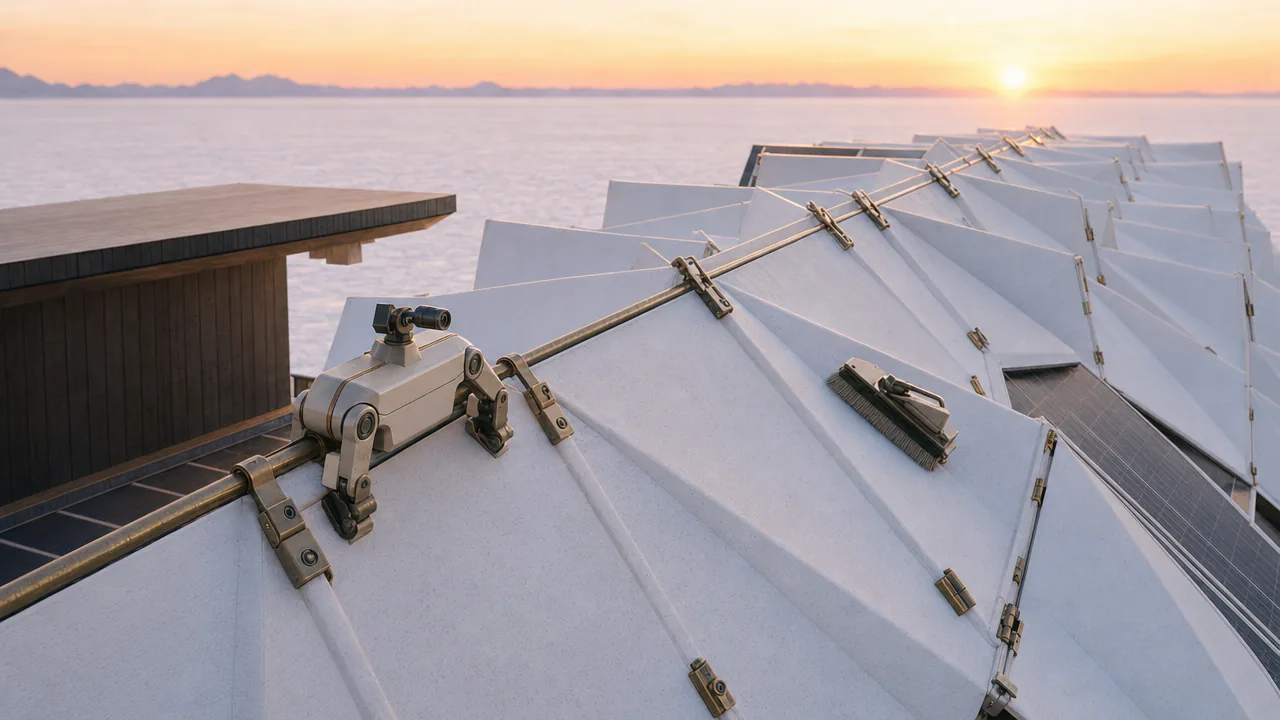
A thick-panel rigid-origami shell on the 910 × 1820 mm jo grid is the fixture every other layer docks into: creases are gutters, rails and datums.

Core mechanism

Rigid-foldable thick panels on membrane hinges (KASANE M01) unfold on one degree of freedom from road-legal packs into a YOSHI barrel vault (M02) standing on self-levelling screw-pile legs (ASHI M03); every 910 mm a ridge datum socket gives robots a building-relative coordinate, and every floor jo is a JO-PORT utility socket (M04). Unfolding a 1.1 t half-shell stores only about 0.0045 kWh of potential energy, so the engineering problem is control, sealing and stiction, not power.

26.5 / about 48 m² / m³

YOSHI-4 floor area / volume

calculatedconcept
21 kN on a 7.4 kg column (about 280x self-weight)

MUTOIS 1 m origami column: tested load (precedent for uniform-thickness load-bearing origami)

measuredzhu2024
about 0.0045 kWh

Potential energy to raise one YOSHI-4 half-shell (1,100 kg, 1.5 m CoG lift)

calculatedconcept-v3

Maturity of the options assessed · 5 options

  • commercial 1
  • pilot 3
  • experimental 1
  • speculative 0

Counted over BUILD-S5 deployable-shell options (TenFold, Boxabl, thick-panel origami, softgoods, LUNARK); the ORIJO shell itself is EXPERIMENTAL, TRL 4 (metre-scale lab demonstrators, v3 M01/M02).

M01 KASANEM02 YOSHIM03 ASHIM04 JO-PORTM10 FLIP-FOLDYOSHI-4YOSHI-6GHOSHI-2KURA-3MUTO-DASHI-4KUSABI latch (build)newAMA-TSUYU rain-and-dew roof (water)new
The structure deep page

Layer 1 · self-powering

Energy: self-powering

Fold-out PV, heat-first storage and a DC spine whose voltage itself enforces survival priorities.

Core mechanism

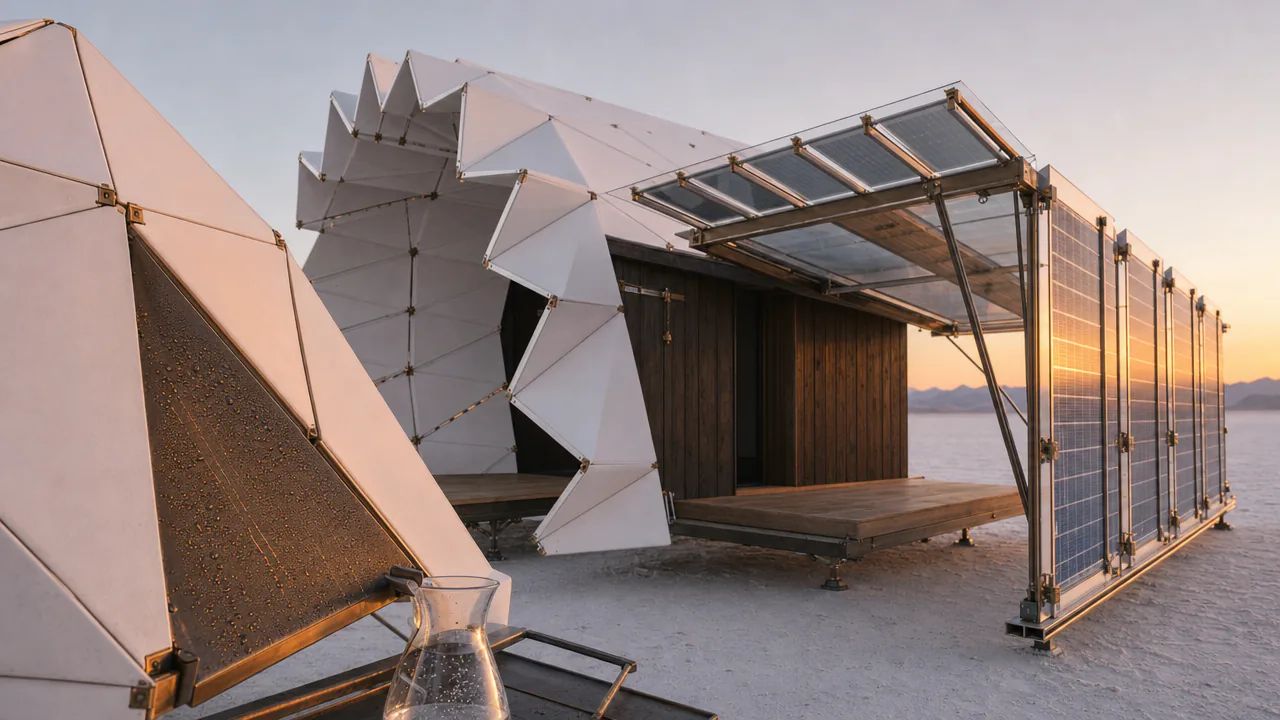
Fold-out c-Si PV (MIURA-W wings, BYOBU-PV vertical bifacial fences) feeds a 48–60 V DC spine through MPPT; LFP covers 1–2 days of firm load and a sodium-ion locker covers cold keep-alive; surplus goes first to a CO₂ heat-pump tank (about 3 kWh of heat per PV kWh) and to deferrable loads, above all the farm LEDs, whose photoperiod follows the sun (HIKARI-DOKI). Each JO-PORT sheds and restores at its own bus voltage (DENATSU-ROPE), so survival priority holds even with every computer off.

14.4–19.2 vs about 14.5 kWh/day

One HATA-4 LED farm cassette vs a whole efficient 4-person home

70 USD/kWh

Stationary battery pack price 2025 (-45% y/y)

reportedbnef2025
about 23 kWh_th

Heat banked in a 500 L tank across 40 K (about 8 kWh_e at COP 3)

calculatedv3-concept

Maturity of the options assessed · 24 options

  • commercial 15
  • pilot 5
  • experimental 4
  • speculative 0
M08 IRORIMIURA-WBYOBU-PVDENCHI-BIRORI-HKRES-7 (wind only after measurement)HIKARI-DOKInewDENATSU-ROPEnewIRORI-KURA tanknewBYOBU-MAKInew
Open the energy layer

Layer 2 · self-watering

Water: self-watering

Recycle first, sense everything, and make only the residual from rain, sea or air.

Core mechanism

Separate grey, yellow, brown and condensate at the source; regenerate grey water in a MIZU organ (biology > UF > RO > UV-C > residual chlorine) released only by a fail-closed soft-sensor verdict (MIZU-MAMORI); make up only the 5–10% loss plus drinking water, ranked by kWh per litre: rain and fog first, any saline water by PV-RO/ED (0.003–0.0055 kWh/L), atmospheric water only where nothing liquid exists, and then preferably from the humid farm air (KUMO-NAE) and with waste heat.

98 %

ISS total water recovery with Brine Processor

44 L/day

Make-up water for a 4-person home at 80 L/person/day and 90% net recovery

calculatedanyground-v3
18–220 vs 0.13–0.24 kWh/day

Energy to make those 44 L/day: sorption AWH vs seawater RO

Maturity of the options assessed · 27 options

  • commercial 14
  • pilot 9
  • experimental 4
  • speculative 0
M05 KUMOM06 MOTTAINAIMIZU-1KUMO-12KRES-7 tankKAWAYA-UKUMO-NAE farm cloudnewSHIO-BUKURO brine bagnewMIZU-MAMORI release guardnewAMA-TSUYU roofnew
Open the water layer

Layer 3 · self-closing

Loop: self-closing

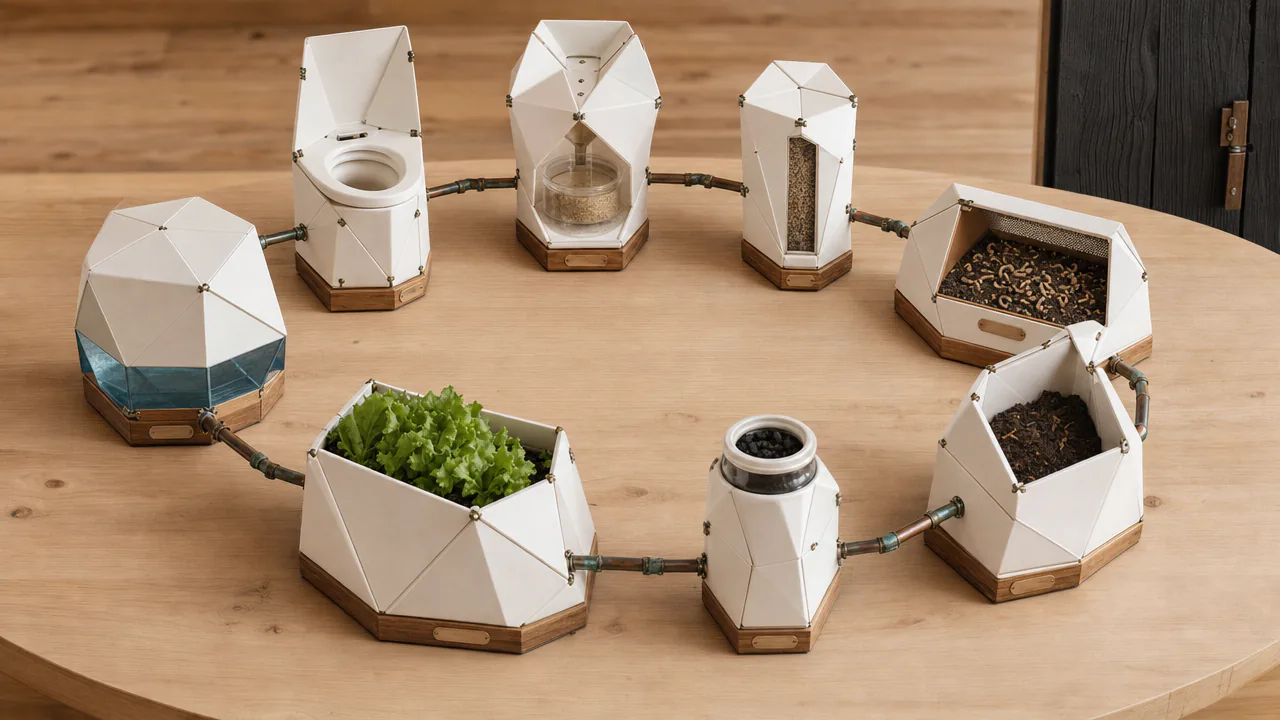
Separate every stream, measure every gram, turn urine, scraps and residue into fertiliser, feed and carbon, export the rest.

Core mechanism

A per-element ledger (BVAD-anchored: O2, CO₂, water, N, P, K, Na) reconciles every stream daily. Urine is stored, struvite-settled for P and passed through clinoptilolite cartridges that capture about 86% of N (TSUBO-Z), food scraps are dried, fed to black soldier fly larvae, and frass plus faeces are hygienised at 55 C for 3 days; dry residue becomes biochar or mycelium infill. The house is not sealed: only grow zones are, fed with living-room CO₂ through a bellows lung (FUIGO), and plant CO₂ drawdown becomes a crop-health sensor. Surplus nitrogen leaves as a product, not as sewage.

98.2 / 99.7 / 67 %

Lunar Palace 365 material closure / urine recovery / solid-waste recovery

12.8 kg N/yr

Urine nitrogen of 4 people (design value 8.8 g N/person/day)

86 %

Overall urine N recovery on clinoptilolite (97% transfer x 88% elution)

Maturity of the options assessed · 16 options

  • commercial 6
  • pilot 7
  • experimental 3
  • speculative 0
M06 MOTTAINAIKAWAYA-UKAMADO-BUKI-PTSUBO-Z zeolite N batterynewKAMADO-2 dry-buffer larvae + hot boxnewFUIGO lungnewWARA-ITA straw-mycelium infillnew
Open the loop layer

Layer 4 · self-feeding

Grow: self-feeding

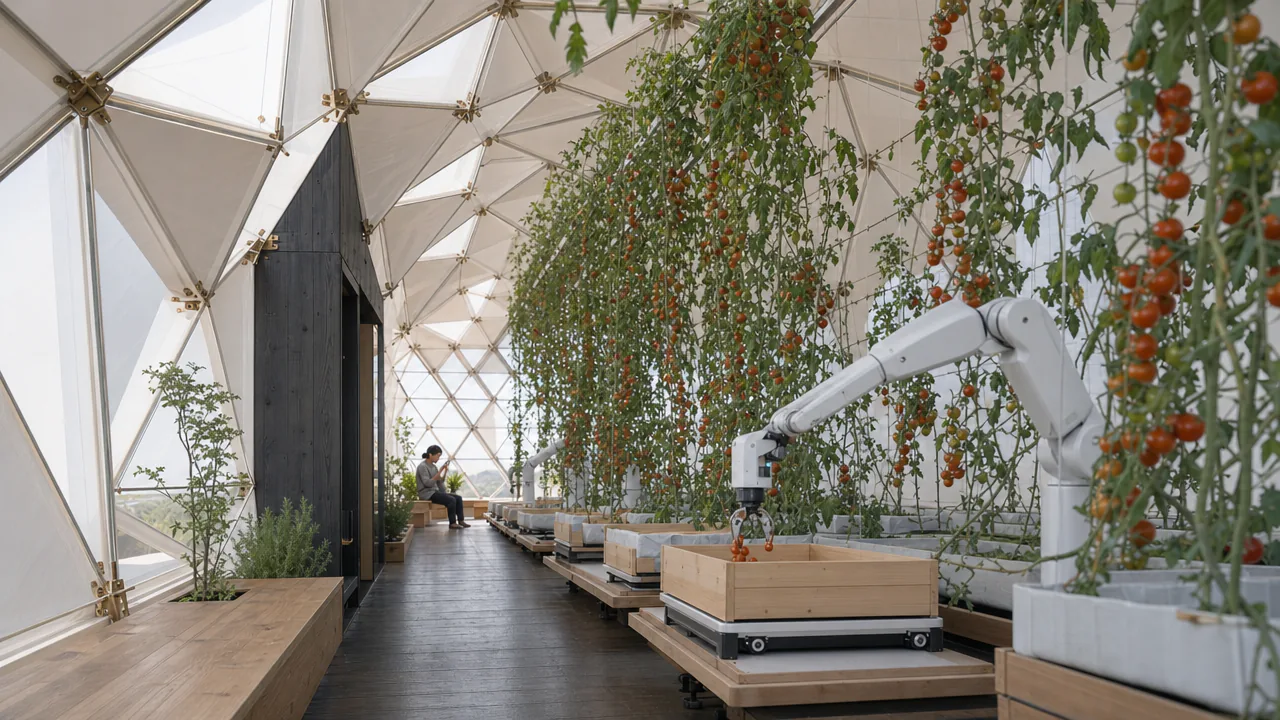
Sunlight grows calories, LEDs grow greens, robots move trays and scout at night; humans still pick fruit.

Core mechanism

Plants ride half-jo carriers (910 × 455 mm) on passive rollers past fixed stations (seed, space, inspect, cut), so robots stay stationary and cheap (KAGO-MICHI); a local crop twin (MPC, AGC-proven) sets climate and a daily light integral rather than a clock, and the energy layer fills that DLI from daylight first, PV-hour LEDs second. Calories and fruit go to daylight vaults (YOSHI-6G) and beds; LEDs only grow greens, herbs and strawberries. Night robots dose UV-C and scout from the ridge rail (YOAKE-UV); humans still pick fruit until robots exceed 90% success.

about 3.0 µmol/J

Best independently tested LED fixture efficacy (practical ceiling 3.4–4.1)

measuredkusuma2020
167–208 kWh/person/day

LED electricity to grow a full human diet indoors

24.78 vs 21.18 EUR/m² (4-month cucumber)

Autonomous Greenhouse Challenge 2018: AI team vs expert growers, net profit

measuredhemming2019

Maturity of the options assessed · 22 options

  • commercial 10
  • pilot 11
  • experimental 1
  • speculative 0
M07 HATAHATA-4YOSHI-6GBYOBU-GUKI-PKAMADO-BHI-NO-WAKE sun splitnewKAGO-MICHI carrier pathnewYOAKE-UV barnewTSUBO-KABE fruit wallnewMUSHI-DAI insect benchnew
Open the grow layer

Layer 5 · self-building

Build: self-building

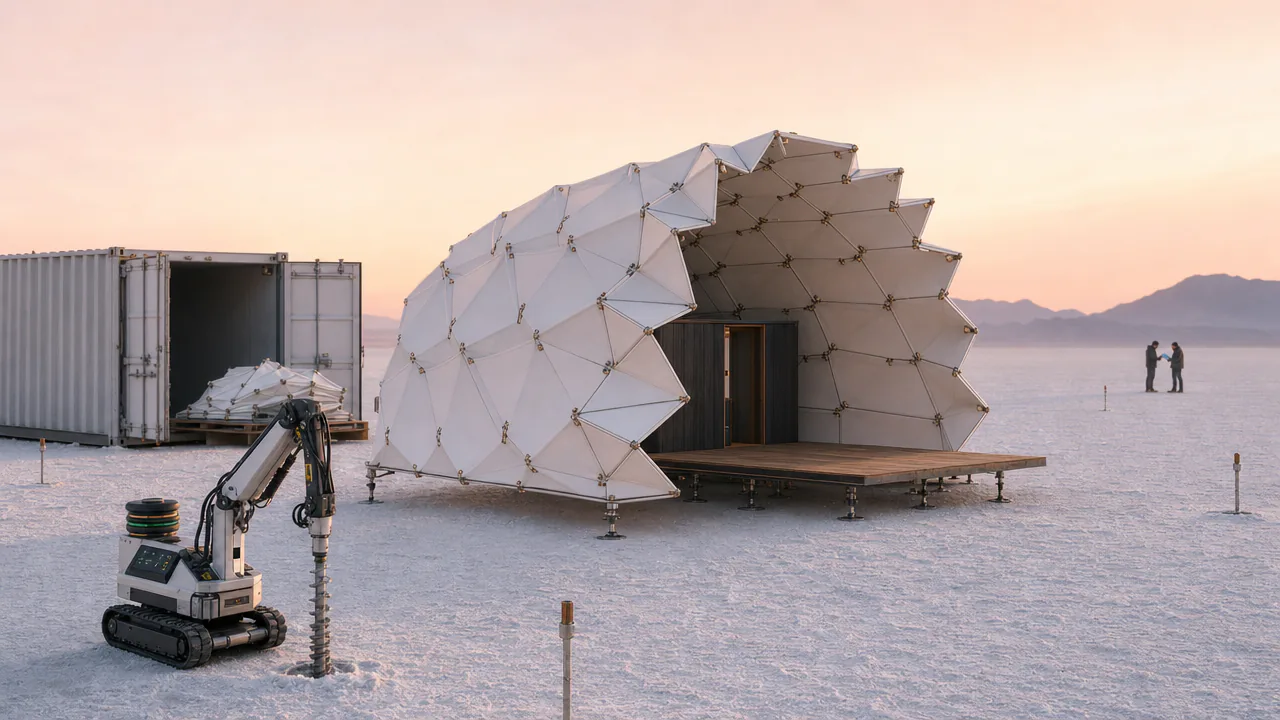
Factories fabricate, robots mark and anchor, shells unfold themselves under closed-loop control; humans only approve gates.

Core mechanism

A licensed container micro-factory (TATAMI-KOUJOU) CNC-cuts, laminates, wires and fold-tests panels; on site only three robotic acts remain: mark (RTK staking rover), anchor (helical piles with logged torque-depth curves, SUMI-ITO) and unfold (ORI-SEQ closed-loop sequencer with sensor-gated KUSABI latches). The as-built survey of datum sockets becomes the map every later robot uses.

68 %

Robotic layout labour-hour reduction (rework 6.42% → 0.25%)

measuredkam2025
744 vs 285 units

Boxabl fold-out homes manufactured vs delivered (to 2025–08–19)

about 300 vs about 100 piles/day

Autonomous solar pile driver vs conventional, 2-person crew

claimedrpd-pvmag

Maturity of the options assessed · 24 options

  • commercial 10
  • pilot 6
  • experimental 8
  • speculative 0
M11 FOLD-TO-ORDERM01/M02 unfoldM03 ASHIASHI-4ORI-SEQ fold sequencernewSUMI-ITO anchoring rovernewKUSABI wedge latchnewTATAMI-KOUJOU micro-factory cellnew
Open the build layer

Layer 6 · self-maintaining

Care: self-maintaining

Make the building the robot's map and fixture, swap whole organs, and keep a remote human for exceptions.

Core mechanism

Few, captive robots on fixtures the building provides: TSURU walks the crease rails twice a day with a thermal/acoustic/gas head (MIMAMORI), HOKI cleans PV and glazing waterlessly along the wing hinge rail, and every swappable organ, cartridge and robot wear part shares one robot handle (KAWARI). Repair is replacement at organ level (one JO-PORT organ = one ORU); a fleet Bayesian ledger (DAICHO) learns real failure rates; a remote desk (MADOGUCHI) handles the few percent of exceptions.

3.89 billion panel cleanings

Ecoppia row-captive waterless PV robots, cumulative panels cleaned

about 80 %

Astrobee console time without crew (>1,200 console h vs ~220 crew h)

calculatedastrobee-tfr
18 %

ISS ECLSS ORUs that failed more often than predicted (6% by >4x)

measuredowens-iss

Maturity of the options assessed · 28 options

  • commercial 11
  • pilot 13
  • experimental 4
  • speculative 0
M09 TSURUM12 SHIKINENTSURU-1M04 JO-PORT as ORU socketKAWARI handlenewHOKI crease broomnewDAICHO ledgernewMADOGUCHI desknewMIMAMORI headnew
Open the care layer

Layer 7 · self-governing

Mind: self-governing

A local, verifiable mind that runs every module, asks humans only for judgement, and survives being cut off.

Core mechanism

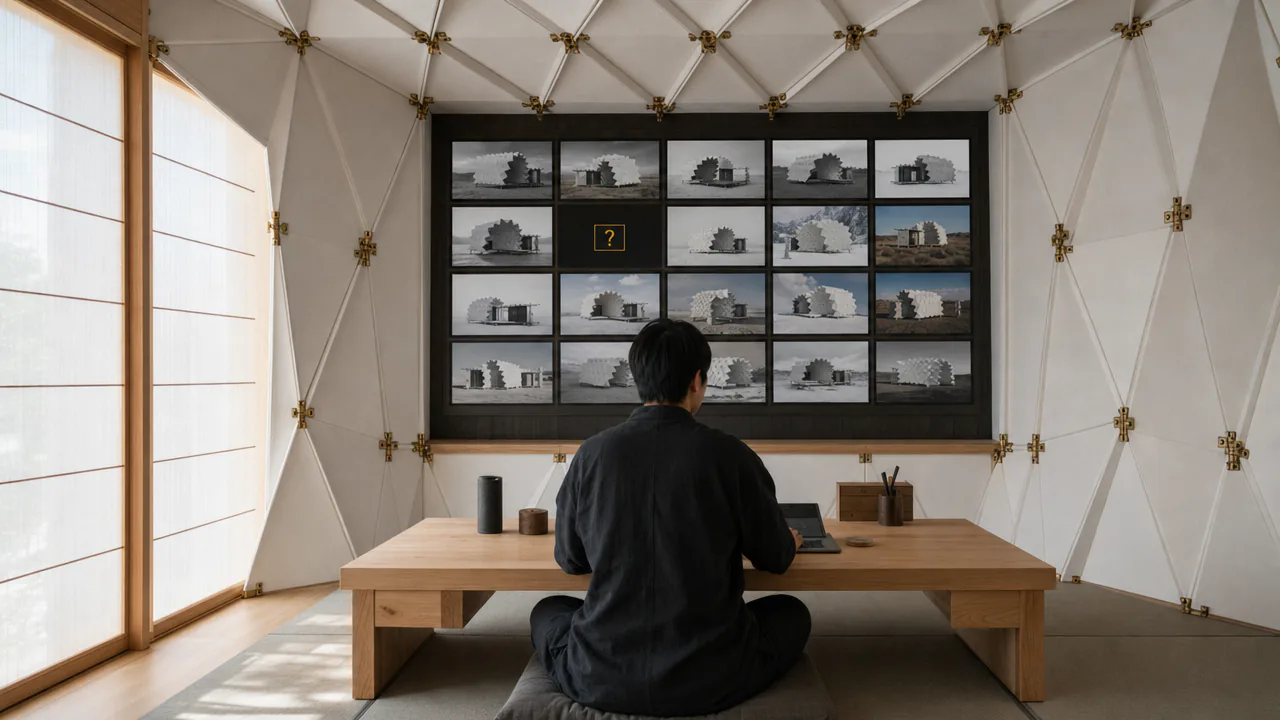
Field devices (Modbus/CAN/BACnet) publish to an MQTT Sparkplug bus on the KURA-3 edge; each module ships its Brick/223P graph and emulator in its fold passport (KIROKU), so docking merges the model. Rules are the baseline, grey-box MPC and warm-started RL propose setpoints, an LLM only translates intent into constraints, and a deterministic safety kernel (BANSHO) on its own microcontroller owns every actuator and accepts only signed, bounded envelopes. Robots share rails and docks through Open-RMF; humans answer questions from a remote queue (YOBIDASHI); island mode (FUYU-GOMORI) coasts 4–14 days without network.

16 / 13 %

Reliable-protocol MPC/RL field savings, residential / commercial (duration-weighted)

measuredkhabbazi2025
70 per about 3,000 (about 1:43) agents : vehicles

Waymo remote-assistance agents on duty vs fleet

about 4 days

Unattended Antarctic observatory battery coast at ~50 W

reportedmelville2014

Maturity of the options assessed · 29 options

  • commercial 13
  • pilot 11
  • experimental 5
  • speculative 0
KURA-3 edge + DC hubM11 configurator (semantic graph origin)BANSHO safety kernelnewKIROKU fold passport graphnewYOBIDASHI remote-assistance queuenewFUYU-GOMORI island modenew
Open the mind layer
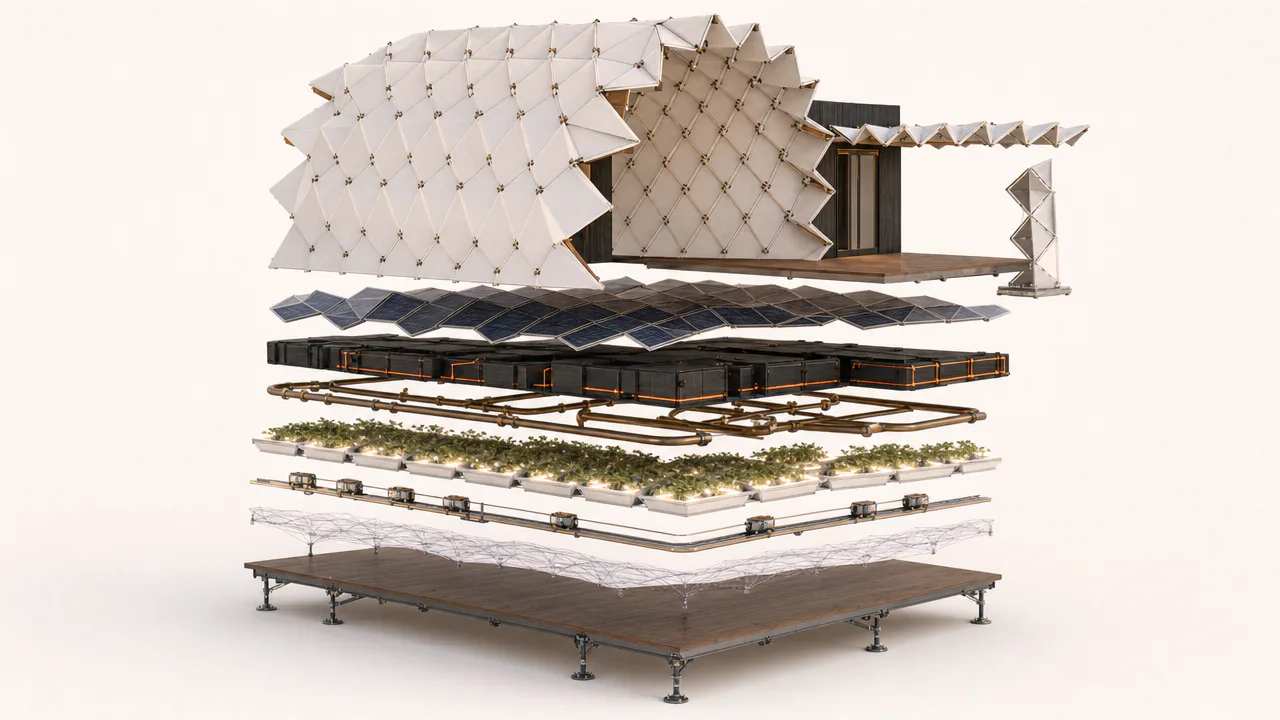
Exploded axonometric render of a folded vault lifted above its floor, revealing PV, battery and water organ, pipe loop, grow trays, ridge robot and data layers
L01 The same stack as a building · concept visual · AI

Thesis

A fully automated space is not one machine but eight layers that trade energy, water, nutrients, labour and information through standard sockets on one 910 × 1820 mm grid. The folded ORIJO shell is the fixture: its creases are gutters, rails and robot datums. It becomes self-powering with fold-out PV on a 48–60 V DC spine that banks most surplus as heat and encodes survival priority in bus voltage; self-watering by recycling 90–98% and making only the residual from rain, saline water or — last — air, preferably the farm's own humid air; self-closing by separating every stream, capturing urine nitrogen in a solid zeolite battery and exporting the surplus as product; self-feeding by growing calories in daylight and greens under LEDs whose photoperiod follows the sun; self-building because factories fabricate and robots only mark, anchor and unfold; self-maintaining because captive robots on building rails swap whole organs with one handle standard; and self-governing through a local, deterministic safety kernel that lets optimisers propose and humans answer questions from a remote desk. The evidence says each piece exists somewhere at TRL 6–9, the integration is TRL 3–5, food is the energy problem and nitrogen the loop problem, and every large failure on the way here (vertical farms, Katerra, Boxabl deliveries, Henn-na, SOURCE, Biosphere 2) was a failure of capital structure, siting, service or sealing — not of physics.

結02 Interfaces

Layers trade five currencies.

Kilowatt-hours, litres, grams of nutrient, robot and human minutes, and bits; heat and the shell’s load and geometry get their own colours. All 56 interfaces from the synthesis, each with its typical value and the design rule it imposes. Click a layer or a cell.

Structure → Energy: PV mounting area on MIURA-W wings and BYOBU fences; DC harness through hingesStructure → Water: Roof catchment and fall lines from every facet to a gutterStructure → Loop: Airtight grow envelope and lung volume for FUIGO; no fresh cement inside sealed volumesStructure → Grow: Glazed daylight vault (YOSHI-6G) and ridge rails at fixed jo heightsStructure → Build: Fold kinematics, latch lines, pile reactionsStructure → Care: Datum sockets every 910 mm, crease rails, robot-readable latch flagsStructure → Mind: Strain, tilt, leg settlement, latch state, hinge temperatureEnergy → Structure: Heat to the envelope; FLIP-FOLD and radiant floorsEnergy → Water: Electricity for MIZU treatment, pumps, UV; low-grade heat for sorbent regenerationEnergy → Loop: Heat for larvae/compost/AD; power for dosing pumps and blowersEnergy → Grow: LED, fan and pump electricity; photoperiod scheduled into PV hoursEnergy → Build: Pre-charged unfold buffer for winches and robotsEnergy → Care: Robot charging on JO-PORT docksEnergy → Mind: SOC, PV forecast, bus voltage as public priority signalWater → Structure: Wet-zone loads and leak risk at JO-PORTWater → Energy: Thermal storage in water tanks; recycler waste heatWater → Loop: Separated urine, RO reject and brine, sludgeWater → Grow: Recycled grey and make-up water for nutrient solutionWater → Build: Drainage routing before pile layoutWater → Care: Cartridge swaps (filters, UV, membranes, sorbent, pump tubing)Water → Mind: Free Cl, ORP, EC, turbidity, UVT, level, flow streams; release verdictsLoop → Structure: Mycelium infill cassettes, biochar, material passportsLoop → Energy: Exothermic heat (larvae, compost, digesters) into the hydronic tankLoop → Water: Plant condensate and urine-derived distillate back to the grey intakeLoop → Grow: Nitrate/ammonium liquor, charged zeolite, struvite, frass, biochar; CO₂-rich airLoop → Build: End-of-life panels, offcuts, refold-return logisticsLoop → Care: Sealed waste cassettes to swap (zeolite, BSF trays, compost bins)Loop → Mind: Mass, pH, EC, NH4, NO2, NO3, Na, CO₂, O2 per stream; ledger residualsGrow → Structure: Floor loads and glazing demandsGrow → Energy: Deferrable load and reject heat from LEDs and dehumidifiersGrow → Water: Transpiration condensate, recoverable as the cleanest water on siteGrow → Loop: Crop residue, roots, spent substrateGrow → Build: Half-jo carriers, rails, cassettes made to the 910 mm pitchGrow → Care: Rail arm and cassette service; shared dock and rail profileGrow → Mind: Images, climate, setpoints, harvest forecastsBuild → Structure: Logged pile positions and torques; registered datum frameBuild → Energy: Commissioning order and unfold power peaksBuild → Water: First-flush and leak test at dockingBuild → Loop: Factory offcuts, packaging returnsBuild → Grow: HATA cassettes docked on JO-PORT datumsBuild → Care: Installs rails, sockets, docks; hands over as-built point cloudBuild → Mind: Fold scripts, IMU/load-cell telemetry, module passports (cycles, dwell, latch torque)Care → Structure: Latch audits, seal and hinge thermal scans, leg re-levellingCare → Energy: PV cleaning (recovered yield), battery/inverter organ swapsCare → Water: Filter/membrane/UV/sorbent cartridge swapsCare → Loop: Zeolite and BSF cassette swaps; odour patrol (NH3/VOC)Care → Grow: Rail-arm and UV-bar upkeep, tray jam clearingCare → Build: Re-levelling, refold before storms, depot repair of swapped organsCare → Mind: Intervention logs as demonstrations; failure ledger; teleop sessionsMind → Structure: Fold/refold policy, storm lockoutsMind → Energy: Dispatch plan, shed tiers, DLI-to-sun scheduleMind → Water: Schedules for AWH, brine drying, cartridge ordersMind → Loop: Ledger reconciliation, product routingMind → Grow: Climate/light setpoints, harvest plan, robot tasksMind → Build: Configurator output: site plan, pile layout, fold scripts, Brick graphMind → Care: Work orders, spare forecasts, remote-assistance routing形Structure力Energy水Water環Loop農Grow建Build守Care心Mind
From (rows) → to (columns)
StructureEnergyWaterLoopGrowBuildCareMind
Structure
Energy
Water
Loop
Grow
Build
Care
Mind
形 Structure → 力 EnergyEnergy

PV mounting area on MIURA-W wings and BYOBU fences; DC harness through hinges

Typical
about 4.5 (MIURA-W); about 4 (BYOBU-PV) kWp per wing target
Design rule
Every fold carries its own DC harness through the hinge with a strain-relieved service loop; battery mass sits on ASHI pads, not floor cassettes.
日03 A day in the life

Twenty-four hours, every layer in step.

Desert (E3) ORIJO home for 4, Atacama-like, early October; values from the Home · 4 people ledger below; battery state-of-charge trajectory illustrative (calculated from the balance, not simulated hourly).

07:00
00:0003:0006:0009:0012:0015:0018:0021:0000:00Batterystate of charge00:00 · SOC 72%72%05:00 · SOC about 55%55%12:00 · SOC 100%100%19:00 · SOC 92%92%LEDs follow the sunSorbent release and condensingSorbent beds loading in night airSorbent beds loading in night air力 Energy水 Water環 Loop農 Grow守 Care心 Mind00:00 · KUMO-12 sorbent cassettes loading in cool night air (RH rises as air cools)00:00 · Battery carries firm night load only; LEDs dark00:30 · HATA dark period (continuous by rule); CO₂ and fans at minimum01:00 · TSURU night patrol on the YOSHI ridge rail: thermal scan of hinges and latches, NH3/VOC sniff near KAWAYA-U02:00 · YOAKE-UV bar rides the rail over the cassette: UV-C dose + RGB/NIR images03:00 · Daily ledger reconciliation closes (water, N, P, mass); forecast pulled for tomorrow04:00 · KAMADO drier finishes overnight buffering of kitchen scraps05:00 · Battery minimum of the day; voltage-rope ladder untouched (no shedding)05:45 · KUMO valves close; sorbent saturated06:30 · Sunrise; BYOBU-PV east faces wake first (vertical bifacial)07:00 · Sunrise release: glazed collector + PV-T and heat-pump reject heat warm the sorbent; vapour condenses on a night-cooled plate07:00 · HIKARI-DOKI starts LEDs with PV, not by clock07:30 · HOKI broom makes the daily waterless pass on MIURA wings (dust)08:00 · MIZU-1 runs its main batch on PV; soft sensor (free Cl, ORP, EC, turbidity, UVT) issues verdict per tank09:00 · Struvite settler doses Mg; urine passes the TSUBO-Z zeolite column10:00 · Heat pump charges IRORI-KURA tank to 60–65 C from surplus11:00 · KAGO-MICHI shuttle moves ready trays to the cutter cell; whole-tray harvest12:00 · Battery full; surplus diverted to tank top-up, SHIO-BUKURO brine drying, laundry13:00 · KAMADO-2 composter logs hygienisation cycle (55 C x 3 days rolling)14:00 · Weekly organ/cartridge swap: TSURU swaps a MIZU pre-filter cartridge with the KAWARI handle15:00 · YOBIDASHI raises one low-confidence question (soft sensor slope drift) to the remote desk16:00 · LEDs ramp down as PV falls; DLI met from PV hours17:00 · KUMO sorbent beds re-open as air cools after sunset18:00 · Residents harvest herbs and taste; human picking is the ritual robots skip19:00 · Evening cooking on DC induction from battery; west BYOBU faces give last yield21:00 · Second TSURU patrol; MIMAMORI head checks KAWAYA odour and latch flags22:00 · Island-mode self-test (FUYU-GOMORI): verifies 4-day coast plan with cloud link disconnected for 60 s23:00 · SOC entering the night

Swipe the chart sideways · tap it to jump to that hour

Battery illustrative
—
between the logged points
Sun
—
sunrise and sunset from the log
Farm LEDs
—
photoperiod follows PV
KUMO sorbent
—
night capture, morning release
  1. 00:00WaterKUMO-12 sorbent cassettes loading in cool night air (RH rises as air cools)beds open; ~40–60% RH outdoors at night (site-dependent)
  2. 00:00EnergyBattery carries firm night load only; LEDs darkSOC 72%, draw about 0.4 kW
  3. 00:30GrowHATA dark period (continuous by rule); CO₂ and fans at minimumDLI target met yesterday 15 mol/m²
  4. 01:00CareTSURU night patrol on the YOSHI ridge rail: thermal scan of hinges and latches, NH3/VOC sniff near KAWAYA-U15 min; 8 datum sockets visited
  5. 02:00GrowYOAKE-UV bar rides the rail over the cassette: UV-C dose + RGB/NIR images10 min; images processed at edge
  6. 03:00MindDaily ledger reconciliation closes (water, N, P, mass); forecast pulled for tomorrowresiduals within ± 10%
  7. 04:00LoopKAMADO drier finishes overnight buffering of kitchen scrapsabout 1.5 kg wet → about 0.4 kg dry
  8. 05:00EnergyBattery minimum of the day; voltage-rope ladder untouched (no shedding)SOC about 55%; bus 51.2 V
  9. 05:45WaterKUMO valves close; sorbent saturatedload complete
  10. 06:30EnergySunrise; BYOBU-PV east faces wake first (vertical bifacial)about 1–2 kW at 07:00
  11. 07:00WaterSunrise release: glazed collector + PV-T and heat-pump reject heat warm the sorbent; vapour condenses on a night-cooled platedesorption 07:00–11:00; 2.4–12 L/day yield range
  12. 07:00GrowHIKARI-DOKI starts LEDs with PV, not by clock2 tiers lit, about 1.1 kW
  13. 07:30CareHOKI broom makes the daily waterless pass on MIURA wings (dust)about 3 min for 25 m²
  14. 08:00WaterMIZU-1 runs its main batch on PV; soft sensor (free Cl, ORP, EC, turbidity, UVT) issues verdict per tankabout 320 L/day treated; release to tap only on pass
  15. 09:00LoopStruvite settler doses Mg; urine passes the TSUBO-Z zeolite columnabout 35 g N captured today
  16. 10:00EnergyHeat pump charges IRORI-KURA tank to 60–65 C from surplusabout 8 kWh_e → about 23 kWh_th (500 L)
  17. 11:00GrowKAGO-MICHI shuttle moves ready trays to the cutter cell; whole-tray harvestabout 0.5 kg greens
  18. 12:00EnergyBattery full; surplus diverted to tank top-up, SHIO-BUKURO brine drying, laundrySOC 100%; about 4–6 kW surplus
  19. 13:00LoopKAMADO-2 composter logs hygienisation cycle (55 C x 3 days rolling)day 2 of 3 at ≥ 55 C
  20. 14:00CareWeekly organ/cartridge swap: TSURU swaps a MIZU pre-filter cartridge with the KAWARI handle10 min; ledger updated (DAICHO)
  21. 15:00MindYOBIDASHI raises one low-confidence question (soft sensor slope drift) to the remote deskabout 5 min human answer; logged
  22. 16:00EnergyLEDs ramp down as PV falls; DLI met from PV hoursLED day 07:00–16:30 = 9.5 h
  23. 17:00WaterKUMO sorbent beds re-open as air cools after sunsetloading begins
  24. 18:00GrowResidents harvest herbs and taste; human picking is the ritual robots skipabout 10 min
  25. 19:00EnergyEvening cooking on DC induction from battery; west BYOBU faces give last yieldSOC 92% at sunset
  26. 21:00CareSecond TSURU patrol; MIMAMORI head checks KAWAYA odour and latch flags15 min
  27. 22:00MindIsland-mode self-test (FUYU-GOMORI): verifies 4-day coast plan with cloud link disconnected for 60 spass
  28. 23:00EnergySOC entering the nightabout 80%; projected 05:00 minimum about 55%
段04 One autonomy scale

L0 to L5, measured in human minutes and island days.

Unified from the mind ladder (MTBI, island days, human minutes) with closure criteria from water, loop and grow ladders; a site is rated at the lowest level any layer meets (grow lags because fruit picking stays human-in-loop).

L0

Manual

Human minutes / week
>600 per site
Mean time between interventions
undefined
Island days (no link, no visit)
0
Water closure, %
0 (mains or trucked)
Greens from site, %
0
Urine N captured, %
0

People operate every system; diesel or grid; no remote visibility.

khabbazi2025pea-wiki

L1

Assisted

ORIJO 2027
Human minutes / week
300–600
Mean time between interventions
< 1 day
Island days (no link, no visit)
< 1
Water closure, %
up to 45 mains cut (certified greywater appliance)
Greens from site, %
0–50 (manual hydroponics)
Urine N captured, %
0–38 (manual UDD + bins)

PV + LFP with inverter-charger, rain tank + greywater recycler, sensors and SMS alarms; humans move material and fix faults within a day.

hydraloop-sitezeeman-2011

L2

Supervised automation

ORIJO 2027
Human minutes / week
60–300
Mean time between interventions
≥ 1 day
Island days (no link, no visit)
≥ 3 with comfort
Water closure, %
90 net (household regeneration organ)
Greens from site, %
100 of greens demand
Urine N captured, %
about 50 (struvite/zeolite with manual handling)

Rule ladder + heat-pump tank absorbs surplus; MPC in shadow; plants on carriers; captive single-task robots (PV row, vacuum); remote human approves daily.

wota-sitefruitnet-spread2017ecoppia-site

L3

Conditional autonomy

ORIJO 2029
Human minutes / week
15–60 on site + about 6 remote (home)
Mean time between interventions
≥ 7 days
Island days (no link, no visit)
≥ 14
Water closure, %
90–95 net
Greens from site, %
100 of greens; < 5 of calories
Urine N captured, %
86 captured (exported surplus)

Safety kernel + MPC/RL inside a verified envelope; soft-sensor water release; TSURU patrols and organ swaps; FDD isolates faults; remote queue answers low-confidence questions; human on call ≤ 4 h.

waymo-futurismreynaert-2023beler-baykal-2011

L4

High autonomy

ORIJO 2032
Human minutes / week
1–15
Mean time between interventions
≥ 30 days
Island days (no link, no visit)
≥ 90 (Halley-winter class)
Water closure, %
95–98 (brine drying + condensate recapture)
Greens from site, %
100 greens + fruit in designed walls; calories still < 10
Urine N captured, %
86–95 with on-site sink (farm module or beds)

Self-heals by redundancy and robot organ swap; robots clean, inspect and refold before storms; humans visit only for SHIKINEN renewal and sealed-module swaps.

bas-halleyowens-issntrs-iss-2026

L5

Earth-independent

Human minutes / week
< 1 remote
Mean time between interventions
≥ 180 days
Island days (no link, no visit)
≥ 365 (PLATO/AGO class)
Water closure, %
≥ 98
Greens from site, %
partial diet 30–50 (TSUKI target, speculative)
Urine N captured, %
> 95 with solids still about 67

All decisions faster than the worst link round trip are onboard; 5x oversizing; robots install and dock new modules; bioregenerative loop at Lunar Palace class.

melville2014fu-2021-biorxivplato2010

Where ORIJO sits on the roadmap

Per layer, per pilot. Grow stays a level behind because fruit picking remains human-in-the-loop.

Pilot Energy Water Loop Grow Build Care MindOverall
2027v3 Phase 1 BenchL2L1-L2L1-L2L2L1L1L2L1-L2
Gate G1 hinge ≥ 2,000 cycles; KUMO ≥ 0.3 L/kg/day field; DENATSU-ROPE 200/200 shed trials · Reefer-container HATA cassettes, KUMO-2 bench, half-length YOSHI, TSURU v0
2029v3 Phase 3 Catalogue (first IE homes, HATA-MURA farms)L3L3L3L3L2L3L3L3
Gate Human ≤ 60 min/week/home measured on the public ledger; MTBI ≥ 7 days; island ≥ 14 days · Licensed micro-factories; 100 units in field target
2032v3 Phase 4 Extreme (KITA winter-over)L4L4L3-L4L3L3L4L4L4 (grow lags at L3)
Gate G4: one winter-over with water recovery ≥ 95%; island ≥ 90 days; MTBI ≥ 30 days · Polar/mountain station kits
衡05 Balances

Home, hotel, farm: the daily ledger.

Energy, water, food, nutrients, waste, robot and human time for three ORIJO configurations. Each line carries its formula and basis. Every line carries value, unit, basis and formula; inputs come from the layer dossiers sizing_reference blocks and v3 module data. Values labelled assumed are design assumptions to be measured at G1/G2.

Desert (E3) ORIJO home for 4 people: KURA-3 + 1 YOSHI-4 (+1 optional) + MIURA-W + 1 BYOBU-PV + 1 HATA-4 run at 2 of 4 tiers + MIZU-1 + KAWAYA-U + KAMADO-B + KUMO-12 + DENCHI-B + TSURU-1. Desert design PSH 6 h, performance ratio 0.75. Autonomy target L3 (2029 catalogue).

Energy

  • Plug, light, cooking, comms, HRV (DC appliances)5 kWh/day targetassumed design input; energy dossier sizing_reference.home_4p
  • Domestic hot water via CO₂ heat pump3.5 kWh/day calculated4 × 50 L x 1.163 Wh/(L K) x 45 K / COP 3 = 10.5 kWh_th / 3
  • Space conditioning, annual average (night flush, FLIP-FOLD, radiant)2 kWh/day targetassumed design input; 0 in shoulder months, cooling peaks in summer; desert annual mean assumed
  • MIZU-1 grey/black water regeneration (320 L/day)note3 kWh/day calculatedpro-rata of 400 W rated at 450–720 L/day: 320/720 × 9.6 = 4.3 upper; 2.0 lower if pumps idle; central 3.0
  • KUMO-12 sorbent rack fans and valves1.44 kWh/day target60 W x 24 h (v3 module power)
  • HATA-4 at 2 of 4 tiers (3.3 m² lit): lighting4.6 kWh/day calculated3.3 m² x DLI 15 mol/m²/day / (3.0 µmol/J x 3.6)
  • HATA-4 at 2 of 4 tiers: climate, dehumidification, pumpsnote3.8 kWh/day calculatedhalf of the 5.2–10 kWh/day residual between v3 cassette total (14.4–19.2) and full-cassette lighting (9.2); central
  • Loop: KAMADO-B 40 W + KAWAYA-U 25 W1.56 kWh/day target(40 + 25) W x 24 h
  • Robots (TSURU patrols, HOKI cleaning, tray shuttle)0.05 kWh/day calculated0.25 kWh/week TSURU + small shuttle/broom draw
  • Edge PC + safety MCU0.3 kWh/day calculated(10–15 W + 1 W) x 24 h
  • TOTAL25.3 kWh/day calculatedsum of lines above
  • PV needed at desert PSH 6, PR 0.755.6 kWp calculated25.3 / (6 × 0.75); installed MIURA-W 4.5 + BYOBU-PV 4 = 8.5 kWp leaves about 13 kWh/day surplus for heat bank and AWH desorption
  • Firm (non-deferrable) night-capable load9.4 kWh/day calculated5 base + 1 potable MIZU path + 30% of HATA (2.5) + 0.6 KAWAYA + 0.3 edge
  • Battery for 2 firm days22 kWh calculated2 × 9.4 / (0.9 DoD x 0.95) → DENCHI-B 20–40 kWh

Water

by use

  • Showers and hand washing160 L/day targetassumed design input; 4 × 40 L of the 80 L/person/day design demand
  • Laundry60 L/day targetassumed design input; 4 × 15 L
  • Kitchen and dishes48 L/day targetassumed design input; 4 × 12 L
  • Drinking and cooking (potable residual)12 L/day calculated4 × 3 L
  • Toilet flushing0 L/day targetdesign choice; KAWAYA-U urine-diverting dry toilet; urine 5.9 L/day goes to the loop, not the water organ
  • Farm gross / net10 / 1–3 L/day calculatedHATA-4 v3 target; net = 6.6 m² x 2–4 L/m²/day ET x 0.1 + biomass water, halved for 2 tiers
  • Treated per day by MIZU320 L/day calculatedN x D = 4 × 80

by source

  • Recycled by MIZU (90% net)288 L/day calculated320 × 0.90
  • Make-up required44 L/day calculated4 x (80 × 0.10 + 3)
  • Rain from 40 m² YOSHI-4 roof at 100 mm/yr8.8 L/day (annual mean) calculated40 × 100 × 0.8 / 365
  • KUMO-12 sorption rack (drinking quality)2.4–12 L/day targetv3 module range; CaCl2-hydrogel 0.3–0.8 L/kg/day target, MOF-303 0.285 L/kg/day measured passive
  • Residual make-up (truck port monthly, or brackish well PV-RO)note23–33 L/day calculated44–8.8 — (2.4 to 12); = 0.7–1.0 m³/month delivery, or 0.13–0.24 kWh/day PV-RO if a brackish well exists

Food

  • Leafy greens (lettuce class) on 2.8 m² tier area2.6–3.8 kg FW/week calculated2.8 m² x 48–70 kg/m²/yr / 52
  • Herbs on 0.5 m² tier area0.3–0.5 kg FW/week targetassumed design input; 0.5 m² x 30–50 kg/m²/yr / 52 (assumed herb yield, not sourced)
  • Demand reference: 100 g greens/person/day2.8 kg/week targetassumed design input; 4 × 0.1 × 7
  • Daylight crops (tomato, cucumber, beans) in an optional YOSHI-6G or shaded bedssite-dependent; not claimed - naEDEN ISS LED-sealed worst case tomato 17–19 kg/m²/yr
  • Share of dietary energy from site< 5 % calculatedgreens supply micronutrients and freshness, not calories (BVAD 0.8 kg dry food/person/day; LMLSTP grew <5% of calories)

Nutrients

  • Urine N excretednote35 (design) — 44 (theoretical) g N/day calculated4 × 8.8 (Fumasoli design assumption) to 4 × 11 (Zeeman theoretical)
  • N recovered on TSUBO-Z zeolite30 g N/day calculated35 × 0.86
  • N taken up by the home HATA-40.7–1.4 g N/day calculated0.25–0.5 kg N/yr per rack / 365
  • N exported as charged zeolite or liquid fertiliserabout 29 g N/day calculated30 — about 1
  • Urine P excreted / recovered as struvite4.0 / 3.8 g P/day calculated4 × 1.0 g; x 0.95 struvite removal
  • Urine K (proxy)noteabout 15 g K-equivalent/day calculatedN x 1.8/4.2 from Aurin product N-P-K ratio (claimed; oxide vs elemental basis not stated)

Waste streams

  • Urine5.9 kg/day calculated4 x (1.42 + 0.061)
  • Faeces (wet)0.53 kg/day calculated4 x (0.101 + 0.032)
  • Kitchen scraps1–2 kg/day targetv3 KAMADO-B design input
  • Crop residue (greens)0.1–0.2 kg/day targetassumed design input; outer leaves and roots of about 0.5 kg/day harvest
  • BSF larvae produced0.15–0.5 kg/day targetv3 KAMADO-B from 1–2 kg waste; pilot 190 kg waste → 79 kg larvae
  • Zeolite cartridge throughput12–25 kg/week calculated35 g N x 7 / 10–20 mg N/g
  • Brine to SHIO-BUKUROabout 1–3 L/day targetassumed design input; RO reject after recovery; dried to salt cake on PV surplus

Robot time

  • TSURU patrol with MIMAMORI head30 min/day target2 × 15 min
  • HOKI PV/glazing cleaning, desert daily pass2.7 min/day calculated25 m² / 9.3 m²/min
  • Cartridge and organ swaps2.1 min/day target1.5 swaps/week x 10 min / 7
  • YOAKE-UV night pass + scouting images10 min/day targetone ridge pass per night over the cassette
  • KAGO-MICHI tray moves and cutter cell15 min/day targetassumed design input; shuttle moves for spacing and harvest
  • TOTALabout 60 robot-min/day calculatedsum

Human time

  • Harvest, tasting, fruit picking (grow)30 min/week targetHATA-4 L3 target ≤ 30
  • Receive/stow consumables, approve swaps (care, water, loop)20 min/week targetKURA-3 crew minutes
  • Energy and water review in app10 min/week targetenergy L3 8 + water L3 rounding
  • Remote operator time (YOBIDASHI)6 min/week calculated23 tasks x 5% intervention x 5 min
  • TOTAL on site + remoteabout 66 min/week calculated60 on site + 6 remote; inside the mind L3 band 15–60 on-site only if harvest is counted as leisure
Conflicts found between dossiers, and how they were resolved
  • HATA-4 energyv3: 600–800 W average = 14.4–19.2 kWh/daygrow: lighting 9.2 kWh/day at DLI 15Both hold: lighting 9.2 + climate/dehumidification/pumps 5.2–10 (residual, calculated). Bench measurement of the split is a G1 deliverable.
  • Specific energy of LED greensenergy EN05: 11–22 kWh/kg (v3 cassette)literature 7.7–12.5 (Pennisi 2025) and 10–18 (Miserocchi 2024)ORIJO cassette sits at or above the literature; target the 3.16 kWh/kg hybrid-daylight benchmark (Ceccanti 2026) through HIKARI-DOKI + daylight vaults, and never price LED kWh at battery LCOS.
  • Urine nitrogenwater: 11 g N/person/day (Zeeman, theoretical)loop: 8.8 g N/person/day (Fumasoli design assumption)8.8 design value, 11 upper bound; both imply large N surplus over indoor-crop uptake.
  • MIZU-1 electricityv3: 400 W average (9.6 kWh/day)energy dossier: 1 kWh/day assumedUse 2–4.3 kWh/day (throughput pro-rata of 400 W rated) for a 4-person home; vendor gives no measured kWh/m³.
  • Hotel PVv3 T2: about 17 kWpenergy dossier: 26.7 kWp needed (30 with MIZU)Add wings/fence pair or drop the LED cassette at low-sun sites.
  • Hotel tomatogrow: cherry tomato in a YOSHI-6Gv3 T2 default has no YOSHI-6GAdd one YOSHI-6G as an option line in the configurator.
  • Farm site labourbuild dossier flagged MIURA-W missing from its module listv3 T1 includes 2 MIURA-W63–71 person-h stands.
  • Lunar Palace food sharegrow/loop cite ~55% food regenerated55% is the 105-day LP1 (2014) figure, not LP365Quote 55% only for LP1; LP365 says plant production met crew plant-food needs.
  • Unfold supervisionbuild L3: shell unfolds itself under closed-loop controlmind rule: fold motions only in commissioning mode with a human present or on cameraCompatible: ORI-SEQ executes autonomously, BANSHO gates it on a live camera link and wind/temperature limits; no optimiser can trigger a fold.
  • Water recoveryISS 98% measuredORIJO 90–95% net assumed in desertSize on 90%; 95–98% is the L4 target that requires brine drying (SHIO-BUKURO) and farm-condensate recapture.
  • Water autonomy level vs regulationautonomy_levels: water L3 in the 2029 catalogue homeCalifornia DPR (2024): potable reuse needs certified operators every shift; no household pathDefine water L3 as unattended non-potable recycling plus potable water from rain/air/delivered sources through a certified point-of-use train; potable recycling stays engineered to the DPR benchmark but reported as uncertified until a regulator accepts sensor logs.
建06 Container to first harvest

Factories fabricate. Robots mark, anchor, unfold.

The build sequence, step by step, with the actor that does each step and how long it takes.

LV2 From container to standing shell · concept film · AI
  1. 1

    D-15 to D-1 · ≤ 15 working days (v3 G3 target) target

    Configurator + TATAMI-KOUJOU micro-factory (CNC router, 2 cobots, vacuum laminator, fold test rig)

    Site pin → physics-checked kit; CNC-cut, laminate, wire; every hinge cycle-tested; Brick graph and emulator written into each KIROKU passport

    conceptauar-trr

  2. 2

    D0 08:00 · 1–2 h target

    Truck/container carrier

    One 40 ft + one 20 ft container arrive; DENCHI-B pre-charged; drone and rover unloaded

    concept

  3. 3

    D0 10:00 · 1 h target

    Survey drone + RTK staking rover (CivDot-class, rented)

    Photogrammetry; water routing generated first, then pile layout; stake 12 pile points

    civ-site

  4. 4

    D0 11:00 · about 3 h (12 × 15 min target) target

    SUMI-ITO anchoring rover or compact excavator auger

    Install 12 helical piles, log torque-depth curve per pile (± 10 mm position)

    romu2020rpd-pvmag

  5. 5

    D0 14:00 · about 1 h target

    ASHI-4 self-levelling legs (12 V hydraulic)

    Set leg sets on piles and level the sills; register datum frame to the pile set

    concept

  6. 6

    D0 15:00 · about 2 h target

    KURA-3 core + human crew of 2

    Dock the service core; energise DC spine and DENCHI; BANSHO kernel boots and accepts the site envelope

    concept-v3

  7. 7

    D1 07:00 · 2–4 h per YOSHI-4 target

    ORI-SEQ fold sequencer + karakuri counterweights + 12 V winch

    YOSHI-4 half-shells unfold on one DoF in staged steps with force limits (stiction rule); KUSABI latches confirm each stage before the next; wind lockout in firmware

    beam-wikihadrian-pat

  8. 8

    D1 11:00 · about 1 h target

    TSURU-1

    Walks the new ridge rail, audits every latch flag, scans hinges thermally; as-built survey becomes robot map

    v3-conceptgregg2024

  9. 9

    D1 13:00 · about 1 h target

    Crew + winch

    MIURA-W PV wing and BYOBU-PV fence unfold; HOKI broom docked at wing root

    concept

  10. 10

    D1 15:00 · about 4–5 h target

    Crew + JO-PORT dry-break docking

    Dock MIZU-1, KAWAYA-U, KAMADO-B, KUMO-12 and HATA-4 on JO-PORT datums; pressure-decay leak test per port; merge passport graphs

    conceptbalaji2016

  11. 11

    D2 · about 4 h (site total 30–38 person-h) calculated

    Crew sign-off + remote engineer

    Envelope checks (blower door), first-flush, MIZU biology inoculated; transplant seedling trays into HATA-4

    concept-v3

  12. 12

    D2-D21 · 1–3 weeks (estimate, vendor start-up time not published) assumed

    MIZU-1 + MIZU-MAMORI

    Biological start-up; water released for non-potable use first, potable only after the soft sensor and an external lab sample agree

    reynaert-2023nguyen-2017

  13. 13

    D3 onward · 2–4 weeks target

    Mind (L2 shadow mode)

    MPC runs in shadow against the rule ladder for 2–4 weeks before taking control

    liu2022mulayim2025

  14. 14

    about D21-D35 · 3–5 weeks after transplant/seed assumed

    HATA-4 + KAGO-MICHI cutter cell

    First whole-tray greens harvest (transplanted seedlings; a 5-week cycle from seed)

    v3-concept

新07 Frontier combinations

Combinations nobody ships yet, buildable now.

Each pairs layers that are usually designed apart. Maturity and TRL are for the combination, not the parts. Prototype costs are estimates.

01WaterGrowEnergy

KUMO-NAE: harvest the farm, not the desert

Put a desiccant/condenser cassette on the HATA or YOSHI-6G return air (70–90% RH) instead of on desert air (10–30% RH); transpired water is already distilled by the plant.

Evidence NASA BPC recovered 94,700 kg condensate from 20 m² over ~1,200 days (3.9 L/m²/day); sorption yields scale strongly with RH (0.7 L/kg/day at 10% RH vs 1.3 at 32% for MOF-303). wheeler-1996hanikel-2019

PILOTTRL 6USD about 6,000 (estimate)
02WaterEnergy

Battery and PV waste heat regenerate the sorbent

Mount KUMO sorbent layers on the DENCHI cabinet heat exchanger and behind PV-T wings: discharge and module heat desorb water; sorption cools the battery and panels in return.

Evidence MOF-303 on a discharging battery exceeded 50 C in 46 min, cut battery peak temperature by ~10 C and produced 1.39 g/g/day, +117% over solar-driven (lab). A sorption-evaporation layer was shown as a PV cooling component (Li 2020; yield/efficiency figures not verified here). chen-2026-mof-batteryli-2020-pv-awh

EXPERIMENTALTRL 4USD 3,000–8,000 (estimate)
03EnergyGrowMind

Farm LEDs as the dump load (HIKARI-DOKI)

Give each cassette a daily light integral, not a clock; the MPC fills it from daylight, then PV surplus, battery last, with a continuous dark period.

Evidence Lighting dominates vertical-farm electricity (10–18 kWh/kg); hybrid daylight strategies cut electricity ~50% to a 3.16 kWh/kg minimum (model); residential battery LCOS is 547–860 USD/MWh vs utility 115–254. miserocchi2024ceccanti2026lazard2025-pdf

PILOTTRL 6USD 18,000–30,000 (bench, estimate)
04EnergyMindCare

Voltage as the priority ladder (DENATSU-ROPE)

Each JO-PORT converter sheds and restores at its own bus-voltage pair (comfort 49.5 V, farm 48.5 V, water 47.5 V, life safety never), so survival order holds with every computer off.

Evidence Low-voltage disconnects and droop sharing are standard in telecom and Current/OS DC buildings; unattended polar observatories survive by tiered shedding. currentosmelville2014

COMMERCIALTRL 7USD 3,000–6,000 (estimate)
05CareEnergyStructure

TSURU + HOKI keep the PV ridge clean and inspected

A waterless helix-microfibre crawler rides the MIURA wing hinge rail and docks at the wing root; TSURU does thermal scans of the same rail at night.

Evidence Soiling costs ≥ 3–4% of global PV output even with optimised cleaning; row-captive robots have logged 3.89 billion panel cleanings (claimed) at ~9.3 m²/min per robot with zero water. ilse-jouleecoppia-siteecoppia-ketura

COMMERCIALTRL 7USD 6,000–9,000 (estimate)
06LoopGrowWater

Urine N feeds the HATA farm through a zeolite battery

Stored urine → struvite settler (P) → clinoptilolite cartridge (N, K); charged cartridges are eluted to nutrient liquor for ornamentals/edibles behind the safety gate, or swapped and shipped to a farm module that is an N sink.

Evidence 86% overall N recovery on clinoptilolite; 95% P as struvite; lettuce took up 0.00004–0.0002% of applied pharmaceuticals; Aurin urine fertiliser authorised for edible crops in Switzerland (2018). beler-baykal-2011wilsenach-2007rodriguez-2025eawag-aurin

EXPERIMENTALTRL 5USD 3,000–6,000 (estimate)
07LoopGrowMind

Living-room CO₂ feeds the grow zone; drawdown is a crop sensor (FUIGO)

A TPU bellows (5–10% of grow volume) moves filtered exhaust into a sealed grow zone and returns O2-enriched air; the CO₂ the crop removes is logged as a daily photosynthesis signal.

Evidence 4 people exhale 4.34 kg CO₂/day (BVAD); CEEF kept people and plants in separate atmospheres with transfer lines; SAM at Biosphere 2 uses CO₂ make-up as a plant-health sensor. bvad-2022nitta-2010sam-b2-2026

PILOTTRL 5USD 4,000–8,000 (estimate)
08EnergyLoopWater

Reject-heat cascade into one tank (IRORI-KURA)

LED drivers, dehumidifier and fridge condensers dump into the cold bottom of a 500 L stratified tank; that layer keeps larvae and composters warm and preheats the sorbent; the top holds 60–65 C DHW.

Evidence 500 L x 40 K = 23 kWh_th; household digesters soured (pH 5.3–6.1) in a cold climate; PoliTo closed-loop desorption needs 2.7 kWh_th/L at 45–80 C. v3-conceptebel-2025pat-polito

COMMERCIALTRL 6USD 8,000–15,000 (estimate)
09MindCareBuild

Fold passport + fleet failure ledger (KIROKU + DAICHO)

Each module ships its semantic graph, emulator and fault signatures; identical siblings across sites feed a Bayesian failure-rate ledger that sizes spares and predicts swaps.

Evidence ISS on-orbit data showed 18% of ECLSS ORUs fail more than predicted and one 7.8x; corrected rates save 3.9–6.0 t of Mars spares; commissioning/modelling labour is the main barrier to Brick and MPC adoption. owens-issbalaji2016khabbazi2025

PILOTTRL 6USD 15,000–30,000 engineering (estimate)
10WaterEnergyLoop

Brine bag dried on PV surplus (SHIO-BUKURO)

RO reject and urine brine go into a membrane bladder dried by surplus heat at ambient pressure; salt cake leaves as a product.

Evidence ISS Brine Processor returned about 780 of 946 L since Feb 2024 and lifted total recovery from 93–94% to 98%. ntrs-iss-2026nasa-98

PILOTTRL 6USD about 1,500 (estimate)
11GrowCareStructure

One ridge rail for UV, harvest and inspection

YOAKE-UV bar, the TSUBO-KABE fruit-wall arm and TSURU share one rail profile, one dock and one handle; the crop is designed for the robot (fixed truss heights on the jo grid).

Evidence Night UV-C rovers claim 70–100% pesticide reduction; harvest robots average 66% success, SWEEPER 61% only in an adapted crop vs 18% otherwise. saga-sitebac2014arad2020

PILOTTRL 5USD 25,000–45,000 fruit wall + 3,000–7,000 UV bar (estimate)
12WaterMind

Fail-closed water verdict at the edge (MIZU-MAMORI)

Free chlorine + ORP + EC + turbidity + UVT slopes feed a logistic soft sensor with a fixed 2% false-positive ceiling; any doubt routes the batch to grey, never to tap.

Evidence Two cheap sensors classified safe/unsafe reuse water at FPR ≤ 2% (NEST); stored treated water regrew pathogens without residual (Autarky). reynaert-2023nguyen-2017
EXPERIMENTALTRL 5USD about 4,000 (estimate)
鑑08 Failures atlas

What the money already learned. Failures of capital, siting, service and sealing, not physics.

Vertical farms, generalist builders, robot hotels, air-water panels and sealed biospheres. Each line ends with what ORIJO does differently.

  1. GrowEnergyMind

    Vertical-farm wave: Bowery (closed Nov 2024), Plenty (Ch.11 Mar 2025), Jones Food (administration Apr 2025), 80 Acres + Infinite Acres (Aug-Sep 2026), Freight Farms (Ch.7 Apr 2025)

    WhyMore than USD 2.35 bn raised in named failures; LED commodity lettuce at 10–18 kWh/kg against field produce; debt-funded scale; Freight Farms' cloud shutdown stranded growers.

    LessonDaylight for calories; LED only for remote-premium greens on owned PV in sun hours; sell hardware as equipment, never as a crop promise; every controller runs locally with escrowed firmware.

    agdive-boweryelevenflo-plentyagnav-joneshortidaily-infiniteac…freightfarms-ch7

  2. Build

    Katerra (> USD 2 bn, Ch.11 2021) and Veev (USD 600 M, closed 2023)

    WhyVertical integration, bespoke projects, capital-hungry plants before unit economics.

    LessonLicensed container micro-factories, one product grammar, OEM organs, build to signed orders.

    katerra-cdveev-tc

  3. BuildStructure

    Boxabl: 744 built vs 285 delivered (mid-2025)

    WhyThe fold works; land, permits, foundations and hook-ups do not.

    LessonShip anchoring (ASHI), off-grid autonomy and a permit pack with every kit.

    boxabl-hwboxabl-bo

  4. Build

    3D-printing shake-out: ICON -25% staff (2025), Mighty Buildings for sale, Diamond Age liquidation

    WhyPrinting automates one trade (walls); roof, MEP, windows stay manual.

    LessonDo not print shells; print only plinths or lunar pads.

    icon-tc25icon-3dp25mighty-3dp

  5. BuildStructure

    BEAM first expansion stalled (2016)

    WhyUnexpected behaviour after long packed dwell; second attempt took ~7 h of staged pulses.

    LessonPre-ship cycle test, dwell-time rule in the passport, slow staged unfolding with force limits (ORI-SEQ).

    beam-wiki

  6. WaterCare

    SOURCE hydropanels in Allensworth, CA

    WhyPanels broke and went unserviced; about 1 gallon/panel/day against town demand.

    LessonSell service, telemetry and spares, sized to the residual; publish litres per kWh per climate.

    sjv-allensworth

  7. WaterLoopCare

    ISS urine processor and toilet: recovery cut 85% → 75% (2009), purge-pump failures and toilet stand-down (2024–26)

    WhyBrine chemistry, unmonitored dose pumps, peristaltic tubing wear.

    LessonEvery dose has a sensor that confirms it; wear parts are robot-swappable cartridges; plan for the loop being down.

    ntrs-iss-2026

  8. LoopStructure

    Biosphere 2 oxygen crash (1991–93)

    WhySoil respiration and fresh-concrete carbonation; O2 fell 21% → 14%.

    LessonNever share one atmosphere with a soil ecosystem; seal only grow zones with a controlled transfer line; no fresh cement inside.

    severinghaus-1994dempster-1999

  9. Loop

    Insect-protein collapse: Ynsect, Aspire, Enorm, AgroLoop, Goterra (USD 777 M raised)

    WhyGiga-factories before unit economics; insect meal costlier than the feed it replaces.

    LessonBSF is an internal waste service sized to the household, never a revenue line.

    insectinstitute-777mtechcrunch-ynsect

  10. Care

    Henn-na Hotel decommissioned about half of 243 robots (2019); iRobot Ch.11 (2025)

    WhyGuest-facing robots created more human work; single-task consumer robots commoditised.

    LessonRobots back-of-house only; sell building uptime inside the SHIKINEN lease, not robots.

    henn-futurismirobot-md

  11. Grow

    Harvest robots: 66% average success over 30 years; SWEEPER 18% in a normal crop

    WhyOcclusion and variability, not arms.

    LessonDesign the crop for the robot; keep humans picking until > 90%.

    bac2014arad2020

  12. Energy

    Natron (ceased 2025) and Ambri (Ch.11 2024) storage start-ups

    WhyNovel chemistry needed factories before revenue.

    LessonBuy commodity cells, innovate in integration; keep DENCHI chemistry-agnostic.

    sodium-wikiambri-pvmag2024

  13. EnergyMind

    PENGUIn AGO propane generators (abandoned 2001)

    WhyExhaust ducts froze, propane will not vaporise below about -40 C, regulators failed shorted.

    LessonNo combustion in the critical path at polar sites; oversize ≥ 5x; survive loss of any two sources.

    melville2014

  14. Mind

    AI-control headline shrinkage and LLM schedule fabrication

    Why40% data-centre headline became 9–13% in commercial buildings; 71% of 104 field demos used possibly unreliable protocols; LLM agents fabricated schedules under conflicts.

    LessonPromise 10–20% with switch-back A/B; LLMs never touch actuators.

    dm2016luo2022khabbazi2025jonah2026

  15. WaterLoop

    Autarky toilet: treated water regrew pathogens in storage

    WhyNo residual disinfectant.

    LessonResidual chlorine or recirculating UV in every store.

    nguyen-2017

地09 Anywhere

Where each layer breaks first.

One row per v3 environment. Binding layer = the layer that limits autonomy first at that site. Autonomy levels use the unified scale in autonomy_levels.

SiteBreaks firstEnergyWaterGrowBuild · careCeiling
E1 Rooftop (urban)build (roof load, permits)Small PV, grid tie optional; ESS caps by location applyRoof rain + MIZU recycling; mains as backupHOSHI/HATA greens near marketBallast-only pods after structural check; no penetrationsL3 (grid and city services remain)
E2 Forestenergy (shade) and logisticsMicro-hydro about 7.2 kWh/day from 300 W where a stream exists (calculated, v3) + PV in clearingsStream + membrane/UV + MIZUShade limits daylight cropsScrew piles between roots (AC358-evaluated piles); parts ≤ 65 kg for drone deliveryL3
E3 Desert (hot-arid)water make-up and heat rejectionPV-rich; heat-pump cooling and night flush90% recycle leaves 44 L/day make-up; air water costs 18–220 kWh/day for it vs 0.13–0.24 for seawater RO (calculated)Daylight vaults with shading; LED greens in sun hoursWaterless PV cleaning robots are the most scaled maintenance robotsL3 (reference case of this report)
E4 Arctic / polarenergy in polar nightOversize PV and curtail into heat; wind where measured; fuel/biomass backup above the Arctic Circle; sodium-ion cold locker; sand/thermal storage proven in Finnish wintersSnow/ice melt plus recycling; freeze protection of every wet line is the failure modeContainer farms run on mostly wind and solar since 2019 (Naurvik) but publish no yield or kWh data; EDEN ISS gave 268 kg in 286 days in AntarcticaHalley VI ran winter autonomy after ice cracks; Princess Elisabeth uses a priority-ladder smart grid with a generator backup; PENGUIn AGO propane generators froze below about -40 CL4 for instrument-class modules (PLATO two years); L3 for inhabited modules with a winter-over human
E5 Mountainaccess and snow loadHigh irradiance, cold; micro-hydro seasonalSnowmelt + recyclingShort season; greenhouse vaultHeli/drone logistics; anchor in rockL3
E6 Coast / floatingcorrosion and stormsPV + windSeawater RO is the cheapest make-up: 0.13–0.24 kWh/day for the 44 L residual (calculated, section 5)Salt-air filtration for grow modulesCorrosion inspection robots (Gecko-type) relevantL3
E7 Steppe / farmlandgrow (field-scale robots and food-safety rules)PV + windRain + well; EU 2020/741 governs reuse for irrigationField robots (LaserWeeder at USD 1.4M) only pay at farm scale; FSMA applies when produce is soldRobotic pile driving and layoutL3
E8 Lunar (speculative)energy through the 14-day night and massFission surface power: 40 kWe, 10 yr, < 6,000 kg requirement; 2025 directive ≥ 100 kW by late 2029 (targets)ISS-class 98% recovery is the preconditionEDEN ISS and Lunar Palace 365 (98.2% material closure, preprint) are the yield/closure references; LMLSTP grew < 5% of caloriesRegolith sintering/binder-jet for pads only (ICON Olympus USD 57.2M award, ESA D-Shape); LUNARK origami habitat 60 days on Earth; ISS ORU failure rates were underestimated up to 7.8xL4-L5 required by physics, SPECULATIVE for ORIJO (TRL 2–3 for ORIJO-specific elements)
律10 Certification

Regulation, not physics, gates the last step.

Regulation, not physics, now gates the last autonomy step. Every layer has a certification route for a non-autonomous product; none has a route for an unattended household system that makes drinking water, holds large battery banks indoors, sells produce or is assembled by robots without per-site inspection. Strategy: certify components on existing routes (NSF/ANSI 350 non-potable, UL 9540, ICC/MBI 1205 plant certification, ICC-ES helical piles), certify novel structure by full-scale testing, and keep learned software out of certified safety functions.

  • C-E1EnergyUSA · in force; editions vary by jurisdiction

    UL 9540 / UL 9540A, IFC and IRC battery provisions, NFPA 855

    DENCHI-B lockers sit outside the habitable volume (wing or plinth bay), are UL 9540 listed, and the per-home kWh total is a design constraint, not only a cost choice.

    Requirement

    2018 IRC: systems > 1 kWh UL 9540 listed, not in habitable space; 2018 IFC Li/Na threshold 20 kWh; NFPA 855 (2020) aggregate 40/80 kWh by location (unverified) nicolello-essnfpa855-snippet

  • C-W1WaterCalifornia, USA · in force since 2024–10–01

    California Direct Potable Reuse (CCR 22, 64669.x)

    Use it as the engineering benchmark for MIZU potable release (four barriers, fail-closed on the 16/10/11 floor), but do not claim regulatory potable reuse at home. Until a household path exists, L3 water = recycled non-potable + potable from rain/air/delivered water through a certified point-of-use train.

    Requirement

    20/14/15 log (virus/Giardia/Crypto) design, 16/10/11 floor at all times; ≥ 4 processes, 3 mechanisms (membrane, chemical, UV ≥ 300 mJ/cm2); continuous SCADA LRV tracking; T5 chief and T3 shift operators ca-dpr-pageca-dpr-text

  • C-W2WaterUSA/Canada (referenced by plumbing codes) · in force; Hydraloop certified 350R

    NSF/ANSI 350 onsite residential and commercial water reuse

    The realistic first certification for MIZU-1 (non-potable mode); test duration and cost to be read from the standard.

    Requirement

    Numeric effluent limits NOT retrieved (NSF pages 403); must be read from the standard before certification planning hydraloop-site

  • C-W3Waterglobal guidance · guidance

    WHO Potable reuse guidance (2017) and water safety plans

    Ship each MIZU with a machine-readable water safety plan; this is how WOTA-type claims ("meets WHO guidelines") should be evidenced.

    Requirement

    Risk-managed water safety plan, control measures, monitoring, public acceptance who-potable-reuse-2017

  • C-W4WaterEU · applies from 2023–06–26

    EU Regulation 2020/741 minimum requirements for water reuse

    Farm-module irrigation with recycled water in the EU sits under this regime, not drinking-water law.

    Requirement

    Quality classes and validation monitoring (numeric limits not retrieved in this pass) eu-reuse-2020-741

  • C-G1GrowUSA · in force; pre-harvest water compliance 2025–2027 by farm size

    FSMA Produce Safety Rule (21 CFR 112) + 2024 pre-harvest water rule

    Homes are exempt; HATA-MURA farm modules that sell produce fall under it. Hydroponic coverage is not explicitly addressed on the FDA pages read; plan as if covered.

    Requirement

    Worker hygiene, water, equipment and building standards; pre-harvest water by systems-based assessment fda-psrfda-preharvest

  • C-G2Grown/a · evidence

    Hydroponic pathogen hazard (scientific basis)

    Never feed untreated greywater or urine-derived nutrient to leafy crops; UV the nutrient loop; keep KAMADO/TSUBO products on validated pathways only.

    Requirement

    Root internalization of enteric pathogens in recirculating systems is the hydroponic-specific hazard riggio2019

  • C-B1BuildUSA (where the appendix is adopted) · optional appendix; adoption varies

    IRC Appendix AW (2021) / BM (2024) 3D printed building construction + UL 3401

    Relevant only to optional printed plinths/hearths; the folded shell is not a printed structure.

    Requirement

    Only materials listed in a UL 3401 report of findings may be used (UpCodes snippet; ICC text 403) irc2024-appbm

  • C-B2BuildUSA · AC509 approved 2023–08; ICC standard work since 2023–10 (1150–2026 listing unverified)

    ICC-ES AC509 and ICC 1150 (3D automated construction, concrete walls)

    Shows the layered route a novel robot-made system follows: optional code appendix (2021 IRC AW), evaluation-service acceptance criteria (AC509, 2023), consensus standard (ICC work from October 2023); the route was still being assembled in 2025–2026.

    Requirement

    Evaluation report per acceptance criteria (full text restricted) icces-ac5093dprint-icc-wallsicc1150-storevasilic2025

  • C-B3BuildUSA (adopted e.g. by Virginia and Utah) · 2021/2023 editions; rejected for the 2024 IBC per advocacy source

    ICC/MBI 1200 (design/fabrication), 1205 (inspection/regulatory compliance), 1210 (MEP)

    The most likely US path for factory-folded ORIJO shells: certify the micro-factory and the fold passport, not each site. Each licensed micro-factory carries its own plant certification cost.

    Requirement

    Initial plant certification with 100 percent inspection of at least one module, then a quality-assurance programme with third-party inspection evstudio-icc-mbithau-1205

  • C-B4BuildUSA · current edition April 2025

    ICC-ES AC358 helical pile systems

    Robots that drive ASHI screw piles must log install torque so the pile capacity claimed in the evaluation report is evidenced per pile.

    Requirement

    Evaluation report for the pile system (full text restricted) icces-ac358

  • C-B5BuildNetherlands precedent (Eindhoven 3DCP bridge) · precedent

    Design by full-scale testing

    Plan the KASANE hinge and YOSHI vault certification as test-based (G1 hinge cycles + full-scale load and water tests).

    Requirement

    Certification through physical load testing when calculation methods do not exist salet2018

  • C-C1Careinternational · ISO 13482 predates learned behaviours

    ISO 13482:2014 (personal care robots), ISO 10218–1/-2:2025 (industrial robots)

    Rail-captive TSURU and tray shuttles are easier to certify than free-roaming humanoids: fixed paths, guarded zones.

    Requirement

    Hazard analysis, speed/force limits, protective stops iso13482iso10218-2025

  • C-M1MindEU · mandatory from 2027–01–20

    EU Machinery Regulation 2023/1230

    Keep learned components out of safety functions: the local deterministic kernel stays the certified safety function; ML proposes only.

    Requirement

    Provisions for AI-powered safety functions and cyber-safety of safety-relevant software ec-machinery

  • C-M2Mindinternational · in force

    ISA/IEC 62443

    Already adopted in mind dossier; required for remote operations credibility.

    Requirement

    Zones and conduits, secure development lifecycle isa62443

  • C-L1LoopSwitzerland · provisional 2016; edible crops 2018

    Swiss fertiliser authorisation of Aurin (urine-derived)

    Only known regulatory precedent; ORIJO exports N as a product only where such approval exists, otherwise to ornamentals/biomass.

    Requirement

    Product authorisation for a defined process eawag-aurinpopsci-aurin-2025

Could not be verified from primary text
  • NSF/ANSI 350 numeric effluent limits and test duration (NSF pages 403)
  • NFPA 855 / IRC R328 residential ESS aggregate limits (snippets only)
  • EU 2020/741 Class A numeric limits
  • Japanese routes: MLIT structural type approval for folding shells; MHLW position on WOTA-type household potable reuse
  • ICC 1150–2026 text and adoption
  • Food-code rules for a hotel serving its own produce (US FDA Food Code, Japan Food Sanitation Act)
資11 Investor view · why now

The parts got cheap. Integration is the product.

Known prices with sources. Components are cheap; the unknowns are integration, certification and service. No ORIJO bill of materials exists yet.

Price then → now, log scale of the share that remains

same pricehalfa tentha thirtieththennowPV module0.140 → 0.107 USD/WStationary battery pack70 (-45% y/y) USD/kWhEdge AI computer, 67 TOPS499 → 249 USDAutomotive lidar (China)30,000 → 1,000 yuan
Each line joins the two prices one source states; the “then” date differs per item (PV module Oct 2023 → Oct 2026; battery pack from its stated year-on-year fall; lidar and edge AI as quoted). All values from layers.json investor_view.why_now.

What a robot costs today · cost ledger, USD items

  1. LaserWeeder G21.4 million + annual fees USD reported
  2. Gantry concrete printerfrom 400,000 USD claimed
  3. Spot quadruped74,500 (2020 list) USD reported
  4. Stretch 3 mobile manipulator24,950 USD reported
  5. 1X NEO home humanoid20,000 or 499/month USD claimed
  6. Unitree R1 humanoid4,900–5,900 USD reported
  7. Edge AI computer249 USD reported
  8. SO-101 arm parts122 USD reported
  • PV modules: China Module Marker (TOPCon <645 W), Oct 2026

    0.107 USD/W

    reportedopis-2026-10

    Was 0.140 USD/W in Oct 2023, then called the lowest ever recorded (OPIS); US-assembled modules about 0.30 USD/W (tariff market).

  • PV deployment 2025

    about 698 GW added (cumulative nearly 3 TW)

    reportediea-pvps2026

  • Stationary battery pack price 2025

    70 (-45% y/y); LFP all segments 81 USD/kWh

    reportedbnef2025

  • Cold-tolerant sodium-ion in mass production

    175 Wh/kg; > 90% capacity at -40 C Wh/kg; %

    claimedcatl-newatlas2026

  • Horticultural LED efficacy (best tested) vs ceiling

    3.0 vs 3.4–4.1 µmol/J

    measuredcalculatedkusuma2020

    The LED curve is nearly finished: only 13–37% headroom remains, so future kWh/kg gains must come from daylight and control, which is ORIJO's architecture.

  • Humanoid hardware price floor

    4,900–5,900 USD (Unitree R1, ~29 kg, 26 DoF)

    reportedunitree-r1

  • Open-source teleop-learning arm BOM

    121.94 (follower) / 229.88 (pair) USD

    reportedso101-bom

  • Industrial robots operating worldwide

    5 million (+9%); > 600,000 installed in 2025 (+11%) units

    reportedifr-2026

  • Lidar unit price in China automotive

    30,000 → about 1,000 yuan (about USD 4,100 → 138)

    reportedlidar-ct-2025

    Quoted in China Daily (Mar 2025) via CleanTechnica; models unnamed.

  • Edge AI compute

    67 INT8 TOPS for 249 (was 499) USD

    reportedjetson-2024

  • Learned manipulation policies

    +46.9% over prior SOTA (Diffusion Policy); < 30% task data to match single-task (LBM, sim) %

    measuredcalculateddplbm

  • Regulatory template for remotely supervised autonomy

    IMO MASS Code voluntary 1 Jul 2026; mandatory target 1 Jan 2032 date

    reportedimo-mass

Moats

  • The jo grid as a coordinate system: shell, carriers, rails, datums and ports share one 910 mm pitch, turning hard perception into positioning (care, grow, build all converge on this).
  • Catalogue modules with fold passports (KIROKU): semantic graph + emulator + fault signatures ship with each organ, removing the commissioning labour that blocks MPC/FDD adoption elsewhere.
  • Fleet data from identical siblings across sites (DAICHO): labelled failure and performance data single buildings never have.
  • Integration IP across layers (voltage-rope priority, DLI-to-sun scheduling, reject-heat cascade, farm-air water, zeolite N battery) rather than any single invented component.
  • SHIKINEN lease: Anyground owns, renews and services organs; recurring revenue and the right incentive to make robots reduce human minutes.
  • Honesty as a differentiator: published human-minutes ledger, litres per kWh per climate and autonomy level per module (lessons of SOURCE, Monarch, Waymo).

Risks

  • KASANE hinge (weathertight, insulated, cycle-rated) is unbuilt and is the single largest technical risk (v3 M01).
  • Energy: LED food is the largest load; cassettes beyond the array's design-month yield break the energy balance (farm module conflict).
  • Water: no household greywater-to-potable appliance has multi-year independent safety data; pathogen-specific online sensing does not exist.
  • Loop: no certified automated household urine-to-fertiliser appliance; regulatory acceptance of urine products for edibles exists only in Switzerland.
  • Robots: no public MTBF data for home mobile manipulators; TSURU crease-rail locomotion untested in ice, snow and sand; field robots take years (Hadrian ~9 years patent-to-sale).
  • Mind: no audited field evidence of LLMs in the actuation path; cyber exposure of remote ops (JCI precedent).
  • Capital structure: every failure atlas entry was a capital-structure or crop/market failure more than a technology failure.
  • Regulation: California DPR requires T5/T3 human operators every shift for potable reuse; no household potable-reuse, robot-assembled-structure or unattended-ESS certification path was found. Autonomy claims must be split into certified (non-potable water, listed batteries, plant-certified shells) and uncertified (potable, robot assembly) scopes.

Milestones

  1. 2027-12G1 BenchHinge ≥ 2,000 cycles; DENATSU-ROPE 200/200 trials; HIKARI-DOKI ≥ 50% battery-throughput cut at ≤ 10% yield loss; KUMO ≥ 0.3 L/kg/day field; TSUBO-Z ≥ 80% N capture over 3 months
  2. 2028-06G1.5 CertificationMIZU-1 submitted for NSF/ANSI 350 (non-potable); DENCHI-B on a UL 9540-listed product; one micro-factory under ICC/MBI 1205-style plant certification in an adopting state; KASANE/YOSHI full-scale load and water test report
  3. 2028-12G2 Pavilion12 months, occupancy ≥ 60%, water availability ≥ 99.9%, human-minutes ledger published, island test ≥ 14 days
  4. 2030-12G3 Catalogue100 units at L3: ≤ 60 human min/week/home, MTBI ≥ 7 days, gross margin ≥ 30% (target)
  5. 2033-12G4 ExtremeKITA winter-over at L4: island ≥ 90 days, water recovery ≥ 95%

Not yet priced

  • Price of a household potable or near-potable recycler (WOTA Unit price not published)
  • Sorbent (KUMO) cost per L/day of capacity and lifetime
  • ORIJO shell cost per m² from a licensed micro-factory
  • Installed off-grid PV and storage cost at remote sites (logistics dominate)
  • Certification costs: NSF/ANSI 350 test, UL 9540 listing, ICC/MBI 1205 plant certification, full-scale fold testing
  • Service cost per site-year (the item that killed SOURCE in Allensworth and Freight Farms customers)
典12 Seven dossiers

Go deeper, layer by layer.

554 unique sources, 219 papers, 195 projects and 207 sourced numbers behind this page. Each layer has its own explorer, project timeline with failures, papers, autonomy ladder and prototype plan.

The full report

The Autonomy Stack: energy, water and robots that build, maintain and grow food.

24 sections, every claim with its basis and an inline source. v4.0 synthesis, 2026-10-29.