Reserve a pilot slot

Fold flat. Land anywhere. Live, farm or host guests by the next sunrise.

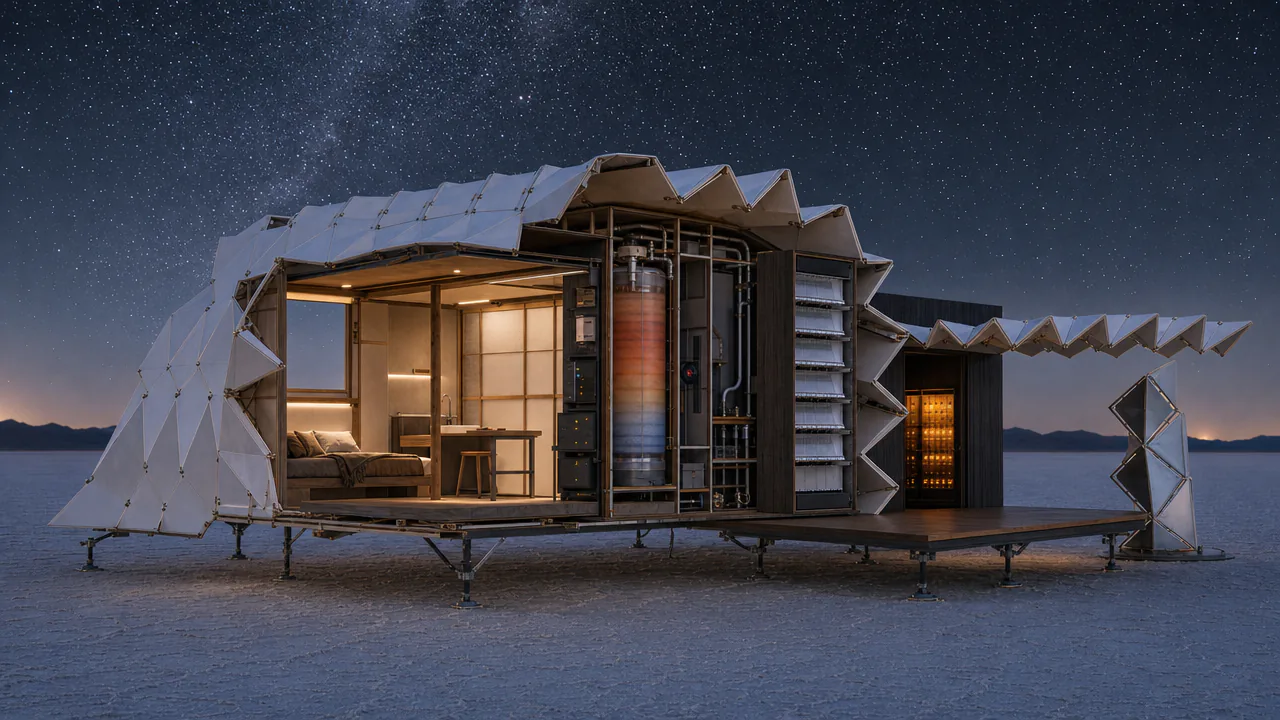
Water layer concept visual
水Layer 2 The Autonomy Stack · self-watering

Water. Recycle first, sense everything, and make only the residual from rain, sea or air.

7 subsystems25 projects36 papers35 numbers79 sources
L02 · concept visual · AI
水01 Thesis

A fully automated water layer is a loop, not a source: grey, yellow, brown and condensate streams are separated at the source, regenerated to the quality each use needs, and released only by a fail-closed sensor verdict, as the ISS does at 98%. Recovery is the master variable, because every point of net recovery shrinks the make-up source; at 90% net, a 4-person desert home needs about 44 L/day, not 320. The non-obvious ranking is by kWh per litre: rain and fog are almost free, any saline water desalinates at 0.003–0.0055 kWh/L, and atmospheric harvesting costs 0.4–5 kWh/L, so AWH belongs only where nothing liquid exists, and even then the farm's humid air and the heat pump's waste heat are better feedstocks than desert air. The binding constraints are not yield but brine chemistry, regrowth in storage, sensor-based safety and service logistics, which is where every documented failure (SOURCE in Allensworth, the ISS toilet and purge pumps, the Autarky toilet) actually happened.

98 %

ISS total water recovery with Brine Processor

44 L/day

Make-up water for a 4-person home at 80 L/person/day and 90% net recovery

calculatedanyground-v3
18–220 vs 0.13–0.24 kWh/day

Energy to make those 44 L/day: sorption AWH vs seawater RO

Slab 2 of the stack · see all eight

Maturity of options assessed

  • commercial 14
  • pilot 9
  • experimental 4
  • speculative 0
水02 Subsystem explorer

How the water layer works, option by option.

Each subsystem lists the technologies the research found, with maturity, an estimated technology readiness level and the numbers that matter. Hover a TRL bar for the reason behind it.

WATER-S1 · function

Sources: harvest liquid water the site already offers

Bring new water into the loop only to cover losses (evaporation, biomass export, brine, leaks) and drinking, ranked by energy per litre.

How it works

Rain capture is gravity plus a first-flush diverter: yield = roof area x rainfall x runoff coefficient, energy near zero. Fog nets intercept 1–40 um droplets carried by wind through a mesh; impaction efficiency depends on fibre diameter, shade coefficient and wind speed, so yield is extremely site specific. Dew condensers are radiatively cooled surfaces that drop below the dew point at night; the cooling budget (tens of W/m² at best) divided by latent heat (about 2.45 MJ/kg) caps yield below about 1 L/m²/night before convective losses. Wells and springs need only pumping (about 0.0027 kWh per m³ per metre of lift at 100% efficiency) but need quality screening for arsenic, fluoride, nitrate and salinity.

COMMERCIALTRL 9

Rooftop rain capture with first-flush and covered cistern

Gravity collection from the folded roof facets into a gutter, first-flush diversion, sediment trap, dark cistern

  • A x P x C L/yr (A m², P mm/yr, C 0.75–0.9) calculatedYield formulaanyground-v3
  • 3200 L/yr calculatedYOSHI-4 roof 40 m² at 100 mm/yr desertanyground-v3
  • 25600 L/yr calculatedSame roof at 800 mm/yr temperateanyground-v3

Best for E1 rooftopE2 forestE5 mountainE6 coastE7 steppeminimal value in E3 desert

Limits Seasonal; storage-bound; roof materials (bitumen, treated timber, Zn) and bird droppings require treatment before potable use.

Millennia of practice; standard products and codes in most jurisdictions.

COMMERCIALTRL 9

Fog mesh / fog harp on a Miura wing

Inertial impaction of wind-borne fog droplets on a vertical mesh, gravity drainage to gutter

  • 3–10 L/m² mesh/day measuredTypical operational yearly averageklemm-2012

Best for E5 mountain and E6 coast with advective fognot E3 inland desert

Limits Needs fog frequency and wind; high-wind sites destroy meshes; requires 12+ months of standard fog collector data before investing.

Decades of operational projects in Chile, Peru, Morocco, Oman; yield is the uncertainty, not the technology.

EXPERIMENTALTRL 4

Radiative dew condenser on shaded roof facets

Sky-facing low-emissivity-to-sky coating cools below dew point at night; hydrophilic slippery surface drains condensate

  • 0.7–1.5 L/m²/night calculatedPhysical upper bound (50–100 W/m² net cooling over 10 h night / 2.45 MJ/kg)beysens-2025

Best for Bonus collection on roofs already built (coastalsteppe)never a primary source

Limits Realistic yields are a fraction of the bound; wind and cloud kill it; dust fouls surfaces.

Measurement standards were only formalised in 2025; household-scale field data remain sparse.

COMMERCIALTRL 9

Shallow well / spring with screening

Pump lift plus pre-treatment chosen after a lab panel

  • 0.0027 kWh per m³ per m lift calculatedIdeal pumping energy

Best for E2 forestE7 steppeE5 mountain

Limits Permits and water rights; geogenic contaminants; not available on rooftops or floating sites.

Standard practice.

史03 Projects · including failures

Who has tried this, and what happened.

25 projects and companies, oldest first. 1 of them closed, failed or went bankrupt; they are kept in, because investors learn more from them than from the successes.

WhenProjectWhatStatusOutcome or lesson
1980s-presentOperational fog collection projects (Chile, Peru, Morocco, Oman, South Africa)Various (FogQuest, Dar Si Hmad and others, reviewed by Klemm et al.) · MultipleLarge passive mesh collectors for villages and reforestation.activeTypical 3–10 L/m²/day yearly average; success hinges on site selection, community ownership and maintenance. klemm-2012
1989-presentMELiSSA closed ecological loopESA / UAB Barcelona pilot plant · EU / SpainFive-compartment bioregenerative loop including a nitrifying compartment fed with urine-derived streams.researchA 2026 COSPAR abstract (title only; abstract page could not be retrieved in verification) reports work toward complete gas closure and liquid integration with food production; still a research pilot after 35+ years, which shows how hard biological closure is. melissa-esamelissa-2026
2006–2011Vacuum blackwater + anaerobic treatment demo (Sneek, NL)Wageningen / DeSaH / STOWA · Netherlands32 houses with vacuum toilets feeding UASB digestion and struvite recovery.pilotPreserved 7.6 g N and 0.63 g P per person per day (69% and 48%); proves cluster-scale source separation. zeeman-2011zeeman-2008
2008-presentISS Water Recovery System (WPA, UPA, BPA)NASA / Boeing / Paragon / Collins · International (US segment)Closed water loop recovering humidity condensate and urine for drinking on orbit.active98% total recovery once the Brine Processor was added (93–94% before); but 2024–26 report lists repeated purge pump failures, a toilet in stand-down from a failed dose pump, a Sabatier offline since 2017, and about 300 L of pretreated urine stored during UPA downtime (later all processed, none disposed). The loop works because a ground team and spares exist. nasa-98ntrs-iss-2026yt-iss-hadfield
2009-presentWatergen GENNY / GEN-M / GEN-LWatergen · IsraelRefrigerant-based atmospheric water generators from countertop to industrial.shippedGENNY Plus 20 L/day; no kWh/L published on the site read, a recurring transparency gap across the AWG industry. watergen-site
2010s-presentGENAQ Stratus / Nimbus / CumulusGENAQ · SpainAWGs for emergencies and industry, claimed to work above 50 C and below 20% RH.shippedNo litres or kWh figures on the site; claims unverifiable. genaq-site
2010s-presentSolarDewSolarDew · NetherlandsSolar membrane-distillation purifier for remote households.pilotStill crowdfunding (Republic Europe) with a target of 1 million people by 2035; no output figures on the site. solardew-site
2010-presentVUNA / Aurin urine fertiliserEawag / Vuna GmbH · Switzerland / South AfricaUrine nitrification, activated carbon and distillation into a licensed fertiliser.activeLicensed by FOAG (temporary 2015, full 2018 per Vuna); eThekwini field work showed social and logistics limits; distillation energy is the cost driver. eawag-vunavuna-aurinudert-2012fumasoli-2016
2011–2018Blue Diversion / Autarky toiletEawag with EOOS · Switzerland / UgandaUrine-diverting toilet recycling wash water through a gravity MBR plus GAC and chlorine/electrolysis.closedUsers in Kampala liked it, but treated water regrew E. coli, Pseudomonas and Salmonella in storage without a residual; cost and space were concerns. Lesson: residual disinfection and business model are not optional. nguyen-2017tobias-2017
2014-presentSOURCE hydropanels (formerly Zero Mass Water)Source Global PBC · USASolar-powered desiccant panels producing drinking water from air.shipped (2026 status unverified)Raised capital from Gates and BlackRock investors (2022, headline). In Allensworth, CA, many of about 42 panels broke and went unserviced, each giving about a gallon per day. Lesson: service network and honest yield beat product novelty. Allensworth report dated 13 March 2024; town need about 1.5 million gal/month; company said it would inspect panels. Company status in 2026 not re-verified (site rate-limited, search budget exhausted). sjv-allensworthcnbc-source-2022pat-sourceyt-source-dubai
2015-presentHydraloop H300/H600Hydraloop Systems · NetherlandsMembrane-free greywater recycler for toilets, laundry, irrigation.shippedNSF/ANSI 350R certified; up to 95% of greywater recycled and up to 45% cut in mains demand. Proves a certified appliance path; non-potable only. hydraloop-sitehydraloop-brochure
2017–2018MOF-801 desert devices (Tempe, Arizona)MIT (Wang) / UC Berkeley (Yaghi) · USAFirst MOF harvesters run in a real desert with sunlight only.researchAbout 0.1–0.25 L/kg MOF per day-night cycle at 10–40% RH with about 14% thermal efficiency; established the physics and the low per-kg yield. kim-2017kim-2018fathieh-2018
2017–2023 (patent)Low-temperature heat AWH cyclePolitecnico di Torino · ItalyPaired enthalpy exchangers with closed near-isothermal regeneration loop.researchClaims 2.7 kWh_th/L closed vs 4.7 open: closing the regeneration air loop is a cheap design win. pat-polito
2019-presentWOTA Unit / WOTA BOX / WOSHWOTA Corp. · JapanAutonomous greywater regeneration for showers (BOX), handwashing (WOSH) and whole homes (Unit).pilotBOX deployed after the 2024 Noto earthquake; Unit claims 97% regeneration and passed TRL 6 in 2025, with household trials from January 2026. Japan's June 2025 Cabinet policy backs decentralised water. Drinking water: conflicting sources — the WOTA site says the Unit meets WHO drinking-water guidelines, while Feb 2026 press says a rainwater purification module for drinking water is still in development. The current WOTA English site does not mention the Noto deployment (claim rests on other sources). wota-sitedailygalaxy-wotayt-wota-unityt-wota-box
2019-presentUravu LabsUravu Labs · IndiaLiquid salt absorbent regenerated by 35–60 C waste heat; now positioned for data centres.activePivoted from bottled water to data-centre cooling by-product (Clausius, regenerated by 35–60 C waste heat); claims up to 30,000 L per MW per day (MW basis unspecified). Seed of USD 2.3 M (2023, headline); further funding from Enrission India Capital reported July 2025 (headline only, amount not verified). uravu-siteentrackr-uravubwdisrupt-uravu-2025
2019–2024On-site reuse with online sensors (NEST Water Hub)Eawag / ETH Zurich · SwitzerlandMBR + chlorination reuse loops with ML microbial-quality prediction.researchTwo cheap sensors (free chlorine, ORP) gave safe/unsafe classification at FPR ≤ 2%. reynaert-2023
2020s-presentAtoco MOF water harvestersAtoco (founded by Omar Yaghi) · USA20-ft containerised MOF harvesters; also greenhouse humidity extraction.pilotClaims 2,000–4,000 L/day on grid and up to 1,000 L/day off grid; commercial rollout aimed 'within the next year' as of January 2026. Yaghi shared the 2025 Nobel Prize in Chemistry. Treat outputs as claims until independent field data. agnav-atoco
2020s-presentAquaria HydropackAquaria · USAResidential condensation AWG sized at 66–264 US gal/day.shippedLarge residential AWG claims; no energy disclosure on the site. aquaria-site
2021-presentBrine Processor AssemblyParagon Space Development / NASA · USAMembrane-distillation bladder drying urine brine with warm forced air.activeAbout 780 L returned from 946 L brine since Feb 2024; a household analogue could take RO reject and urine brine to dryness. ntrs-iss-2026
2022Adaptive self-optimising MOF deviceAlmassad et al. (Jordan / Saudi Arabia team) · JordanController adapts adsorption and desorption timing to weather.research3.5 L/kg/day at 17–32% RH with 1.67–5.25 kWh/L in a desert, arid climate; the +169% is relative to the best previously reported active device (MOF-303, 0.7–1.3 L/kg/day, a different device), not a controlled A/B test of control software alone. Still the strongest evidence that weather-adaptive cycle timing matters. almassad-2022
2023Death Valley hand-held MOF harvesterUC Berkeley (Yaghi group) · USAPassive MOF harvester tested in Death Valley in ambient sunlight.research285 g water per kg MOF per day, 85–90% of captured vapour delivered: honest scale is cups, not tanks. uc-deathvalleysong-2023-nwyt-yaghi-desert
2023–2025Power-to-water batteryShanghai Jiao Tong University (Wu group) · ChinaStores surplus electricity as MgO-based high-temperature heat, discharges it to desorb a liquid sorbent.research3.06 L/day prototype at 1.13 kWh/kg; turns curtailed PV into water. lin-2025-p2w
2024-presentAirJoule PrimeAirJoule Technologies (JV with GE Vernova) · USASorbent water-from-air units using waste heat from chillers and heat pumps.pilotUnveiled 2026 with up to 2,000 L/day; energy per litre not disclosed in the article read. technically-airjouleyt-airjoule
2024Direct-drive PV electrodialysisMIT (Winter lab) · USABattery-free brackish desalination following the sun.pilot5,000 L/day for six months at Alamogordo using over 94% of PV electricity directly. mit-pved-2024
2024Optimal Harvesting Window silica-gel AWHShanghai Jiao Tong University (Ge, Wang) · ChinaThermodynamically tuned silica-gel AWH with PV drive.research0.46–1.5 L/kWh; a 1 m² PV panel makes 0.66–2 L/day: cheap sorbent plus control beats exotic materials. li-2024-ohw

Failures, read for lessons

  1. SOURCE hydropanels in Allensworth, California

    WhyMany panels broke; community-centre panels down for months; contract had no reachable support; output about a gallon per panel versus a town need of 1.5 million gallons per month.

    Lesson for AnygroundSell service, not panels: every water module ships with remote telemetry, a stocked spare kit and a guaranteed response time, and is sized against the residual, not the whole demand.

  2. ISS UPA recovery cut from 85% to 75% (2009)

    WhyIssues with urine quality (per the 2026 status paper) forced recovery down until a phosphate-based pretreat was introduced in 2016.

    Lesson for AnygroundBrine chemistry, not membranes, limits recovery; design urine and RO-reject paths with acid flush and conservative recovery set-points that rise only with data.

  3. ISS Universal Waste Management System toilet in stand-down

    WhyFailed dose pump and controller; no direct monitoring of pretreat dose quality; fluid releases limited crew use.

    Lesson for AnygroundEvery chemical dose needs a sensor that confirms it was delivered; KAWAYA-U must detect a missed acid or flush dose.

  4. ISS UPA purge pump failures 2024–26 and 300 L urine backlog

    WhyPeristaltic tubing ruptures and motor failures in five pump swaps; stored urine aged and needed a flight-rule waiver.

    Lesson for AnygroundPlan for the loop being down: buffer tanks with stabilised storage, and wear parts (tubing, pumps) as robot-swappable cartridges for TSURU.

  5. Russian-segment urine processor distiller failed at checkout (2018)

    WhyHardware failures and vacuum leaks.

    Lesson for AnygroundVacuum distillation is unforgiving; prefer ambient-pressure membrane distillation for household brine.

  6. Blue Diversion Autarky toilet (Eawag/EOOS)

    WhyTreated wash water regrew pathogens in storage; cost and space concerns from users; project did not reach market.

    Lesson for AnygroundAlways carry a residual disinfectant or recirculating UV in storage; test business model with users early.

  7. VUNA nitrification process failures

    WhyNitrite accumulation and selection of acid-tolerant ammonia oxidisers, especially at start-up; distillation energy 4–5x conventional nutrient removal.

    Lesson for AnygroundUse electrochemical pH control and nitrite sensors; consider zeolite capture (M06) where energy is short; supervise start-up remotely.

  8. Constructed wetlands as sole greywater barrier

    WhyCannot reliably meet microbiological reuse standards.

    Lesson for AnygroundWetlands are biology, not disinfection; always add UV and residual.

  9. AWG industry energy opacity

    WhyWatergen, Genaq and Aquaria sites read give no kWh/L; claims like 'works below 20% RH' come without data.

    Lesson for AnygroundPublish measured litres per kWh per climate for every KUMO unit; it is a trust differentiator.

  10. Lab-to-field gap in solar evaporation and MOF yields

    WhyIndoor 3.58 vs outdoor 1.95 kg/m²/h; lab MOF projections of 2.8 L/kg/day vs field 0.1–0.7.

    Lesson for AnygroundSize from single-cycle field data only (as M05 already does).

文04 Key papers

The science underneath, 36 papers.

Newest first. Each line states the finding that the dossier relies on.

  1. 2026

    Status of ISS Water Management and Recovery (ICES-2026–425)

    Williamson J., Wilson J.P., Luong H., Chen L. · 55th International Conference on Environmental Systems · field-trial

    WPA produced about 17,900 L in Feb 2024-Feb 2026; UPA recovers 87% of US urine (target 90%); total 98+% with BPA.

  2. 2025

    Multi-stage power-to-water battery synergizes flexible energy storage and efficient atmospheric water harvesting

    Lin H. et al. · Nature Communications · experiment

    3,060 g/day prototype at 1.13 kWh/kg, with three AWH stages cutting energy by 26%.

  3. 2025

    Wood-based solar interfacial evaporator for efficient seawater desalination processed by picosecond laser

    Chu D. et al. · Langmuir · experiment

    3.58 kg/m²/h indoors at 1 sun but 1.95 kg/m²/h outdoors: the lab-to-field gap in evaporation.

  4. 2024

    An atmospheric water harvesting system based on the Optimal Harvesting Window design for worldwide water production

    Li Q. et al. · Science Bulletin · experiment

    3 kg silica gel produced 5.76–17.64 L/day at 0.46–1.5 L/kWh; 1 m² PV gives 0.66–2 L/day in Shanghai.

  5. 2024

    Enhanced continuous atmospheric water harvesting with scalable hygroscopic gel driven by natural sunlight and wind

    Yang X., Chen Z., Xiang C., Shan H., Wang R. · Nature Communications · experiment

    Solar-concentrated hygroscopic gel device gave 3.5–8.9 L/m²/day outdoors (14.9 indoors).

  6. 2024

    Solar-off-grid atmospheric water harvesting system: performance analysis in diverse climate conditions

    Tashtoush B., Alshoubaki A.Y. · Science of the Total Environment · model

    Modelled 3.25, 2.69 and 1.87 kg/kWh for coastal, typical and desert regions.

  7. 2024

    Direct Potable Reuse regulations, CCR Title 22 sections 64669.00–64669.130

    California State Water Resources Control Board · California Code of Regulations · regulation

    Treatment train validated for ≥ 20/14/15 log (virus/Giardia/Cryptosporidium) with ≥ 4 processes of ≥ 1 log each (max 6 per process) and 3 diverse mechanisms (membrane, chemical, UV ≥ 300 mJ/cm2); never below 16/10/11 log; LRV tracked continuously by SCADA surrogates; T5 chief and T3 shift operators required.

  8. 2023

    MOF water harvester produces water from Death Valley desert air in ambient sunlight

    Song W. et al. (Yaghi group) · Nature Water · field-trial

    Up to 285 g water per kg MOF per day in Death Valley, releasing 85–90% of captured vapour (via UC press release; paper not read).

  9. 2023

    Sorbents, processes and applications beyond water production in sorption-based atmospheric water harvesting

    Li R., Wang P. · Nature Water · review

    Review of sorbent classes and co-applications (cooling, dehumidification, irrigation); numbers not extracted (not read).

  10. 2023

    Predicting microbial water quality in on-site water reuse systems with online sensors

    Reynaert E. et al. · Water Research · experiment

    Logistic regression on free chlorine and ORP classified safe/unsafe reuse water with FPR fixed at ≤ 2%.

  11. 2023

    NSF/ANSI 350 Onsite residential and commercial water reuse treatment systems

    NSF International · NSF/ANSI standard · standard

    Certification route used by Hydraloop (350R); effluent limits not retrieved (page 403).

  12. 2022

    Environmentally adaptive MOF-based device enables continuous self-optimizing atmospheric water harvesting

    Almassad H.A. et al. · Nature Communications · field-trial

    Adaptive cycle control gave 3.5 L/kg MOF/day at 17–32% RH using 1.67–5.25 kWh/L.

  13. 2021

    Global potential for harvesting drinking water from air using solar energy

    Lord J. et al. · Nature · model

    A 1 m² device at 0.2–2.5 L/kWh (30–90% RH) could meet 5 L/person/day for about a billion people.

  14. 2021

    Electrochemical in situ pH control enables chemical-free full urine nitrification with concomitant nitrate extraction

    De Paepe J. et al. · Environmental Science & Technology · experiment

    An electrochemical cell steered by a pH controller replaced base dosing and enabled full nitrification plus nitrate extraction (space and Earth).

  15. 2020

    Domestic water quantity, service level and health, 2nd edition

    Howard G., Bartram J., Williams A. et al. · World Health Organization · standard

    Defines service-level tiers by litres per person per day (full text not retrieved; tiers used here are labelled unverified).

  16. 2019

    Rapid cycling and exceptional yield in a metal-organic framework water harvester

    Hanikel N. et al. · ACS Central Science · field-trial

    MOF-303 multicycle harvester: 1.3 L/kg/day indoors at 32% RH and 0.7 L/kg/day in the Mojave at 10% RH.

  17. 2019

    Performance of anaerobic treatment of blackwater collected from different toilet flushing systems

    Gao M. et al. · Journal of Hazardous Materials · experiment

    Vacuum toilets use 0.5–1.2 L/flush but their blackwater gave 34% BMP vs 48% for 5–9 L flush toilets due to free ammonia.

  18. 2018

    Adsorption-based atmospheric water harvesting device for arid climates

    Kim H. et al. · Nature Communications · field-trial

    Air-cooled MOF-801 device at 10–40% RH reached about 14% thermal efficiency and over 0.25 L/kg per daily cycle (predicted).

  19. 2018

    Practical water production from desert air

    Fathieh F. et al. · Science Advances · field-trial

    1.2 kg MOF-801 prototype produced 100 g water/kg/day in the Arizona desert with sunlight only.

  20. 2018

    Hybrid hydrogel with high water vapor harvesting capacity for deployable solar-driven atmospheric water generator

    Li R. et al. · Environmental Science & Technology · experiment

    35 g of salt-hydrogel delivered 20 g water in 2.5 h of outdoor sunlight.

  21. 2018

    Constructed wetlands for greywater recycle and reuse: a review

    Arden S., Ma X. · Science of the Total Environment · review

    Wetlands meet chemical/physical reuse standards but not microbiological ones without UV or chlorine.

  22. 2018

    Towards development of a standard methodology for testing field performance of residential greywater reuse systems

    Craig M, Richman R · Journal of Water Reuse and Desalination 8(2):135 · field study

    Off-the-shelf household greywater systems have variable field performance; a field method measuring water balance, quality, energy, durability, maintenance, economics and satisfaction was applied in 22 homes (numeric savings truncated in the retrieved abstract).

  23. 2017

    Water harvesting from air with metal-organic frameworks powered by natural sunlight

    Kim H. et al. · Science · experiment

    MOF-801 harvest of 2.8 L per kg MOF per day at 20% RH (projected from lab cycle).

  24. 2017

    Controlling bacterial pathogens in water for reuse: treatment technologies for water recirculation in the Blue Diversion Autarky Toilet

    Nguyen M.T. et al. · Frontiers in Environmental Science · experiment

    After MBR treatment, E. coli, P. aeruginosa and S. typhimurium could regrow in storage absent competition or residual disinfectant.

  25. 2017

    Early testing of new sanitation technology for urban slums: the case of the Blue Diversion Toilet

    Tobias R. et al. · Science of the Total Environment · field-trial

    Acceptance study with 22 regular users, 308 one-time users and 1,538 surveyed in Kampala (2013).

  26. 2017

    Potable reuse: guidance for producing safe drinking-water

    World Health Organization · WHO manual (152 pp.) · guidance

    Frames potable reuse as a practical source in specific circumstances, managed through water safety plans, control measures, monitoring and public acceptance (catalogue summary only).

  27. 2016

    Operating a pilot-scale nitrification/distillation plant for complete nutrient recovery from urine

    Fumasoli A. et al. · Water Science & Technology · field-trial

    Distillation needed 71 W/capita primary energy vs 13 W/capita for nitrification.

  28. 2016

    Single house on-site grey water treatment using a submerged membrane bioreactor for toilet flushing

    Fountoulakis M.S. et al. · Science of the Total Environment · field-trial

    Single-house SMBR removed 87% COD and cut TSS from 95 to 8 mg/L.

  29. 2016

    A novel, optical, on-line bacteria sensor for monitoring drinking water quality

    Hojris B. et al. · Scientific Reports · experiment

    Image-recognition bacteria counter with 10-minute resolution using 59 image parameters.

  30. 2016

    Application of ultraviolet light-emitting diodes (UV-LEDs) for water disinfection: a review

    Song K., Mohseni M., Taghipour F. · Water Research · review

    UV-LED inactivation data are inconsistent across studies; a standard dose protocol is needed.

  31. 2012

    Fog as a fresh-water resource: overview and perspectives

    Klemm O. et al. · Ambio · review

    Operational fog projects typically yield 3–10 L/m² mesh/day as yearly averages.

  32. 2012

    Complete nutrient recovery from source-separated urine by nitrification and distillation

    Udert K.M., Waechter M. · Water Research · experiment

    Nitrification (max 1.8 g N/m²/d) plus distillation recovered all nutrients except under 3% of N; primary energy 4–5x conventional unless RO removes 80% of water first.

  33. 2011

    Resource recovery from source separated domestic waste(water) streams; full scale results

    Zeeman G., Kujawa-Roeleveld K. · Water Science & Technology · field-trial

    Vacuum blackwater in 32 houses preserved 7.6 g N/p/d (69%); urine theoretically carries 11 g N and 1.0 g P per person per day.

  34. 2011

    The future of seawater desalination: energy, technology, and the environment

    Elimelech M., Phillip W.A. · Science · review

    Seawater desalination remains more energy-intensive than fresh-water treatment; reviews limits of energy reduction (numbers not in abstract).

  35. 2009

    Review of the technological approaches for grey water treatment and reuses

    Li F., Wichmann K., Otterpohl R. · Science of the Total Environment · review

    Aerobic biology + filtration + disinfection is the most economical greywater recycling train; physical processes alone are insufficient.

  36. 2008

    Anaerobic treatment as a core technology for energy, nutrients and water recovery from source-separated domestic waste(water)

    Zeeman G. et al. · Water Science & Technology · pilot-based concept

    New sanitation concept (UASB for black and grey water plus kitchen waste) saves 200 MJ/year vs conventional sanitation (abstract does not state per-person basis), recovers 0.14 kg P/p/year and yields 90 L of potentially reusable water.

数05 Numbers ledger

Every number, with its basis.

Measured, reported, claimed, calculated or target: the basis travels with the value.

QuantityValueUnitBasisSources
ISS total water recovery with Brine ProcessorUp from 93–94% before BPA; 2 lb lost per 100 lb collected.98%measurednasa-98ntrs-iss-2026
ISS UPA recovery from US pretreated urineDesign 85%, cut to 75% after 2009 urine-quality problems, restored by phosphate pretreat (2016); target 90%; Russian-segment urine 70%.87%measuredntrs-iss-2026
ISS WPA product water Feb 2024-Feb 2026Daily mean calculated as 17,900 L / 730 days.17900L (about 24.5 L/day)measuredntrs-iss-2026
ISS water use per crew memberDrinking, food preparation and hygiene; shows the floor of a closed-loop life.about 1US gal/person/day (about 3.8 L)reportednasa-98
UN-recognised domestic water needUN GA resolution 64/292 (2010), read via secondary source. WHO 2020 service tiers not retrieved.50–100L/person/dayreportedwiki-hrw
Solar AWH design envelope (1 m² device)Needed to meet 5 L/person/day drinking water.0.2–2.5L/kWh at 30–90% RHtargetlord-2021
Passive MOF-801 desert yieldArizona, sunlight only, one cycle.0.1L/kg MOF/daymeasuredfathieh-2018
Passive MOF harvester, Death Valley85–90% of captured vapour released as drinking water.up to 0.285L/kg MOF/daymeasureduc-deathvalley
Active MOF-303 multicycle yield, MojaveAt 10% RH; 1.3 L/kg/day at 32% RH indoors.0.7L/kg MOF/daymeasuredhanikel-2019
Adaptive MOF device energy intensity3.5 L/kg/day at 17–32% RH.1.67–5.25kWh/Lmeasuredalmassad-2022
Silica-gel sorption AWH energy efficiency13–35 C, 18–72% RH; 1 m² PV gives 0.66–2 L/day.0.46–1.5L/kWhmeasuredli-2024-ohw
Closed vs open regeneration loop heat demandPatent example assumes 45 C regeneration and 35 C condensation, 100 m³/h air (about 45 L/day over 8 h of solar heat); heat-source range stated 50–80 C.2.7 vs 4.7kWh_th/Lclaimedpat-polito
Fog collection yearly averageOperational projects worldwide.3–10L/m²/daymeasuredklemm-2012
Seawater RO electricityThermodynamic minimum about 1 kWh/m³; i.e. 0.003–0.0055 kWh/L, about 300–1,000x less than AWH.3–5.5kWh/m³reportedwiki-desal
PV-ED direct-drive outputOver 94% of PV electricity used directly, no battery, six months, brackish wells.up to 5000L/daymeasuredmit-pved-2024
WOTA Unit domestic wastewater regenerationVendor figure, 'may vary with usage'. TRL 6 passed 2025 (press). Drinking-water make-up depends on a rainwater purification module still in development per Feb 2026 press; WOTA site claims WHO-guideline quality.97%claimedwota-sitedailygalaxy-wota
Hydraloop greywater recycled / mains reductionNSF/ANSI 350R certified, H600 up to 720 L/day.95 / 45% (up to)claimedhydraloop-site
Single-house MBR COD removalTSS 95 to 8 mg/L.87%measuredfountoulakis-2016
Soft-sensor false-positive ceilingFree chlorine + ORP logistic regression on MBR-chlorination disruptions.2% maxmeasuredreynaert-2023
Urine nutrient loadTheoretical; 38–63% of N recovered in practice in Sweden.11 g N, 1.0 g Pper person per dayreportedzeeman-2011
Urine volumeAbout 1.4 L/person/day.500L/person/yearreportedvuna-aurin
Urine distillation energyPlus 13 W/capita nitrification, i.e. about 2 kWh/capita/day primary.71W/capita (primary)measuredfumasoli-2016
Vacuum toilet flush volumeConventional 5–9 L/flush.0.5–1.2L/flushmeasuredgao-2019
SOURCE hydropanel field outputAllensworth, CA; many panels broken and unserviced in 2024.about 1US gal/panel/dayreportedsjv-allensworth
Atoco container output20-ft containerised unit; article of 21 Jan 2026 says commercial rollout aimed 'within the next year' (no fixed year).2,000–4,000 (grid) / 1,000 (off-grid)L/dayclaimedagnav-atoco
Uravu Clausius output per MW35–60 C waste heat.30000L per MW per day (site does not say whether MW is heat load or IT load)claimeduravu-site
Outdoor interfacial evaporation rateSame device 3.58 kg/m²/h indoors.1.95kg/m²/hmeasuredchu-2025-langmuir
Latent heat of water as electrical floor for dewing AWG before COP2.45 MJ/kg / 3.6 MJ/kWh; divide by compressor COP 2–4 for best-case humid air.0.68kWh/Lcalculated
ORIJO 4-person make-up water (desert)4 x (80 L x (1–0.90) + 3 L drinking/cooking).44L/daycalculatedanyground-v3
Energy to make 44 L/day by sorption AWH vs desalinationAWH at 0.2–2.5 L/kWh (N06); SWRO at 3–5.5 kWh/m³ (N14).18–220 vs 0.13–0.24kWh/daycalculatedlord-2021wiki-desal
California DPR pathogen log-reduction design target (enteric virus / Giardia / Cryptosporidium)CCR 22 s.64669.45(a)(1); ≥ 4 processes per pathogen each credited ≥ 1.0 and ≤ 6 log; 3 diverse mechanisms (membrane, chemical, UV); regulation text read20 / 14 / 15log10 reductionreportedca-dpr-text
California DPR never-below floorMust be met at all times (s.64669.45(b)(2)); full 20/14/15 at least 90% of production time (b)(3); LRV tracked continuously by SCADA via surrogates (b)(1)16 / 10 / 11log10 reductionreportedca-dpr-text
Minimum UV dose in a California DPR trains.64669.45(a)(7)300mJ/cm2reportedca-dpr-text
Certified operators required for a California DPR plants.64669.35(b); plus AWT5/AWT3 for the advanced treatment plant (c). Municipal scope only; no household potable-reuse pathway exists in this ruleT5 chief + T3 per shiftoperator gradereportedca-dpr-text
Japanese mobile disaster water purifier: cost and capacityMinistry figures via Yomiuri, Sep 2026; one-third purchase subsidy for prefectures from FY2025; Suzu still using three units after the 2024 Noto earthquaketens of millions to 100 million JPY; about 2,000 L/hJPY per unit; L/hreportedann-japan-purifiers
段06 Autonomy ladder

From manual to Earth-independent, in human minutes.

Human minutes per week for this layer at each level (log bars). The unified site-level scale is on the Autonomy Stack page.

  1. L0

    Mains or trucked water, manual filters, no reuse.

    None; dependent on utility.

    0 min/wk
  2. L1

    Rain tank plus certified greywater recycler for toilets and laundry, alarms by SMS.

    Hydraloop-class appliance, float switches, UV lamp.

    30 min/wk
  3. L2

    Greywater-to-potable appliance with autonomous control, online EC/turbidity/free Cl, remote fleet monitoring; owner swaps cartridges.

    WOTA Unit-class, JO-PORT dry-break cartridges.

    20 min/wk
  4. L3

    Source-separated streams (urine nitrification, BSF, grey) plus one make-up source sized to the residual, soft-sensor release interlock, predictive cartridge ordering.

    Reynaert-type soft sensor, KAWAYA-U, MIZU-1, KUMO-12 or rain.

    10 min/wk
  5. L4

    Closed loop at 95–98% with brine drying and farm transpiration recapture; robot swaps cartridges; human role is quarterly verification sampling.

    BPA-analogue brine bladder, TSURU cartridge handling, optical bacteria counter.

    5 min/wk
  6. L5

    Self-sizing fleet: units negotiate water and spare parts across sites, adapt AWH cycles to forecasts, and certify their own compliance via sealed sensor logs accepted by regulators.

    Regulatory acceptance of continuous-monitoring compliance (not yet available), fleet ML, adaptive AWH control.

    1 min/wk

ORIJO roadmap for this layer

  • 2027 L1-L2 · v3 Phase 1 Bench
  • 2029 L3 · v3 Phase 3 Catalogue (first IE homes, HATA-MURA farms)
  • 2032 L4 · v3 Phase 4 Extreme (KITA winter-over)
結07 Interfaces

What crosses to the other layers.

Flows into and out of this layer from the synthesis, coloured by currency.

  • Structure →Roof catchment and fall lines from every facet to a gutter3,200 at 100 mm/yr desert; 25,600 at 800 mm/yr (40 m² YOSHI-4 roof, C 0.8) L/yr calculated
  • Energy →Electricity for MIZU treatment, pumps, UV; low-grade heat for sorbent regeneration2–4.3 MIZU (home) + 1.4 KUMO fans; heat 2.7–4.7 kWh_th per AWH litre kWh/day calculated
  • → StructureWet-zone loads and leak risk at JO-PORTabout 2,000 (KRES-7 tank on mast) kg tank mass target
  • → EnergyThermal storage in water tanks; recycler waste heat14–23 per 300–500 L tank kWh_th calculated
  • → LoopSeparated urine, RO reject and brine, sludgeurine 5.9 (4 people); brine to SHIO-BUKURO L/day calculated
  • → GrowRecycled grey and make-up water for nutrient solutionabout 10 gross, 1.8–3.1 net with 90% condensate recapture L/day per HATA-4 calculated
  • → BuildDrainage routing before pile layoutpile layout generated after water routing - design rule
  • → CareCartridge swaps (filters, UV, membranes, sorbent, pump tubing)about 1.5 (12 consumables, mean 8-week interval) swaps/week target
  • → MindFree Cl, ORP, EC, turbidity, UVT, level, flow streams; release verdicts≤ 2% false-positive ceiling measured
  • Loop →Plant condensate and urine-derived distillate back to the grey intake3.9 (NASA BPC transpiration condensate) L/m²/day calculated
  • Grow →Transpiration condensate, recoverable as the cleanest water on site13–26 transpired at 2–4 L/m²/day ET on 6.6 m² (assumption) L/day per HATA-4 calculated
  • Build →First-flush and leak test at dockingpressure-decay test per port - design rule
  • Care →Filter/membrane/UV/sorbent cartridge swaps10 robot min/swap target
  • Mind →Schedules for AWH, brine drying, cartridge ordersAWH cycles adapted to RH/PV forecast - design rule
折08 ORIJO design

The recommended stack and what we would build next.

What ORIJO adopts from the state of the art, the new mechanisms this layer adds and the 12-month prototype for each, with its pass and kill criteria.

SubsystemORIJO choiceWhy
WATER-S5 reuseMIZU-1 household wastewater regeneration organ (WOTA Unit class; potable release only behind MIZU-MAMORI, since no product has independently proven potable reuse) + KAWAYA-U urine diversion with nitrification routeRecovery multiplies every other source: at 90% net recovery the make-up need falls 10x.
WATER-S1 sourcesRain capture on every roof facet as default; fog harp on Miura wing only after a 12-month standard fog collector surveyLowest kWh per litre; fog is excellent where it works and useless elsewhere.
WATER-S3 desalinationSmall PV-RO or PV-ED when any saline/brackish source exists (coast, brackish well)3–5.5 kWh/m³ versus 400–5,000 kWh/m³ for AWH.
WATER-S2 AWHKUMO-12 sorption rack only for E3 desert / no-source sites, sized to drinking + residual; regenerate with heat-pump or PV-T waste heat in a closed vapour loopField yields are 0.1–0.7 L/kg/day; closed regeneration loop cuts heat need about 40% (2.7 vs 4.7 kWh_th/L claimed).
WATER-S4 barriersBiology > UF > RO > UV-C LED > electrochlorinated residual > GAC on drinking tapIndependent barriers; residual needed against regrowth in storage.
WATER-S6 monitoringFree Cl + ORP + EC + turbidity + UVT with slope features, logistic soft sensor at FPR ≤ 2%, membrane pressure-decay test dailyCheapest proven predictor of microbial safety in on-site reuse.
WATER-S7 storage and residualsKRES-7 gravity tank with recirculating UV; brine bladder dryer (BPA analogue) on PV surplusPushes net recovery from 90–95% toward 98%, and leaves salt cake, not liquid reject.

01 New mechanism

KUMO-NAE (the farm cloud)

Desiccant cassette that harvests water from the HATA/YOSHI-6G grow air instead of outside air.

How it works

Grow chambers sit at 70–90% RH because plants transpire most of the irrigation water. A rotating silica-gel or MOF-303 cassette loads from grow air at night, is regenerated by the heat pump's hot side (45–60 C) in a closed vapour loop, and condenses on the heat pump's cold side, so one compressor dehumidifies the farm, heats the hot water tank and makes water. Condensate goes to the grey loop (Legionella and organics risk), not straight to the tap. The SOURCE patent US11160223B2 describes the farm-air coupling; the closed regeneration loop follows PoliTo CN111278532B.

12-month prototype
One HATA-4 cassette in a sealed 1-jo chamber with load cells on trays, a 1.5 kg silica-gel wheel, a 1 kW R290 heat pump, condensate scale and RH/T sensors.
BOM
USD about 6,000 (estimate, not quoted)
Test
Run 90 days of lettuce; measure litres recovered / litres irrigated, kWh/L, and condensate HPC/Legionella monthly.
Pass
≥ 80% of irrigation water recovered at ≤ 0.5 kWh/L with no Legionella detection after UV.
Kill
< 60% recovery or > 1 kWh/L, or recurrent Legionella.

02 New mechanism

SHIO-BUKURO (salt bag)

Household brine bladder that dries RO reject and urine brine to salt cake, after ISS BPA.

How it works

A replaceable hydrophobic-membrane bag holds brine; warm dry air from the PV-T loop flows over it so water vapour crosses the membrane while salts stay inside. The humid air is returned to the HRV dehumidifier and the condensate joins the grey loop. When the bag's mass stops falling, TSURU swaps it; the dry cake goes to salt or fertiliser export.

12-month prototype
20 L bag of PTFE or ePTFE laminate in a ventilated 1-jo locker with a 300 W heater fan on PV surplus and a load cell.
BOM
USD about 1,500 (estimate)
Test
Feed WOTA-class RO reject and stored urine brine for 6 months.
Pass
≥ 80% of brine water recovered, no membrane wetting, odour below household threshold.
Kill
Membrane wetting within 4 weeks or > 3 kWh per litre recovered.

03 New mechanism

MIZU-MAMORI (water guardian)

Fail-closed release controller that decides tap, farm or grey for every tank batch.

How it works

Batches, not continuous flow: each storage batch is held until free chlorine, ORP (and their slopes), EC, turbidity and UV-sensor readings feed a logistic model trained to FPR ≤ 2%; only a 'safe' verdict opens the potable solenoid, otherwise the batch recirculates or goes grey. Weekly, a sealed grab-sample vial is drawn automatically for E. coli testing to recalibrate. Logs are hash-chained for regulators.

12-month prototype
Sensor manifold (free Cl, ORP, EC, turbidity, UVT), 3 solenoids, edge controller, auto-sampler on a MIZU-1 test loop.
BOM
USD about 4,000 (estimate)
Test
Induce the six disruption types from Reynaert 2023 (membrane breach, chlorine dosing failure, etc.) 50 times.
Pass
Zero unsafe batches released; false alarm rate below 10%.
Kill
Any unsafe release that grab samples detect.

04 New mechanism

AMA-TSUYU roof (rain-and-dew roof)

Folded roof facets with a radiative-cooling, slippery hydrophilic top coat that collects rain by day and dew by night into one gutter with first-flush.

How it works

The same facets that shed rain are tilted at 30 degrees or more to drain dew; the coating emits in the 8–13 um sky window to cool below dew point at night. Gutter flow sensors separate rain, dew and first flush.

12-month prototype
Two 1 × 2 m coated facets vs uncoated control at a coastal and a steppe site, tipping-bucket gauges.
BOM
USD about 2,500 (estimate)
Test
12 months of paired data per the 2025 dew measurement standard.
Pass
≥ 0.1 L/m²/night annual mean added on the coated facet without hurting roof thermal performance in summer.
Kill
< 0.03 L/m²/night or coating soiling > 30% loss in emissivity in 6 months.

Sizing reference

home 4p

formula
make_up = N x (D x (1 — R) + Dk); treat = N x D

inputs

N
4
D L per person day
80
R net recovery
0.9
Dk drinking cooking L
3
treat L day
320
make up L day
44

source options

rain needed roof m2 at 100mm yr
44 × 365 / (100 × 0.8) = 201 m² (desert: rain alone insufficient)
rain needed roof m2 at 600mm yr
44 × 365 / (600 × 0.8) = 33 m²
MOF passive kg at 0.1-0.285 L kg day
154–440 kg
sorption AWH kWh day at 0.2-2.5 L kWh
18–220
SWRO kWh day
0.13–0.24
basis
calculated

sources

0
src-anyground-v3
1
src-fathieh-2018
2
src-uc-deathvalley
3
src-lord-2021
4
src-wiki-desal

hotel 6key

formula
same; guests G = 12 at D = 100 L, staff 2 at 50 L
treat L day
1300
make up L day
12 x (100 × 0.1 + 3) + 2 x (50 × 0.1 + 3) = 172
equipment
2 × 720 L/day greywater appliances (Hydraloop H600-class capacity) or two MIZU-1 organs; urine to Aurin-type route or zeolite bed; brackish PV-ED if a well exists
basis
calculated

sources

0
src-hydraloop-site
1
src-wota-site

farm module

formula
net = A_grow x ET x (1 — r_condensate) + biomass water

inputs

A grow m2
6.6
ET L m2 day assumed
2–4 (assumption, not sourced)
r condensate
0.9
biomass fresh kg day
0.5
water content
0.95
net L day
6.6 × 2–4 × 0.1 + 0.475 = 1.8–3.1
nutrient supply
4 persons x 11 g N/day urine = 44 g N/day available vs a few g N/day for one rack (M06 already notes surplus)
basis
calculated (ET assumption labelled)

sources

0
src-zeeman-2011
1
src-pat-source
問09 Open problems

What is not solved yet.

  1. No household greywater-to-potable appliance has long-term (multi-year) independent safety data; WOTA household trials began January 2026.
  2. Online, low-cost, pathogen-specific sensing (E. coli, viruses, protozoa) does not exist; all release logic relies on proxies.
  3. Regulators do not yet accept continuous-sensor logs in lieu of lab sampling for on-site potable reuse.
  4. MOF cost, dust fouling and multi-year cycling stability in real deserts are not established; vendor yields (Atoco, AirJoule, Uravu) lack independent kWh/L data.
  5. Brine and urine concentrate scaling (struvite, calcium salts) still limits recovery above 95% outside spacecraft.
  6. Legionella risk in farm-condensate and warm storage loops in small buildings is poorly quantified.
  7. Seasonal storage: rain and fog arrive in seasons; a 2,000 L tank covers about 45 days of a 4-person desert make-up only.
  8. WHO 2020 service tiers and NSF/ANSI 350 numeric limits were not retrieved in this sweep and must be read from the primary documents before certification planning.
  9. California DPR (2024) requires certified T5/T3 human operators on every shift for municipal potable reuse; no jurisdiction found with a household potable-reuse certification path. [gaps-2026–10–29]
検10 Verification

Checked adversarially.

Claims re-checked
22
Confirmed
14
Corrected
11
Unverifiable
7

Substantially sound. Every paper DOI is real and every checked paper number matches its abstract or primary text; the ISS figures match the ICES-2026–425 PDF exactly. Problems found were overstatement rather than fabrication: an inflated attribution of the Almassad +169% to software alone, a TRL 7 for waste-heat AWH where the flagship unit is still a pilot, a 'greywater to potable' label for WOTA Unit that the latest press contradicts, COMMERCIAL maturity for ISS flight hardware that has no terrestrial product, and minor unit/basis slips (Uravu MW basis, PoliTo regeneration temperature, Zeeman 2008 per-person). All corrected in place; company statuses for Source Global and Uravu funding remain open.

Corrections made (11)
  • P-ADAPTIVE-MOF outcomesoftware control alone gave +169% yield → +169% vs the best previously reported active device (different hardware); not an isolated software effect
  • N12 contextPatent example at 50 C regeneration, 100 m³/h air. → Patent example assumes 45 C regeneration and 35 C condensation, 100 m³/h air (about 45 L/day over 8 h of solar heat); heat-source range stated 50–80 C.
  • N26 unitL per MW heat per day → L per MW per day; vendor page does not specify heat vs IT load
  • N25 context20-ft unit, rollout targeted 2026. → 20-ft containerised unit; article of 21 Jan 2026 says commercial rollout aimed 'within the next year' (no fixed year).
  • Waste-heat AWH option TRL/whyPILOT 7: Industrial units being built and sold (AirJoule Prime, Uravu data-centre product); household integration unproven. → PILOT 6: AirJoule Prime unveiled 2026 and 'still being refined' with two more units being built for demonstrations/customer trials; Uravu markets a data-centre product but no independent field data; household integration unproven.
  • WOTA option nameGreywater to potable appliance (WOTA Unit) → Household wastewater regeneration appliance (WOTA Unit; potable status disputed)
  • N16 contextMake-up from filtered rainwater; TRL 6 passed 2025. → Vendor figure, 'may vary with usage'. TRL 6 passed 2025 (press). Drinking-water make-up depends on a rainwater purification module still in development per Feb 2026 press; WOTA site claims WHO-guideline quality.
  • ISS total loop option maturityCOMMERCIAL → PILOT (TRL 9 applies to the flight system only; no terrestrial product)
  • PA-zeeman-2008 findingNew sanitation concept saves 200 MJ/person/year and recovers 0.14 kg P/person/year. → New sanitation concept (UASB for black and grey water plus kitchen waste) saves 200 MJ/year vs conventional sanitation (abstract does not state per-person basis), recovers 0.14 kg P/p/year and yields 90 L of potentially reusable water.
  • P-ISS-WRS urine backlog300 L urine backlog → about 300 L pretreated urine collected during downtime, subsequently all processed, none disposed
  • N08, N15 values0.285 / 5000 → up to 0.285 / up to 5000 (sources state maxima)
Could not verify (7)
  • P-SOURCE: Source Global company status in 2026 (site returned 429; serp budget exhausted). Status labelled 'shipped (2026 status unverified)'.
  • P-MELISSA: 2026 COSPAR abstract content (ADS page not retrievable); only title-level claim retained.
  • P-URAVU: amount and round of the July 2025 Enrission India Capital funding (article 403; headline only).
  • P-WOTA: whether WOTA Unit currently delivers potable water (vendor site says WHO-compliant; Feb 2026 press says drinking-water module still in development); Noto 2024 deployment not stated on the WOTA English site.
  • P-GENAQ, P-AQUARIA, P-SOLARDEW (output figures not published by vendors; SolarDew Republic Europe crowdfunding and 1 million people by 2035 target confirmed).
  • N05 UN 50–100 L/p/d read via Wikipedia, WHO 2020 primary not retrieved.
  • Hydraloop and Watergen corporate status (operating as of their 2026 sites; no financial filings checked).

Certification route

  • C-W1California, USA · in force since 2024–10–01

    California Direct Potable Reuse (CCR 22, 64669.x)

    20/14/15 log (virus/Giardia/Crypto) design, 16/10/11 floor at all times; ≥ 4 processes, 3 mechanisms (membrane, chemical, UV ≥ 300 mJ/cm2); continuous SCADA LRV tracking; T5 chief and T3 shift operators

    For ORIJO: Use it as the engineering benchmark for MIZU potable release (four barriers, fail-closed on the 16/10/11 floor), but do not claim regulatory potable reuse at home. Until a household path exists, L3 water = recycled non-potable + potable from rain/air/delivered water through a certified point-of-use train.

  • C-W2USA/Canada (referenced by plumbing codes) · in force; Hydraloop certified 350R

    NSF/ANSI 350 onsite residential and commercial water reuse

    Numeric effluent limits NOT retrieved (NSF pages 403); must be read from the standard before certification planning

    For ORIJO: The realistic first certification for MIZU-1 (non-potable mode); test duration and cost to be read from the standard.

  • C-W3global guidance · guidance

    WHO Potable reuse guidance (2017) and water safety plans

    Risk-managed water safety plan, control measures, monitoring, public acceptance

    For ORIJO: Ship each MIZU with a machine-readable water safety plan; this is how WOTA-type claims ("meets WHO guidelines") should be evidenced.

  • C-W4EU · applies from 2023–06–26

    EU Regulation 2020/741 minimum requirements for water reuse

    Quality classes and validation monitoring (numeric limits not retrieved in this pass)

    For ORIJO: Farm-module irrigation with recycled water in the EU sits under this regime, not drinking-water law.

典11 Sources

79 sources, linked.

Raw data: /d/layers/water.json. Search log and method: Evidence.

  1. src-nasa-98NASA Achieves Water Recovery Milestone on International Space Station (2023, updated 2026) · agency · read
  2. src-ntrs-iss-2026Williamson, Wilson, Luong, Chen — Status of ISS Water Management and Recovery, ICES-2026–425 · agency · read
  3. src-lord-2021Lord et al. 2021 — Global potential for harvesting drinking water from air using solar energy, Nature 598:611 · paper · read
  4. src-kim-2017Kim et al. 2017 — Water harvesting from air with metal-organic frameworks powered by natural sunlight, Science · paper · read
  5. src-kim-2018Kim et al. 2018 — Adsorption-based atmospheric water harvesting device for arid climates, Nat Commun · paper · read
  6. src-fathieh-2018Fathieh et al. 2018 — Practical water production from desert air, Sci Adv · paper · read
  7. src-hanikel-2019Hanikel et al. 2019 — Rapid cycling and exceptional yield in a MOF water harvester, ACS Cent Sci · paper · read
  8. src-song-2023-nwSong et al. 2023 — MOF water harvester produces water from Death Valley desert air in ambient sunlight, Nature Water · paper
  9. src-uc-deathvalleyUniversity of California News 2023 — Hand-held water harvester powered by sunlight · news · read
  10. src-almassad-2022Almassad et al. 2022 — Environmentally adaptive MOF-based device enables continuous self-optimizing AWH, Nat Commun · paper · read
  11. src-li-2024-ohwLi Q. et al. 2024 — AWH system based on the Optimal Harvesting Window design, Science Bulletin · paper · read
  12. src-lin-2025-p2wLin H. et al. 2025 — Multi-stage power-to-water battery, Nat Commun · paper · read
  13. src-yang-2024-hipgYang X. et al. 2024 — Enhanced continuous AWH with scalable hygroscopic gel driven by sunlight and wind, Nat Commun · paper · read
  14. src-li-2018-hydrogelLi R. et al. 2018 — Hybrid hydrogel for deployable solar-driven atmospheric water generator, Environ Sci Technol · paper · read
  15. src-tashtoush-2024Tashtoush & Alshoubaki 2024 — Solar-off-grid AWH system performance in diverse climates, Sci Total Environ · paper · read
  16. src-tao-2026Tao et al. 2026 — Copper foam-integrated zwitterionic cellulose aerogels for AWH, ACS AMI · paper · read
  17. src-li-wang-2023-reviewLi R. & Wang P. 2023 — Sorbents, processes and applications beyond water production in sorption-based AWH, Nature Water · paper
  18. src-ejeian-2021Ejeian & Wang 2021 — Adsorption-based atmospheric water harvesting, Joule · paper
  19. src-klemm-2012Klemm et al. 2012 — Fog as a fresh-water resource: overview and perspectives, Ambio 41:221 · paper · read
  20. src-beysens-2025Beysens et al. 2025 — A standard for dew measurement, J Hydrology · paper
  21. src-chu-2025-langmuirChu et al. 2025 — Wood-based solar interfacial evaporator processed by picosecond laser, Langmuir · paper · read
  22. src-sie-review-2025Solar-driven interfacial evaporation technologies for food, energy and water, Nat Rev Clean Technol 2025 · paper
  23. src-wiki-desalWikipedia — Desalination (energy table citing IWA and Panagopoulos 2020) · web (encyclopedia) · read
  24. src-elimelech-2011Elimelech & Phillip 2011 — The future of seawater desalination: energy, technology and the environment, Science 333:712 · paper · read
  25. src-mit-pved-2024MIT News 2024 — Solar-powered desalination system requires no extra batteries (Bessette, Pratt, Winter, Nature Water) · news · read
  26. src-li-2009-greywaterLi, Wichmann, Otterpohl 2009 — Review of technological approaches for grey water treatment and reuses, Sci Total Environ · paper · read
  27. src-fountoulakis-2016Fountoulakis et al. 2016 — Single house on-site grey water treatment using a submerged MBR, Sci Total Environ · paper · read
  28. src-arden-ma-2018Arden & Ma 2018 — Constructed wetlands for greywater recycle and reuse: a review, Sci Total Environ · paper · read
  29. src-reynaert-2023Reynaert et al. 2023 — Predicting microbial water quality in on-site water reuse systems with online sensors, Water Research · paper · read
  30. src-hojris-2016Hojris et al. 2016 — A novel optical on-line bacteria sensor for monitoring drinking water quality, Sci Rep · paper · read
  31. src-song-2016-uvledSong, Mohseni, Taghipour 2016 — Application of UV-LEDs for water disinfection: a review, Water Research · paper · read
  32. src-hijnen-2006Hijnen et al. 2006 — Inactivation credit of UV radiation for viruses, bacteria and protozoan (oo)cysts: a review, Water Research · paper
  33. src-udert-2012Udert & Waechter 2012 — Complete nutrient recovery from source-separated urine by nitrification and distillation, Water Research · paper · read
  34. src-fumasoli-2016Fumasoli et al. 2016 — Operating a pilot-scale nitrification/distillation plant for complete nutrient recovery from urine, WST · paper · read
  35. src-eawag-vunaEawag — VUNA project page (process, energy, pilots, FOAG licence) · agency · read
  36. src-vuna-aurinVuna GmbH — Aurin recycling fertiliser page · company · read
  37. src-depaepe-2021De Paepe et al. 2021 — Electrochemical in situ pH control enables chemical-free full urine nitrification, Environ Sci Technol · paper · read
  38. src-zeeman-2011Zeeman & Kujawa-Roeleveld 2011 — Resource recovery from source separated domestic waste(water) streams; full scale results, WST · paper · read
  39. src-zeeman-2008Zeeman et al. 2008 — Anaerobic treatment as a core technology for energy, nutrients and water recovery from source-separated domestic waste(water), WST · paper · read
  40. src-gao-2019Gao et al. 2019 — Anaerobic treatment of blackwater from different toilet flushing systems, J Hazard Mater · paper · read
  41. src-nguyen-2017Nguyen et al. 2017 — Controlling bacterial pathogens in water for reuse in the Blue Diversion Autarky Toilet, Front Environ Sci · paper · read
  42. src-tobias-2017Tobias et al. 2017 — Early testing of new sanitation technology for urban slums: Blue Diversion Toilet, Sci Total Environ · paper · read
  43. src-melissa-esaESA — MELiSSA programme page · agency · read
  44. src-melissa-2026Arnau, Godia et al. 2026 — Complete gas closure and liquid integration for air revitalization and food production in the MELiSSA Pilot Plant (COSPAR abstract) [unverified: ADS page not retrievable on 2026–10–29] · paper
  45. src-wota-siteWOTA Corp. official site (WOSH, WOTA BOX, WOTA Unit) · company · read
  46. src-dailygalaxy-wotaThe Daily Galaxy 2026 — Japan built a home machine that purifies and reuses almost all household water (WOTA Unit) · news · read
  47. src-hydraloop-siteHydraloop official site (H300/H600 specs, certifications) · company · read
  48. src-hydraloop-brochureHydraloop distributor brochure (e-terratech, 2023) · company · read
  49. src-sjv-allensworthSJV Water 2024 — Allensworth residents feel abandoned by company that makes water out of thin air · news · read
  50. src-cnbc-source-2022CNBC 2022 — Bill Gates and BlackRock backing Source Global, maker of hydropanels (headline only) · news
  51. src-pat-sourceUS11160223B2 — Systems for generating water for a container farm (Source Global PBC / Zero Mass Water) · patent · read
  52. src-pat-politoCN111278532B — Method for producing water from air based on low-temperature heat (Politecnico di Torino) · patent · read
  53. src-pat-us2008US20080148744A1 — Water generation from air utilizing solar energy and adsorption refrigeration · patent
  54. src-uravu-siteUravu Labs official site · company · read
  55. src-entrackr-uravuEntrackr 2023 — Uravu Labs raises $2.3 Mn in seed round (headline only) · news
  56. src-technically-airjouleTechnical.ly 2026 — This machine in Delaware turns data center heat into water (AirJoule Prime) · news · read
  57. src-agnav-atocoAgNavigator 2026 — Atoco targets commercial rollout of atmospheric water harvesting tech following Nobel Prize · news · read
  58. src-watergen-siteWatergen official site · company · read
  59. src-genaq-siteGENAQ official site · company · read
  60. src-aquaria-siteAquaria official site (Hydropack) · company · read
  61. src-solardew-siteSolarDew official site · company · read
  62. src-who-2020Howard et al. (WHO) 2020 — Domestic water quantity, service level and health, 2nd ed. · standard
  63. src-wiki-hrwWikipedia — Human right to water and sanitation (UN GA Res. 64/292: 50–100 L/person/day) · standard · read
  64. src-who-gdwqWHO Guidelines for Drinking-water Quality, 4th ed. incorporating addenda · standard
  65. src-nsf-350NSF/ANSI 350 Onsite residential and commercial water reuse treatment systems · standard
  66. src-yt-yaghi-desertYouTube — 'This water harvester can turn desert air into drinkable water' (UC Berkeley, Arizona desert prototype) · video
  67. src-yt-wota-unitYouTube — 'The world's first Residential Water Regeneration System WOTA Unit (English)' · video
  68. src-yt-wota-boxYouTube — SoftBank exhibit of WOTA BOX water circulation shower, RISCON Tokyo 2022 · video
  69. src-yt-iss-hadfieldYouTube — 'Water Recycling on the ISS' (CSA astronaut Chris Hadfield, 2013) · video
  70. src-yt-source-dubaiYouTube — 'Here's how a Dubai farm makes water from sunlight and air' (SOURCE Global) · video
  71. src-yt-airjouleYouTube — 'AirJoule: Inside the world's most efficient Atmospheric Water Harvester' · video
  72. src-anyground-v3Anyground v3 concept.json (internal: MIZU-1, KUMO-12, M05, M06) · company · read
  73. src-bwdisrupt-uravu-2025BW Disrupt 2025 — Climate tech startup Uravu Labs secures funding from Enrission India Capital (headline only; page returned 403) · news
  74. src-ca-dpr-pageCalifornia State Water Resources Control Board — Direct Potable Reuse (adoption 19 Dec 2023; effective 1 Oct 2024; OAL approval 6 Aug 2024) · regulator · read
  75. src-ca-dpr-textSWRCB SBDDW-23–001 Direct Potable Reuse final regulation text, CCR Title 22 sections 64669.00–64669.130 (June 2024, 63 pp.; read sections 64669.35 and 64669.45) · regulation · read
  76. src-who-potable-reuse-2017WHO (2017) Potable reuse: guidance for producing safe drinking-water, ISBN 978–92–4-151277–0 (catalogue page) · agency · read
  77. src-eu-reuse-2020-741European Commission — Water reuse (Regulation (EU) 2020/741, applies from 26 June 2023, agricultural irrigation only) · regulator · read
  78. src-craig-richman-2018Craig & Richman (2018) Towards development of a standard methodology for testing field performance of residential greywater reuse systems: 22 homes in Southern Ontario, J. Water Reuse Desal. 8(2):135 (abstract via Elicit, truncated; publisher page 403) · paper
  79. src-ann-japan-purifiersAsia News Network / Yomiuri (2 Sep 2026) Japan government to boost water supply capacity during disasters · news · read