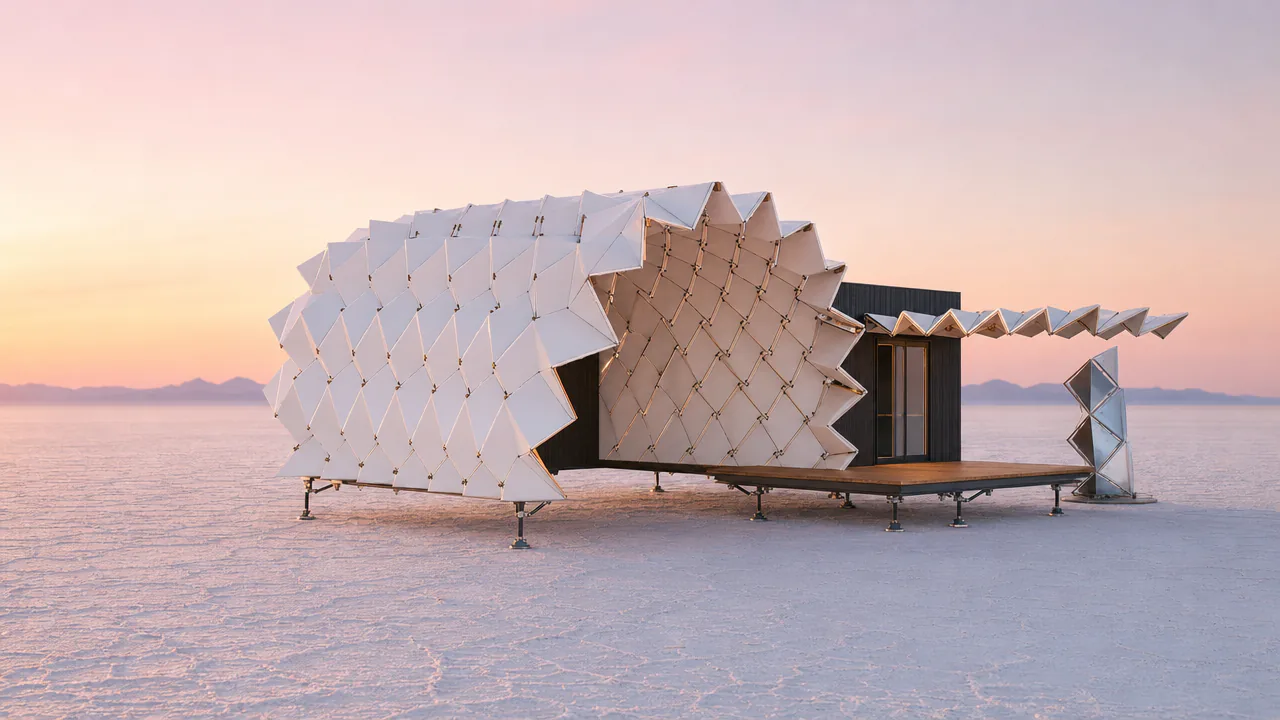
 F1 · I01
YOSHI vault
≈ 2.6×shell volumeRigid-foldable one-DOF quadrilateral-panel barrel with degree-4 vertices
- Folded
- 2 half-shell packs
- Deployed
- 3.64 span x 7.28 long x 2.90 rise
- Moves by
- Gable portal winched along floor rails
Every ORIJO shell must fold on one degree of freedom at zero panel strain before it reaches a tool. This is that check, running in your browser: the same bar-and-hinge solver we use to accept or reject a crease pattern.
Drag to orbit · pinch or click then scroll to zoom
3D is unavailable in this browser. The simulator needs WebGL. The strain chart, crease heat maps and family table below are computed by the same solver and are plain HTML.
Every ORIJO building is assembled from eight fold families, each with its own hinge, lock and way of moving. Every card opens the nearest simulator pattern, and says plainly when that pattern is only a stand-in.
F1 · I01Rigid-foldable one-DOF quadrilateral-panel barrel with degree-4 vertices
 F2 · I06
Thick-panel Miura-ori with uniform-thickness correction
 F3 · I09
Bistable Kresling cylinder cells
 F4 · I07
Uniformly thick degree-6 diamond vertex modules and zipper-coupled Miura tubes
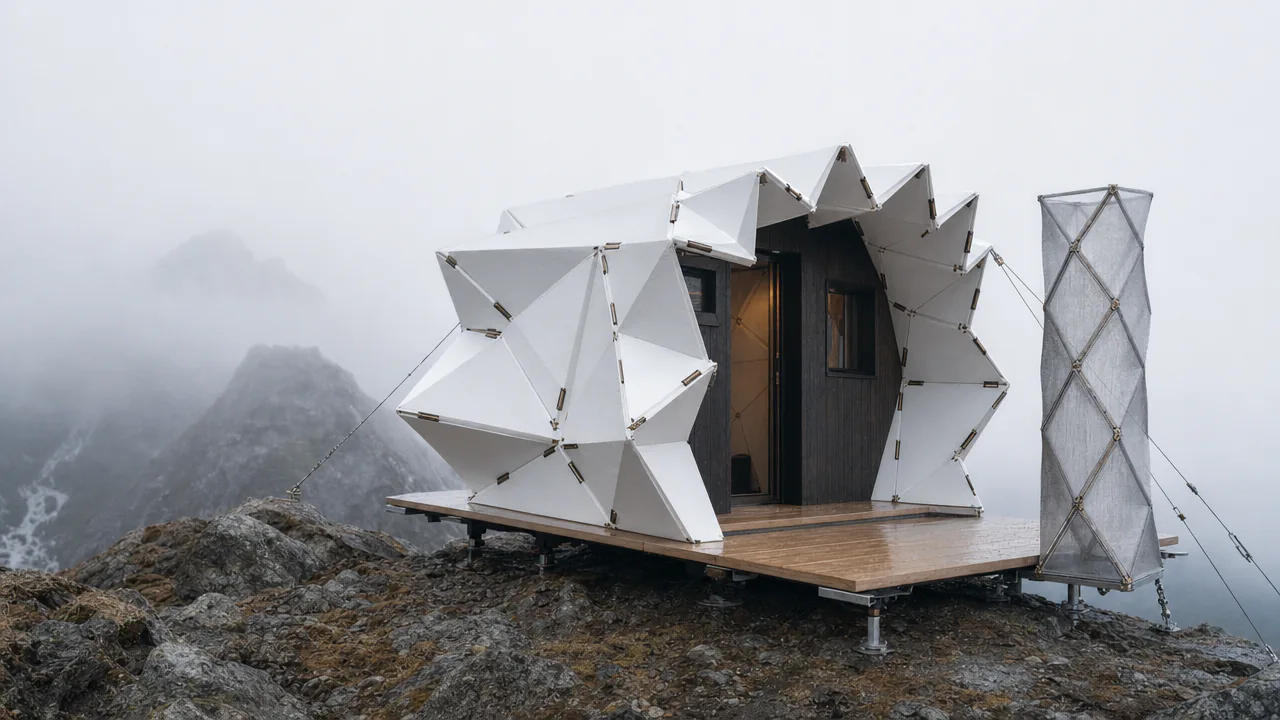 F5 · I13
Thick-panel Ron Resch star-tuck tessellation with seasonal partial-fold states
 F6 · I18
Lockable rigid-foldable origami-kirigami cells and single-string kirigami tiles
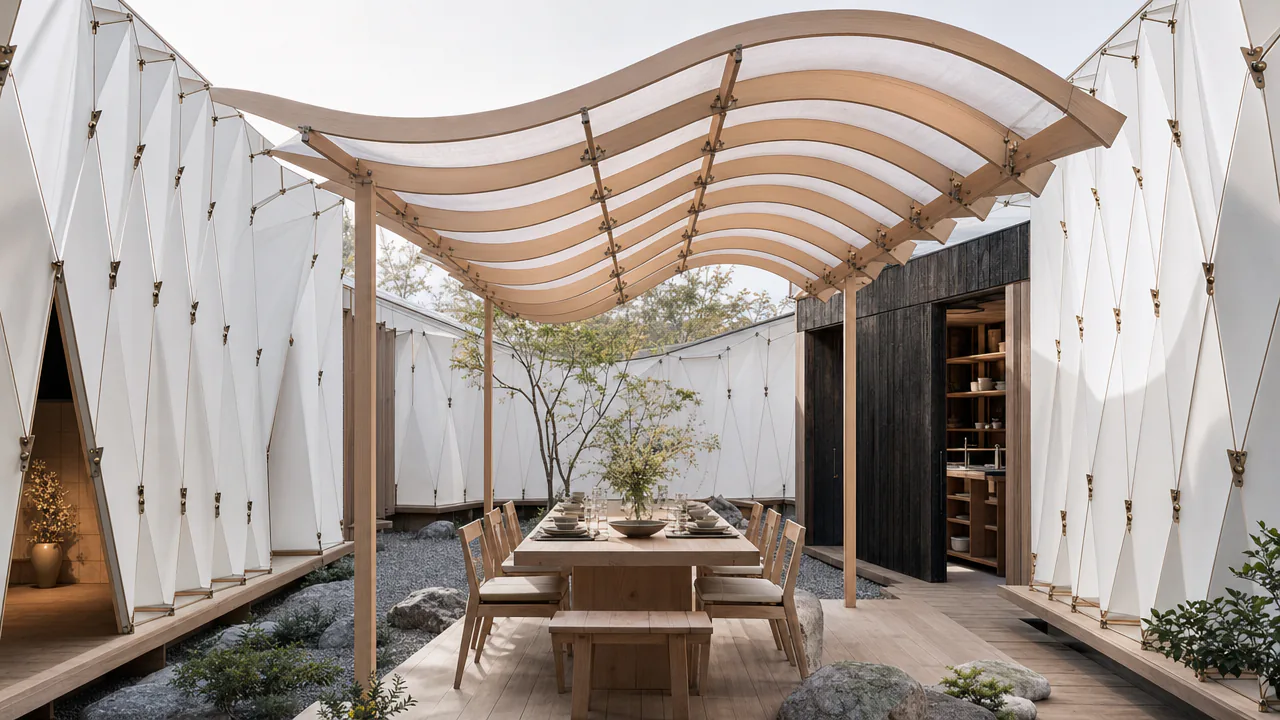 F7 · I19
Curved-crease shells approximated by self-shaping hygromorphic timber bilayers and bistable auxetic sheets
F8 · I07Pyramidal-Based Approximated Dome thick-panel pattern deployed by gravity and wire tension
Fold two 80 mm insulated panels about a line through their middle and they crash into each other at once. There are two proven ways out, and each ORIJO test article uses exactly one of them.
The mathematical model. Rigid-foldability is a property of this sheet first.
Material on the closing side has nowhere to go. Clash grows with t · sin θ.
Hinge on the surface, edges bevelled. Folds cleanly until the bevels meet, which gives a built-in stop but a limited range. Used for the Miura wall.
Hinge moved to the face that closes. Folds fully flat into a stepped stack, and the far face opens by t · Δθ. Used for the vault.
Sections drawn to scale: t = 80 mm temperate panel, 400 mm of each facet shown. Shu red marks material that would have to occupy the same space.
One degree of freedom
A rigid-foldable pattern moves like a linkage: one input, here a gable portal winched along the floor rails, sets every crease angle at once. There is no transition front and no moment when part of the shell is open and part is closed. Tachi (2009) showed quadrilateral-panel cylinders that do this; the YOSHI vault is one.
The gate before tooling
A crease pattern goes to the CNC only after a kinematic simulator shows zero facet strain across the full fold. Anything that needs panels to bend or snap through, such as the classic Yoshimura, is either rejected for thick panels or redesigned as a compliant part with its own snap-through test.
target 0 % facet strain, MERLIN or Origami Simulator check
One method per article
Tapered panels fold only part-way, so the Miura wall takes its folded thickness from geometry. Offset panels fold flat but need stack depth for the stepped hinge lines, so the vault packs as 2 × 3.70 × 2.30 × 1.10 m. No packing figure assumes both methods at once.
The Yoshimura diamond pattern is the textbook origami barrel, and it was our first sketch. Hold its springing lines at span and push it together like a bellows: its diagonals would need to shorten by about a fifth. Paper puckers quietly. Fibreglass sandwich panels crack. So we replaced it.
Peak panel strain through the fold modelled
Yoshimura peaks at 24.1% in a 21-step sweep (22 % at the 70 % checkpoint of the engine tests). The arc-Miura stays at 0.033%, which is solver noise. Strain is per bar, at equilibrium, in the same engine that runs the lab above.
Where it strains: the flat crease patterns
Two membranes and a gasket replace taped seams. A tight membrane spans the face the crease turns about; a slack bellows spans the face that opens; GFRP closeouts take bearing at the stop; a thermally broken latch carries the tension.
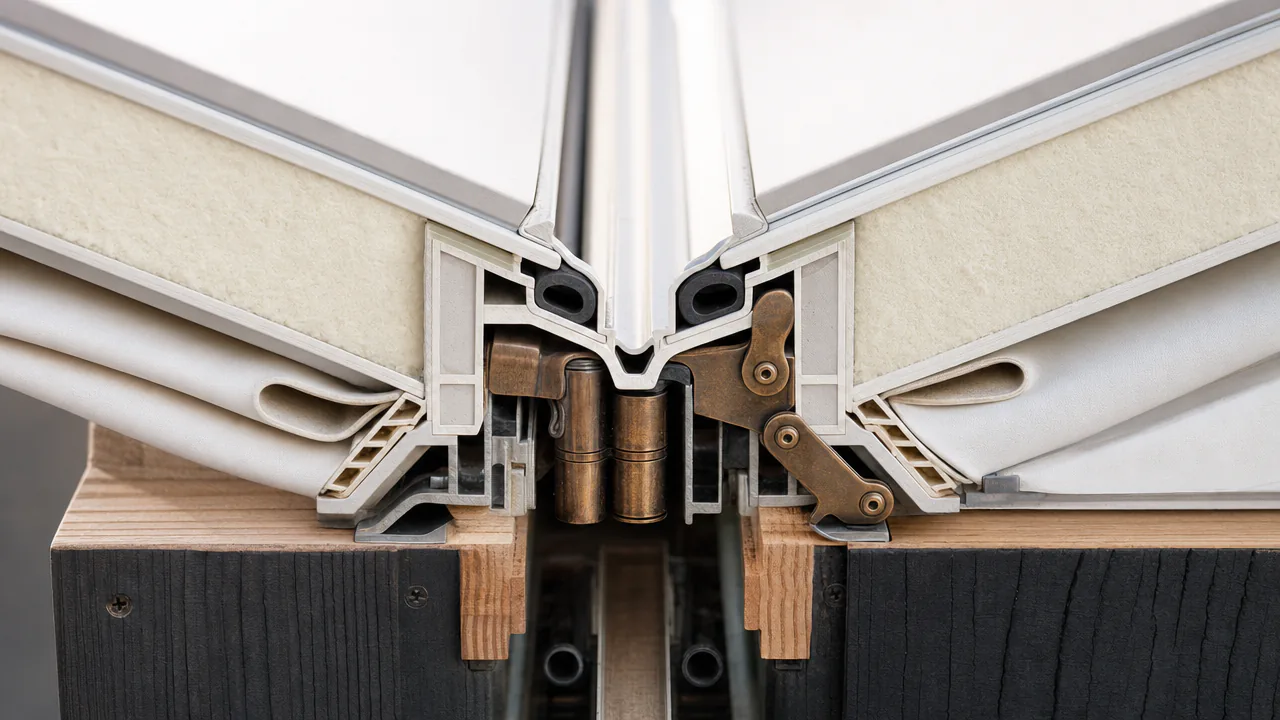 I02 · Hinge macro
Panel
Measured on this drawing; t · Δθ = 0 mm along the face.
1.2 · t · π/2 for a 90° fold change; 0 % of it is in use.
T = M / 0.8t at 910 mm pitch, illustrative M = 0.5 kN·m/m until the FE wind case.
λ 0.022 / t, surface resistances ignored. Polar sites need 200–250 mm.
Parts
| Part | Material | Spec |
|---|---|---|
| Facet panel | Glass-FRP faces, PIR core (mycelium optional), aerogel strip behind edge closeout | 80-120 mm temperate, 200-250 mm PIR-equivalent polar; 10-12 kg/m2 at 120 mm PIR (calculated) |
| Edge closeout | Pultruded GFRP channel or hardwood | 15-25 mm deep bearing surface; allowable bearing stress from closeout datasheet, not from the core (PIR about 0.15-0.3 MPa) |
| Axis-face membrane | PVDF-coated polyester, vacuum laminated | tight across crease; target 2,000 fold cycles |
| Opening-face bellows | Slack PVDF-polyester loop, or EPDM/silicone sheet (>= 300% elongation) bonded to membrane | length >= 1.2 x t x dTheta (150 mm at 80 mm, 230 mm at 120 mm, 90 degree fold) |
| Over-centre latch | GFRP or polyamide body, bronze cam at bearing point only, stainless pin | primary tension member; T = M_crease / (0.8 t); 910 mm pitch; inside face behind vapour layer; Hall sensor |
| Backup gasket | EPDM bulb | compressed 30-40% at preload (target) |
| Obi repair kit | Membrane roll, adhesive, portable vacuum pump | 300 mm patch, 30 min (target) |
Maturity
Every ingredient exists as a prototype or lab result. The weathertight, insulated building hinge with an opening-face bellows is unbuilt, and it is the single biggest risk in ORIJO. The 12-month gate: water spray on every opening crease, q50 ≤ 1.5 m³/(h·m²) on a 2 × 2 × 2 m box, 2,000 powered fold cycles.
Ratios are measured on different bases (volume, plan area, height), so each is labelled with its basis. For comparison on the same basis as the YOSHI vault's 2.6×, a TenFold TF-20 manages about 1.9×.
| ID | Family | Folded (m) | Deployed (m) | Expansion log · 1× — 10× — 100× | Maturity |
|---|---|---|---|---|---|
| F1 | YOSHI vault | 2 half-shell packs, each 3.70 x 2.30 x 1.10 (80 mm panels; 1.60 high for 120 mm); target envelope to be confirmed by fold simulation | 3.64 span x 7.28 long x 2.90 rise (YOSHI-4); 3.64 x 10.92 x 2.90 (YOSHI-6) | ≈ 2.6× shell volume about 2.6x shell only (calculated: about 48 m3 interior / 18.7 m3 of packs); about 2.2x whole room incl. floor cassettes and gables (48 / 22.2); TenFold TF-20 about 1.9x on the same basis |
EXPERIMENTAL |
| F2 | MIURA wing (engawa) | 1.00 x 0.70 x 0.60 stack (one wing) | 7.28 x 3.64 canopy at 2.6 m eave height (26.5 m2) | 37.9× plan area 63x plan area (calculated: 26.5 m2 / (1.00 x 0.70 m) = 37.9; with 0.6 m stack the area-to-pack-volume ratio is 63 m2/m3) |
COMMERCIALEXPERIMENTAL |
| F3 | KRES mast | diameter 1.20 x 0.90 high (7 cells at 0.12 m folded + base) | diameter 1.20 x 6.30 high (7 cells at 0.90 m) | 7× height 7x height (calculated: 6.30 / 0.90) |
EXPERIMENTAL |
| F4 | MUTO spine | 1.82 x 0.91 x 0.25 cassette | deck or bridge 0.91 wide x 3.64-4.0 m span; or column 2.73 m | ≈ 5× pack to span about 5x (calculated from fold-to-span geometry; MUTOIS reports packaging ratio >5 for deployable shelters) |
EXPERIMENTAL |
| F5 | RESCH roof | 2.00 x 1.90 x 0.40 (KURA roof cap) | 5.46 x 1.82 roof at 33% fold (summer) or 66% fold (winter) | 33–66 % fold, by season state-variable (33-66% fold) |
EXPERIMENTAL |
| F6 | KIRI shoji skin | 0.91 x 1.82 x 0.08 panel | gable, partition or louvre wall to 3.64 x 2.73 | ≈ 6× area about 6x area (target) |
EXPERIMENTAL |
| F7 | KASA curved-crease canopy | flat bundle 3.64 x 1.82 x 0.30 | single-curved canopy up to 7.28 x 3.64 (target) | n/a flat → curved n/a: flat-to-curved shaping, not volume expansion |
EXPERIMENTALSPECULATIVE |
| F8 | HOSHI gravity dome | 2.00 x 2.00 x 0.60 (one pallet) | 3.64 x 3.64 plan x 2.60 high | 14× volume 14x (calculated: about 34.4 m3 approximated dome volume 3.64 x 3.64 x 2.6 x 0.67 / 2.40 m3 pack); PBAD prototype reported 15x |
EXPERIMENTAL |
Four families that each move by a different force: a dome that falls open, a mast that snaps up cell by cell, a roof that changes its fold for snow, and a skin that opens with one pull.
A tripod winch or telehandler lifts the crown of the folded pallet; released, the pyramid facets swing down under their own weight in tens of seconds. Wire tension, contact locks and a floor-ring latch then hold the dome.
Each Kresling cell has two stress-free states. One compressor pulse or a twist ring drives a cell through its strained middle until it snaps tall; a collar pin locks it there. The lowest two cells carry a 2,000 L food-grade water bladder.
One linear actuator at the central vertex sets the star-tuck tessellation between 33 % fold (summer) and 66 % fold (winter); mechanical pins carry the load in each state. An ESP32 controller reads the forecast and moves it ahead of snow.
F6 · I18Lockable hexagonal origami-kirigami cells and single-string tiles open into gables, partitions or louvres. Hygromorph and Janus flip facets switch on their own with humidity or heat; at full deployment a contact lock holds every panel.
Simulated width, length and height against the Schenk–Guest solution at 30, 70 and 100 % fold
345 nodes · 960 bars · 888 hinges, folded flat to packed in 21 steps
Springing lines held at span on rails; diagonals must shorten, so panels would have to stretch
per step on a 1,521-node Miura sheet (last test run), so the whole lab runs live in the browser