The system continues
after installation.
Design, factory work, shipping, commissioning, daily use, maintenance and reuse are one value chain. The gaps between them are part of the product.
Make it repeatable.
Keep it recoverable.
A useful job, on a real site.
Start with activity, occupancy, climate, access, water, power, hazards and a full-cost ceiling. The site survey includes approvals, service distance and a recovery route.
Reject impossible combinations.
A module passport describes ratings, dependencies, output quality, maintenance and revision. A configuration must satisfy resource, safety and workflow constraints together.
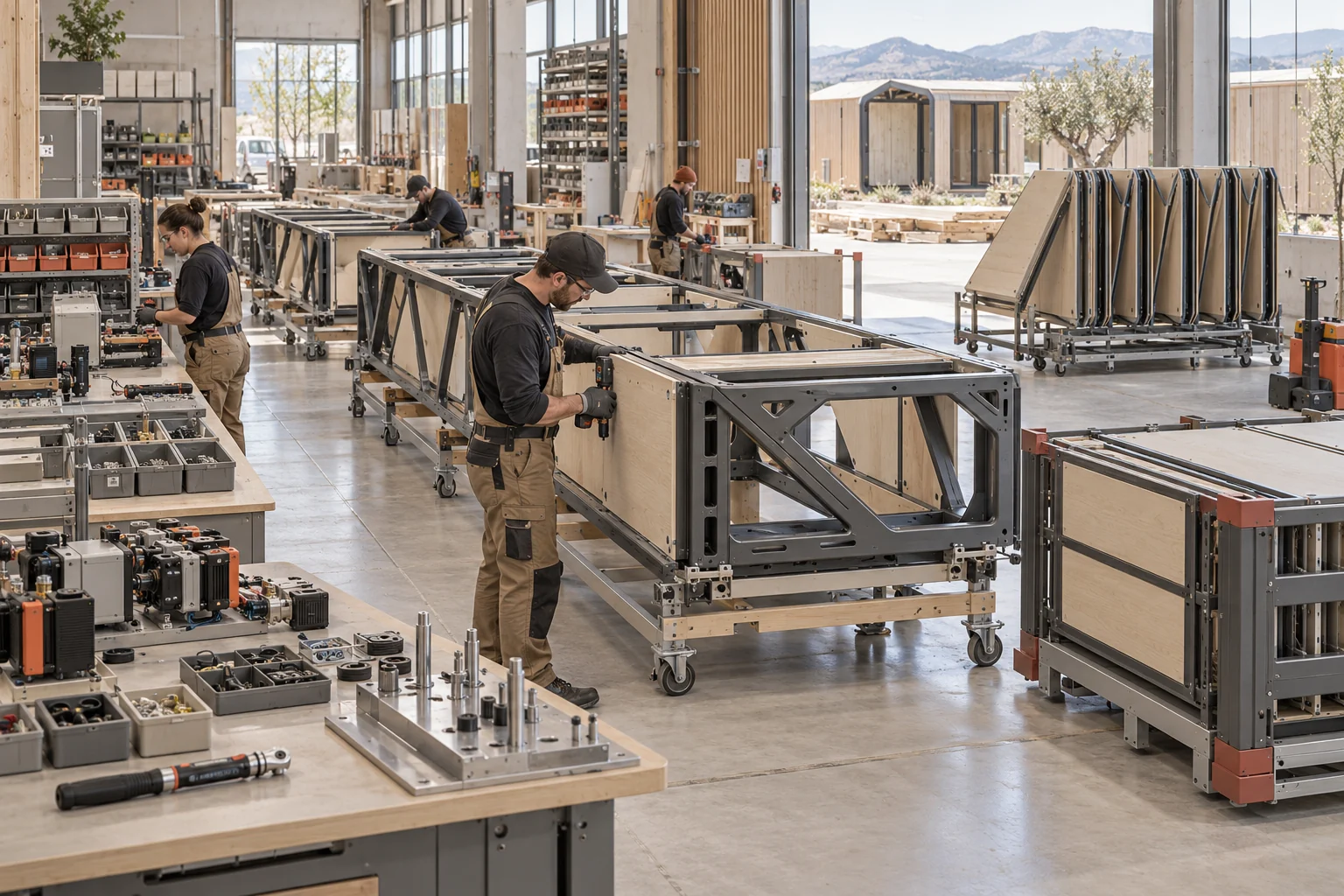
Repeat the difficult work in the factory.
Standardize fixtures, fasteners, inspection and utility subassemblies. Test branches before shipping. Use local approved suppliers for site-specific structure and installation.
Ship work that is already understood.
Use reusable stillages, stable mass classes, accessible lifting points and sequenced kits. Do not confuse compact packing with safe unloading or easy ground preparation.
Check the place, not just its parts.
Verify identity, mechanical engagement, isolation, leaks, actual flows, protection and fault behavior. Record the installed configuration and customer acceptance boundary.
Local essentials. Visible limits.
Essential controls work locally. Supervisory automation stays within a declared operating domain. Every intervention, supply input, reject and maintenance task is counted.
A safe exchange is a transaction.
Diagnose → isolate → prove safe → capture residuals → exchange → verify → recommission. Fast replacement is not live hot-swapping unless specifically engineered and validated.
Make the second life easier.
Recalculate capacity before adding a bay. Reused parts retain wear and configuration history, pass inspection and return-to-service tests, and return to a repairable catalog.
Standardize the stable core.
Localize the qualified edge.
Established components
Use qualified pumps, sensors, protection, HVAC, PV and batteries. Establish alternatives early; a supplier API is not a decade-long compatibility guarantee.
The integration layer
Own fixtures, carrier interfaces, service access, configuration rules, commissioning and acceptance. Protect the knowledge that removes repeated engineering work.
Regional execution
Local installers, growers, water specialists and structural engineers qualify the site. Distributed manufacturing needs process control and consistent inspection.
A decision test for folding: compare freight volume, deployment labor and reuse gains with the added hinges, locks, seals, actuation, inspection and repair over the full life. A fixed version remains a valid winner.
Count the work
the robot does not do.
An autonomy ledger records every local and remote intervention, planned and unplanned. Cleaning, consumable changes, expert review and maintaining the robot remain inside the accounting boundary.
Start with deterministic work
Known tray geometry, docking fixtures, bounded motion, ordinary local controls and protective interlocks. Add vision or planning only where variation makes it useful.
Avoid shared failure
Branch-level isolation, separated fluids, protected clean areas and local reserve. A central spine must not turn one contamination or electrical fault into a site-wide loss.
Keep residents in control
Reachable manual controls, intelligible alarms, a usable degraded state and no subscription or cloud dependency for essential safe local functions.
Test the uncomfortable cases
A stuck sensor, blocked flow, leak, empty tank, wrong part, network loss, power interruption and interrupted exchange. Confirm the physical result, not just a successful command.